Anticorps Recombinant de lapin anti-ILT-3/LILRB4
ILT-3/LILRB4 Recombinant Antibody for FC
Hôte / Isotype
Lapin / IgG
Réactivité testée
Humain
Applications
FC
Conjugaison
Non conjugué
CloneNo.
250356B3
N° de cat : 98486-3-RR
Synonymes
Galerie de données de validation
Filter:
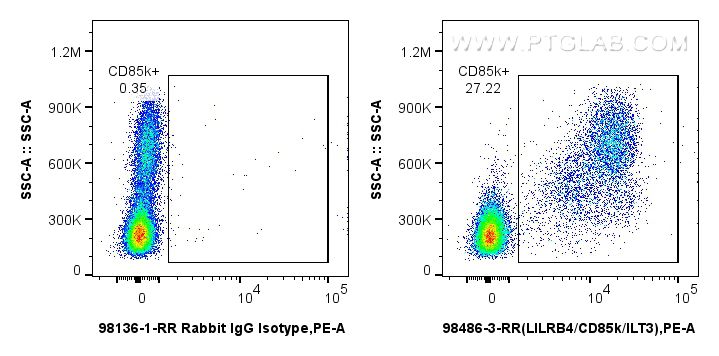
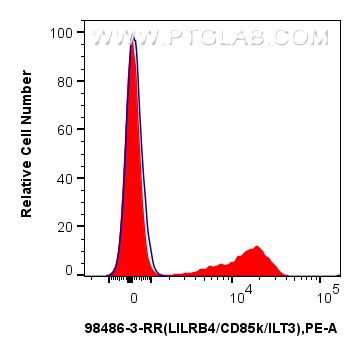
Applications testées
| Résultats positifs en cytométrie | CMSP humaines |
Dilution recommandée
| Application | Dilution |
|---|---|
| This reagent has been tested for flow cytometric analysis. It is recommended that this reagent should be titrated in each testing system to obtain optimal results. | |
| Sample-dependent, check data in validation data gallery | |
Informations sur le produit
98486-3-RR cible ILT-3/LILRB4 dans les applications de FC et montre une réactivité avec des échantillons Humain
| Réactivité | Humain |
| Hôte / Isotype | Lapin / IgG |
| Clonalité | Recombinant |
| Type | Anticorps |
| Immunogène | ILT-3/LILRB4 Protéine recombinante Eg1743 |
| Nom complet | leukocyte immunoglobulin-like receptor, subfamily B (with TM and ITIM domains), member 4 |
| Masse moléculaire calculée | 49kDa |
| Numéro d’acquisition GenBank | AAH26309.1 |
| Symbole du gène | LILRB4 |
| Identification du gène (NCBI) | 11006 |
| Conjugaison | Non conjugué |
| Forme | Liquide |
| Méthode de purification | Purification par protéine A |
| Tampon de stockage | PBS with 0.09% sodium azide |
| Conditions de stockage | Store at 2 - 8°C. Stable for one year after shipment. |
Informations générales
LILRB4 is an inhibitory receptor in the LILR family mainly expressed on normal and malignant human cells of myeloid origin. LILRB4 is activated and subsequently recruits adaptors to cytoplasmic immunoreceptor tyrosine inhibitory motifs to initiate different signaling cascades, thus playing an important role in physiological and pathological conditions, including autoimmune diseases, microbial infections, and cancers.
Protocole
| Product Specific Protocols | |
|---|---|
| FC protocol for ILT-3/LILRB4 antibody 98486-3-RR | Download protocol |
| Standard Protocols | |
|---|---|
| Click here to view our Standard Protocols |

