Anticorps Polyclonal de lapin anti-JMJD3
JMJD3 Polyclonal Antibody for WB, Indirect ELISA
Hôte / Isotype
Lapin / IgG
Réactivité testée
Humain
Applications
WB, Indirect ELISA
Conjugaison
Non conjugué
N° de cat : 55354-1-PBS
Synonymes
Galerie de données de validation
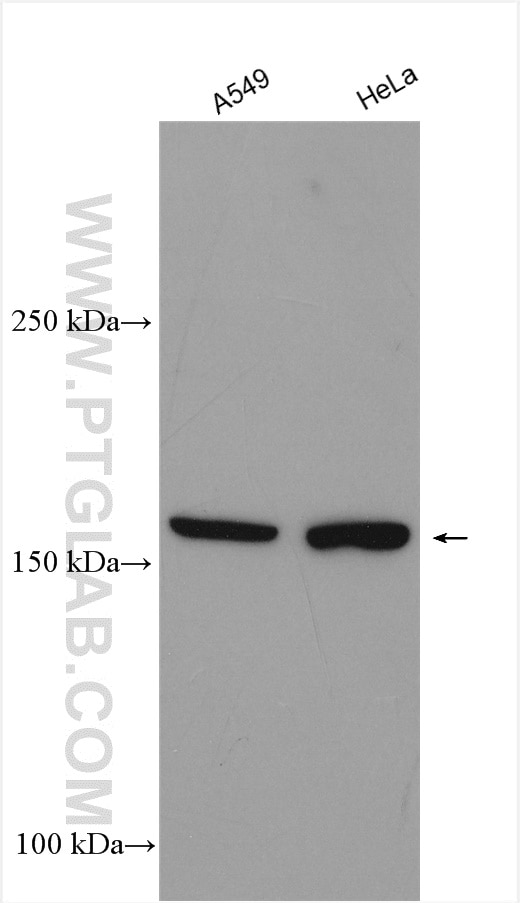
Informations sur le produit
55354-1-PBS cible JMJD3 dans les applications de WB, Indirect ELISA et montre une réactivité avec des échantillons Humain
| Réactivité | Humain |
| Hôte / Isotype | Lapin / IgG |
| Clonalité | Polyclonal |
| Type | Anticorps |
| Immunogène | Peptide |
| Nom complet | jumonji domain containing 3, histone lysine demethylase |
| Masse moléculaire calculée | 177 kDa |
| Poids moléculaire observé | 177 kDa |
| Numéro d’acquisition GenBank | NM_001080424 |
| Symbole du gène | JMJD3 |
| Identification du gène (NCBI) | 23135 |
| Conjugaison | Non conjugué |
| Forme | Liquide |
| Méthode de purification | Purification par affinité contre l'antigène |
| Tampon de stockage | PBS only |
| Conditions de stockage | Store at -80°C. 20ul contiennent 0,1% de BSA. |
Informations générales
JMJD3, also known as KDM6B, is a 1643 amino acid protein, which belongs to the UTX family. JMJD3 is a Histone demethylase that specifically demethylates 'Lys-27' of histone H3, thereby playing a central role in histone code (PubMed:17825402, PubMed:17851529, ). JMJD3 demethylates trimethylated and dimethylated H3 'Lys-27', so it Plays a central role in regulation of posterior development, by regulating HOX gene expression (PubMed:17851529). Histone demethylases are epigenetic actors with a crucial role in cancer by acting as suppressors of tumors or as oncogenes. JMJD3 and UTX (ubiquitously transcribed tetratricopeptide repeat, X chromosome) are transcription activators, being specific H3K27me3 demethylases. JMJD3 is involved in many cellular process such as development, differentiation, senescence and aging by p16, p53 and RB pathways and finally inflammation. Depending on cancer type, JMJD3 expression is increased (prostate and breast cancers, melanoma, gliomas, renal cell carcinoma or decreased (lung, liver, pancreatic, colon and colorectal cancers. This role in carcinogenesis has allowed the development of "epidrugs" to modulate JMJD3 expression (PMID: 29805743 ).


