Anticorps Polyclonal de lapin anti-KCNJ9
KCNJ9 Polyclonal Antibody for WB, Indirect ELISA
Hôte / Isotype
Lapin / IgG
Réactivité testée
Humain, rat, souris
Applications
WB, Indirect ELISA
Conjugaison
Non conjugué
N° de cat : 31742-1-PBS
Synonymes
Galerie de données de validation
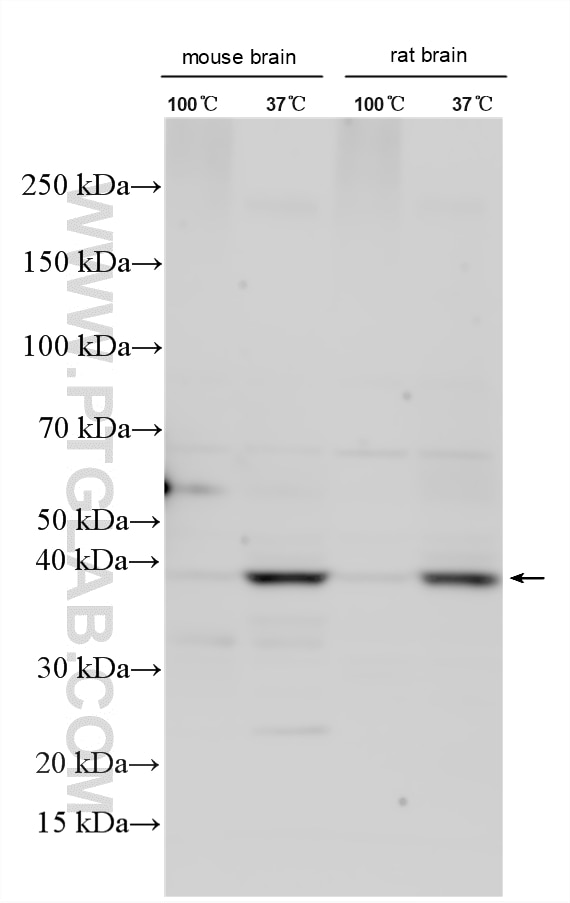
Informations sur le produit
31742-1-PBS cible KCNJ9 dans les applications de WB, Indirect ELISA et montre une réactivité avec des échantillons Humain, rat, souris
| Réactivité | Humain, rat, souris |
| Hôte / Isotype | Lapin / IgG |
| Clonalité | Polyclonal |
| Type | Anticorps |
| Immunogène | KCNJ9 Protéine recombinante Ag35873 |
| Nom complet | potassium inwardly-rectifying channel, subfamily J, member 9 |
| Poids moléculaire observé | 38-44 kDa |
| Numéro d’acquisition GenBank | BC167777 |
| Symbole du gène | KCNJ9 |
| Identification du gène (NCBI) | 3765 |
| Conjugaison | Non conjugué |
| Forme | Liquide |
| Méthode de purification | Purification par affinité contre l'antigène |
| Tampon de stockage | PBS only |
| Conditions de stockage | Store at -80°C. 20ul contiennent 0,1% de BSA. |
Informations générales
KCNJ9, also known as GIRK3 (G protein-activated inwardly rectifying potassium channel 3), is a crucial subunit that forms inwardly rectifying potassium channels. These channels are primarily activated by inhibitory G proteins (Gi/o) downstream of various G protein-coupled receptors (GPCRs), such as those for neurotransmitters like GABA, acetylcholine, and adenosine. Upon activation, KCNJ9 facilitates potassium efflux, leading to membrane hyperpolarization and a reduction in neuronal excitability. It is widely expressed in the brain, where it plays a key role in regulating synaptic transmission and neuronal circuits, influencing processes ranging from pain perception to reward and motivation.


