Anticorps Polyclonal de lapin anti-KCNQ3
KCNQ3 Polyclonal Antibody for WB, Indirect ELISA
Hôte / Isotype
Lapin / IgG
Réactivité testée
Humain, rat, souris
Applications
WB, Indirect ELISA
Conjugaison
Non conjugué
N° de cat : 24580-1-PBS
Synonymes
Galerie de données de validation
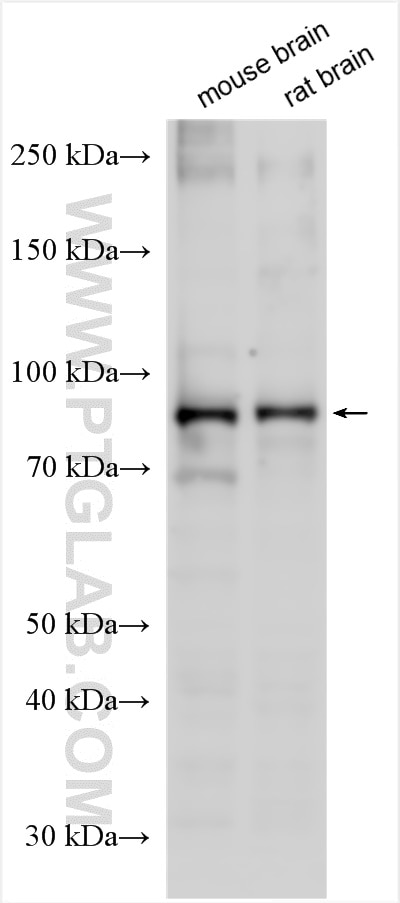
Informations sur le produit
24580-1-PBS cible KCNQ3 dans les applications de WB, Indirect ELISA et montre une réactivité avec des échantillons Humain, rat, souris
| Réactivité | Humain, rat, souris |
| Hôte / Isotype | Lapin / IgG |
| Clonalité | Polyclonal |
| Type | Anticorps |
| Immunogène | KCNQ3 Protéine recombinante Ag20147 |
| Nom complet | potassium voltage-gated channel, KQT-like subfamily, member 3 |
| Masse moléculaire calculée | 872 aa, 97 kDa |
| Poids moléculaire observé | ~90 kDa |
| Numéro d’acquisition GenBank | BC128576 |
| Symbole du gène | KCNQ3 |
| Identification du gène (NCBI) | 3786 |
| Conjugaison | Non conjugué |
| Forme | Liquide |
| Méthode de purification | Purification par affinité contre l'antigène |
| Tampon de stockage | PBS only |
| Conditions de stockage | Store at -80°C. 20ul contiennent 0,1% de BSA. |
Informations générales
KCNQ3, also named as BFNC2, EBN2 and KV7.3, belongs to the potassium channel family and KQT subfamily. KCNQ3 is probably important in the regulation of neuronal excitability. Associates with KCNQ2 or KCNQ5, KCNQ3 forms a potassium channel with essentially identical properties to the channel underlying the native M-current, a slowly activating and deactivating potassium conductance which plays a critical role in determining the subthreshold electrical excitability of neurons as well as the responsiveness to synaptic inputs. Defects in KCNQ3 are the cause of benign neonatal epilepsy type 2 (EBN2).


