Anticorps Polyclonal de lapin anti-KCTD7
KCTD7 Polyclonal Antibody for WB, Indirect ELISA
Hôte / Isotype
Lapin / IgG
Réactivité testée
Humain
Applications
WB, Indirect ELISA
Conjugaison
Non conjugué
N° de cat : 32488-1-PBS
Synonymes
Galerie de données de validation
Informations sur le produit
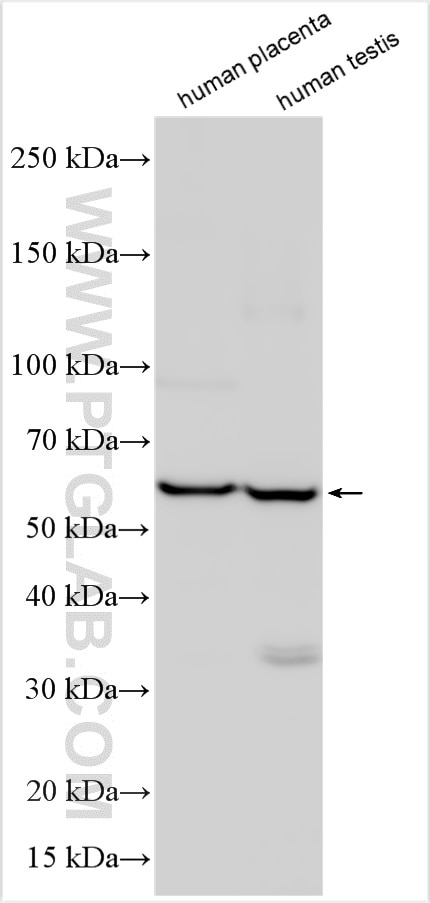
32488-1-PBS cible KCTD7 dans les applications de WB, Indirect ELISA et montre une réactivité avec des échantillons Humain
| Réactivité | Humain |
| Hôte / Isotype | Lapin / IgG |
| Clonalité | Polyclonal |
| Type | Anticorps |
| Immunogène | KCTD7 Protéine recombinante Ag35756 |
| Nom complet | potassium channel tetramerisation domain containing 7 |
| Masse moléculaire calculée | 33 kDa,289 aa |
| Poids moléculaire observé | 62 kDa |
| Numéro d’acquisition GenBank | NM_153033.4 |
| Symbole du gène | KCTD7 |
| Identification du gène (NCBI) | 154881 |
| Conjugaison | Non conjugué |
| Forme | Liquide |
| Méthode de purification | Purification par affinité contre l'antigène |
| Tampon de stockage | PBS only |
| Conditions de stockage | Store at -80°C. 20ul contiennent 0,1% de BSA. |
Informations générales
KCTD7, or Potassium Channel Tetramerization Domain Containing 7, is a member of the KCTD family of proteins. The role of KCTD7 in regulating autophagy-lysosome pathways, which are essential for cellular homeostasis and response to nutrient stress (PMID: 36964131). It has been implicated in several neurodegenerative disorders, particularly progressive myoclonic epilepsy (PME) and neuronal ceroid lipofuscinosis (NCL). The deficiency of KCTD7 results in the accumulation of lipofuscin and lipid droplets, which are hallmarks of NCL (PMID: 33970744). The 62 kDa form most likely corresponds to an SDS-stable dimer (PMID: 22748208).


