Anticorps Polyclonal de lapin anti-KIR2DL3
KIR2DL3 Polyclonal Antibody for WB, Indirect ELISA
Hôte / Isotype
Lapin / IgG
Réactivité testée
Humain
Applications
WB, Indirect ELISA
Conjugaison
Non conjugué
N° de cat : 18966-1-PBS
Synonymes
Galerie de données de validation
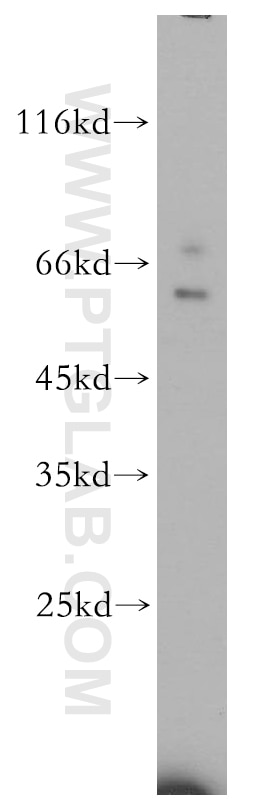
Informations sur le produit
18966-1-PBS cible KIR2DL3 dans les applications de WB, Indirect ELISA et montre une réactivité avec des échantillons Humain
| Réactivité | Humain |
| Hôte / Isotype | Lapin / IgG |
| Clonalité | Polyclonal |
| Type | Anticorps |
| Immunogène | KIR2DL3 Protéine recombinante Ag5163 |
| Nom complet | killer cell immunoglobulin-like receptor, two domains, long cytoplasmic tail, 3 |
| Masse moléculaire calculée | 341 aa, 38 kDa |
| Poids moléculaire observé | 58 kDa |
| Numéro d’acquisition GenBank | BC032422 |
| Symbole du gène | KIR2DL3 |
| Identification du gène (NCBI) | 3804 |
| Conjugaison | Non conjugué |
| Forme | Liquide |
| Méthode de purification | Purification par affinité contre l'antigène |
| Tampon de stockage | PBS only |
| Conditions de stockage | Store at -80°C. 20ul contiennent 0,1% de BSA. |
Informations générales
Killer cell immunoglobulin-like receptors (KIRs) are a diverse family of inhibitory and activating receptors expressed on NK cells and a subset of T cells (PMID: 11861603). These polymorphic receptors interact with specific motifs on HLA class I molecules, modulate NK cytolytic activity and are encoded by genes located on chromosome 19q13.4 (PMID: 17069649). KIR2DL3, also known as CD158B2 or NKAT2, is an inhibitory receptor that is specific for HLA-C alleles (HLA-Cw1, HLA-Cw3 and HLA-Cw7) (PMID: 10196125). It is a 341-amino acid transmembrane glycoprotein consisting of an extracellular region containing two C2-type Ig-like domains, a 19-amino acid hydrophobic transmembrane region, and a long cytoplasmic tail with two immunoreceptor tyrosine-based inhibitory motifs (ITIMs). KIR2DL3 inhibits the cytolytic activity of NK cells thus preventing cell lysis (PMID: 7724594).


