Anticorps Polyclonal de lapin anti-Kir6.2
Kir6.2 Polyclonal Antibody for WB, Indirect ELISA
Hôte / Isotype
Lapin / IgG
Réactivité testée
Humain, rat, souris
Applications
WB, Indirect ELISA
Conjugaison
Non conjugué
N° de cat : 16920-1-PBS
Synonymes
Galerie de données de validation
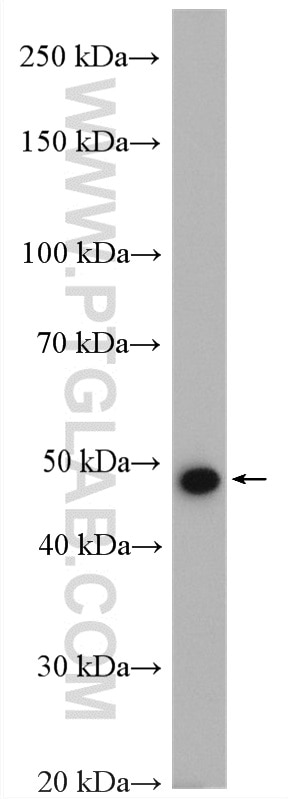
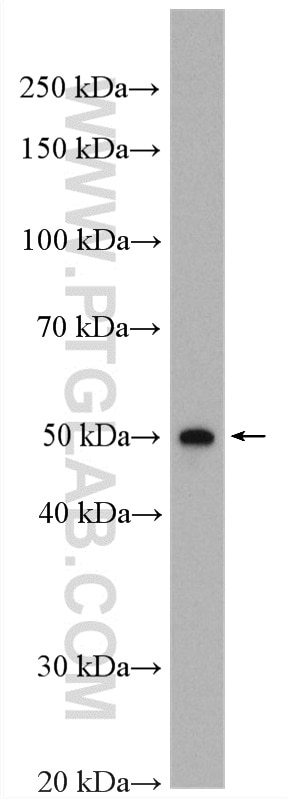
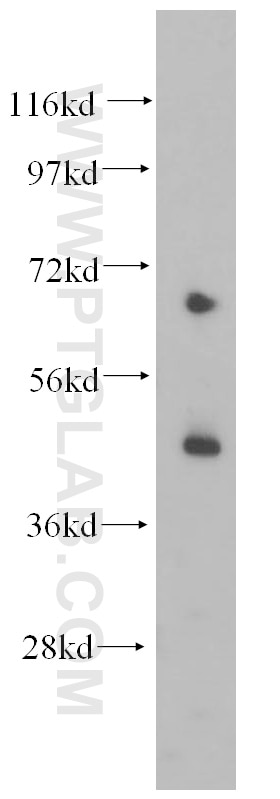
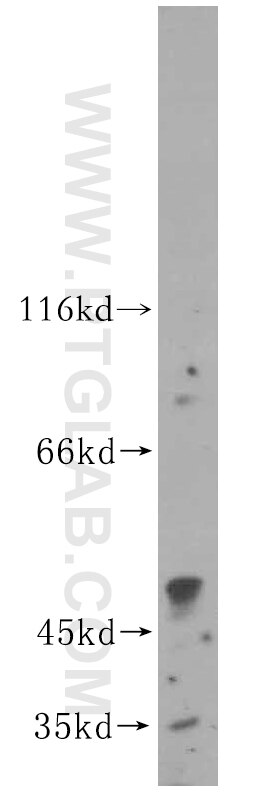
Informations sur le produit
16920-1-PBS cible Kir6.2 dans les applications de WB, Indirect ELISA et montre une réactivité avec des échantillons Humain, rat, souris
| Réactivité | Humain, rat, souris |
| Hôte / Isotype | Lapin / IgG |
| Clonalité | Polyclonal |
| Type | Anticorps |
| Immunogène | Kir6.2 Protéine recombinante Ag10262 |
| Nom complet | potassium inwardly-rectifying channel, subfamily J, member 11 |
| Masse moléculaire calculée | 390 aa, 44 kDa |
| Poids moléculaire observé | 48 kDa |
| Numéro d’acquisition GenBank | BC064497 |
| Symbole du gène | Kir6.2 |
| Identification du gène (NCBI) | 3767 |
| Conjugaison | Non conjugué |
| Forme | Liquide |
| Méthode de purification | Purification par affinité contre l'antigène |
| Tampon de stockage | PBS only |
| Conditions de stockage | Store at -80°C. 20ul contiennent 0,1% de BSA. |
Informations générales
Kir6.2 (also known as BIR or IKATP), encoded by the KCNJ11 gene, is the pore-forming unit of the ATP-sensitive K+ channel, an inward-rectifier potassium ion channel. Kir6.2 is controlled by G-proteins and is found associated with the sulfonylurea receptor (SUR) to constitute the ATP-sensitive K+ channel. The KCNJ11 gene is located at 11p15.1 and has no intron. Mutations in KCNJ11 are a cause of familial PHHI, an autosomal recessive disorder characterized by unregulated ins secretion. Defects in KCNJ11 may also contribute to autosomal dominant non-ins-dependent diabetes mellitus type II (NIDDM), transient neonatal diabetes mellitus type 3 (TNDM3), and permanent neonatal diabetes mellitus (PNDM).


