Anticorps Polyclonal de lapin anti-L1CAM/CD171
L1CAM/CD171 Polyclonal Antibody for WB, Indirect ELISA
Hôte / Isotype
Lapin / IgG
Réactivité testée
Humain, rat, souris
Applications
WB, Indirect ELISA
Conjugaison
Non conjugué
N° de cat : 20659-1-PBS
Synonymes
Galerie de données de validation
Informations sur le produit
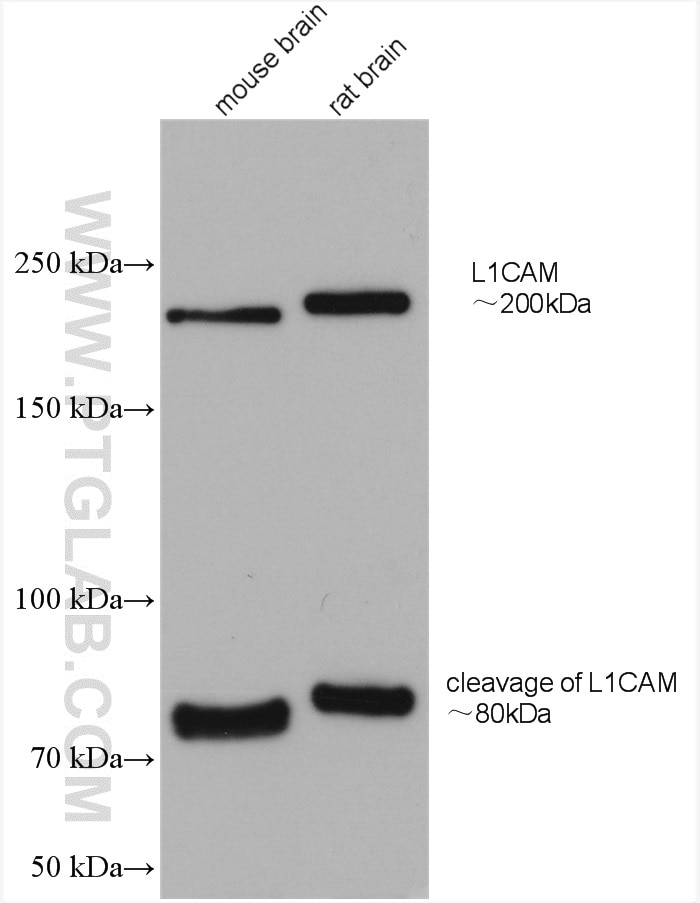
20659-1-PBS cible L1CAM/CD171 dans les applications de WB, Indirect ELISA et montre une réactivité avec des échantillons Humain, rat, souris
| Réactivité | Humain, rat, souris |
| Hôte / Isotype | Lapin / IgG |
| Clonalité | Polyclonal |
| Type | Anticorps |
| Immunogène | Peptide |
| Nom complet | L1 cell adhesion molecule |
| Masse moléculaire calculée | 140 kDa |
| Poids moléculaire observé | 200-220 kDa, 80 kDa |
| Numéro d’acquisition GenBank | NM_000425 |
| Symbole du gène | L1CAM |
| Identification du gène (NCBI) | 3897 |
| Conjugaison | Non conjugué |
| Forme | Liquide |
| Méthode de purification | Purification par affinité contre l'antigène |
| Tampon de stockage | PBS only |
| Conditions de stockage | Store at -80°C. 20ul contiennent 0,1% de BSA. |
Informations générales
L1CAM, also known as NCAM-L1 or CD171, is a cell adhesion molecule of the immunoglobulin superfamily. It is a 200-220 kDa transmembrane glycoprotein composed of six Ig-like domains and five fibronectin type III repeats followed by a transmembrane region and a highly conserved cytoplasmic tail (PMID: 3412448; 22796939). L1CAM is primarily expressed in the nervous system and is involved in neuron-neuron adhesion, neurite fasciculation, outgrowth of neurites, cerebellar granule cell migration, neurite outgrowth on Schwann cells and interactions among epithelial cells of intestinal crypts (PMID: 3412448; 10767310). L1CAM is overexpressed in many human cancers and is often associated with bad prognosis (PMID: 27267927; 26111503). It has been reported that L1CAM can be proteolytically cleaved into a soluble fragment of 140 kDa and an intracellular fragment of 80-85 kDa (PMID: 30842511; 34380733). This antibody raised against 1206-1221aa of human L1CAM detects 200-220 kDa full-length L1CAM and 80-kDa cleaved fragment of L1CAM.


