Anticorps Polyclonal de lapin anti-LRAT
LRAT Polyclonal Antibody for WB, Indirect ELISA
Hôte / Isotype
Lapin / IgG
Réactivité testée
Humain, rat, souris
Applications
WB, Indirect ELISA
Conjugaison
Non conjugué
N° de cat : 12815-1-PBS
Synonymes
Galerie de données de validation
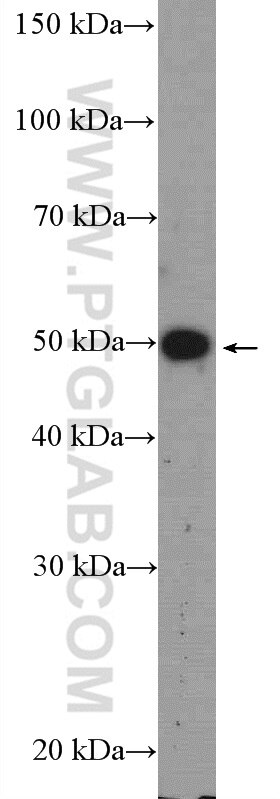
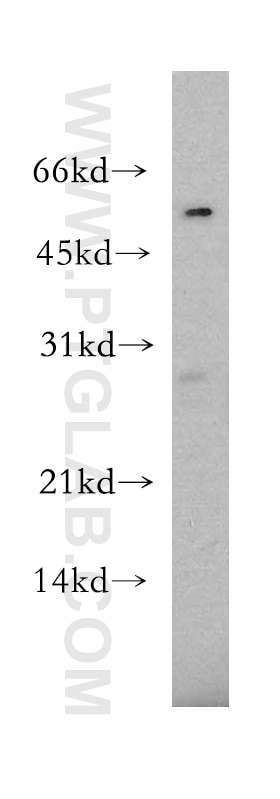

Informations sur le produit
12815-1-PBS cible LRAT dans les applications de WB, Indirect ELISA et montre une réactivité avec des échantillons Humain, rat, souris
| Réactivité | Humain, rat, souris |
| Hôte / Isotype | Lapin / IgG |
| Clonalité | Polyclonal |
| Type | Anticorps |
| Immunogène | LRAT Protéine recombinante Ag3556 |
| Nom complet | lecithin retinol acyltransferase (phosphatidylcholine--retinol O-acyltransferase) |
| Masse moléculaire calculée | 230 aa, 26 kDa |
| Poids moléculaire observé | 26 kDa, 50-54 kDa |
| Numéro d’acquisition GenBank | BC031053 |
| Symbole du gène | LRAT |
| Identification du gène (NCBI) | 9227 |
| Conjugaison | Non conjugué |
| Forme | Liquide |
| Méthode de purification | Purification par affinité contre l'antigène |
| Tampon de stockage | PBS only |
| Conditions de stockage | Store at -80°C. 20ul contiennent 0,1% de BSA. |
Informations générales
LRAT belongs to the H-rev107 family. LRAT transfers the acyl group from the sn-1 position of phosphatidylcholine to all-trans retinol, producing all-trans retinyl esters. LRAT plays a critical role in vision. It provides the all-trans retinyl ester substrates for the isomerohydrolase which processes the esters into 11-cis-retinol in the retinal pigment epithelium; due to a membrane-associated alcohol dehydrogenase, LRAT monomers (26kDa) interact in membranes and form functional homodimers (50-54 kDa) through protein-protein interactions and disulfide bond formation.Defects in LRAT are a cause of severe early-onset retinal dystrophy (RD). This antibody was generated against the internal residues of human LRAT. It is predicted to detect endogenous LRAT.


