Anticorps Recombinant de lapin anti-LTBP2
LTBP2 Recombinant Antibody for WB, Indirect ELISA
Hôte / Isotype
Lapin / IgG
Réactivité testée
Humain
Applications
WB, Indirect ELISA
Conjugaison
Non conjugué
CloneNo.
241911C7
N° de cat : 84574-4-PBS
Synonymes
Galerie de données de validation
Informations sur le produit
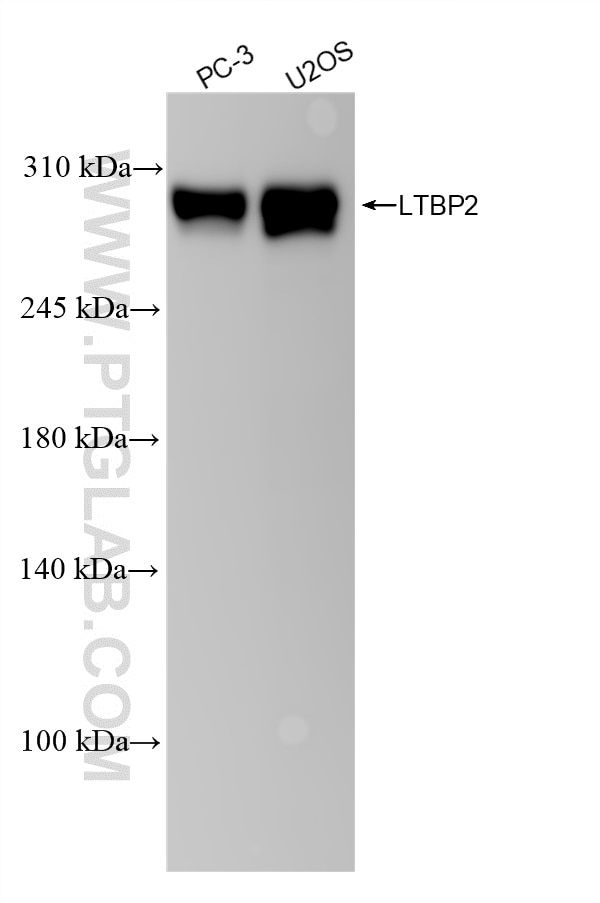
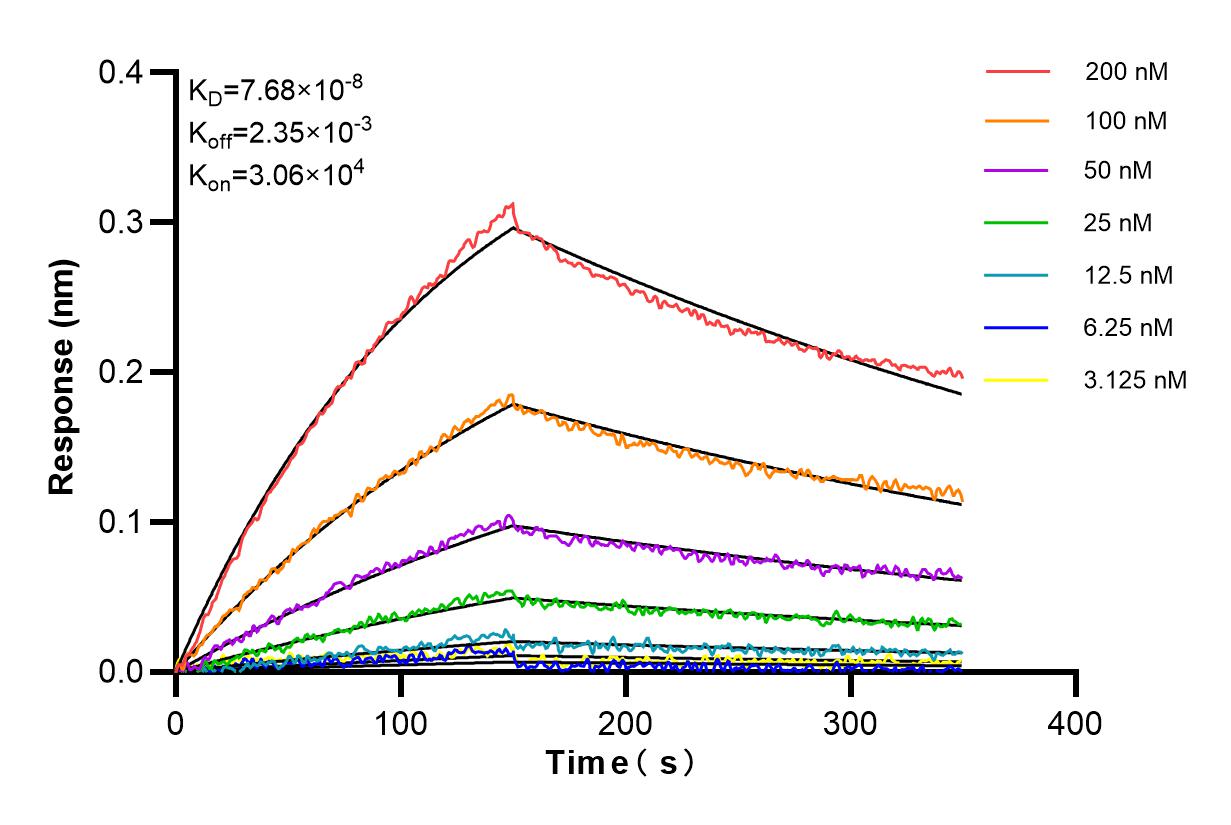
84574-4-PBS cible LTBP2 dans les applications de WB, Indirect ELISA et montre une réactivité avec des échantillons Humain
| Réactivité | Humain |
| Hôte / Isotype | Lapin / IgG |
| Clonalité | Recombinant |
| Type | Anticorps |
| Immunogène | LTBP2 Protéine recombinante Ag29720 |
| Nom complet | latent transforming growth factor beta binding protein 2 |
| Masse moléculaire calculée | 1821 aa, 195 kDa |
| Poids moléculaire observé | 290 kDa |
| Numéro d’acquisition GenBank | BC078659 |
| Symbole du gène | LTBP2 |
| Identification du gène (NCBI) | 4053 |
| Conjugaison | Non conjugué |
| Forme | Liquide |
| Méthode de purification | Protein A purfication |
| Tampon de stockage | PBS only |
| Conditions de stockage | Store at -80°C. 20ul contiennent 0,1% de BSA. |
Informations générales
LTBP2, an extracellular glycoprotein mapping to chromosome 14q24, belongs to a family of latent TGF-β binding proteins (LTBPs) that regulates a well-known growth factor, TGF-β. LTBP2 is an elastic fiber-associating protein whose function in elastogenesis is not clear, as a DANCEbinding Protein. (PMID: 17581631 )It may play an integral structural role in elastic-fiber architectural organization and/or assembly. LTBP2 associates covalently with small latent TGF-beta complex via Repeat B and Repeat C. Defects in LTBP2 are the cause of primary congenital glaucoma type 3D (GLC3D). [MIM:613086] LTBP2 is a role in the structural stability of ciliary zonules, and growth and development of lens.(PMID: 20617341) LTBP2 null mutations in an autosomal recessive ocular syndrome with megalocornea, spherophakia, and secondary glaucoma (PMID: 20179738 ) . LTBP2 is a biomarker of heart failure. LTBP2 has a molecular weight of 260 kDa (PMID: 20878956), and even larger molecular weights of 290 and 310 kDa were detected in tissue extracts. (PMID: 8524260)


