Anticorps Recombinant de lapin anti-MOG
MOG Recombinant Antibody for WB, Indirect ELISA
Hôte / Isotype
Lapin / IgG
Réactivité testée
Humain, porc, rat, souris
Applications
WB, Indirect ELISA
Conjugaison
Non conjugué
CloneNo.
250235E1
N° de cat : 83063-6-PBS
Synonymes
Galerie de données de validation
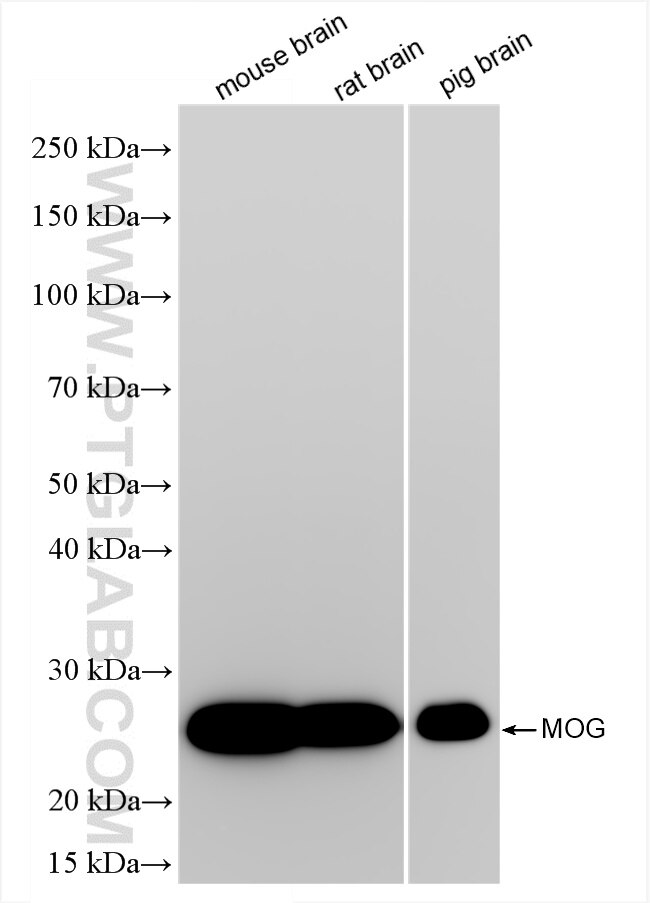
Informations sur le produit
83063-6-PBS cible MOG dans les applications de WB, Indirect ELISA et montre une réactivité avec des échantillons Humain, porc, rat, souris
| Réactivité | Humain, porc, rat, souris |
| Hôte / Isotype | Lapin / IgG |
| Clonalité | Recombinant |
| Type | Anticorps |
| Immunogène | MOG Protéine recombinante Eg2878 |
| Nom complet | myelin oligodendrocyte glycoprotein |
| Masse moléculaire calculée | 24 kDa |
| Poids moléculaire observé | 25-28 kDa |
| Numéro d’acquisition GenBank | N/A |
| Symbole du gène | MOG |
| Identification du gène (NCBI) | 4340 |
| Conjugaison | Non conjugué |
| Forme | Liquide |
| Méthode de purification | Purification par protéine A |
| Tampon de stockage | PBS only |
| Conditions de stockage | Store at -80°C. 20ul contiennent 0,1% de BSA. |
Informations générales
Myelin/oligodendrocyte glycoprotein (MOG), a 23~28 kDa glycoprotein, a myelin antigen at the outer surface of the central nervous system (CNS) myelin sheath, which may trigger T-cell as well as B-cell responses. It therefore constitutes a pivotal target for autoimmune responses, which result in inflammation and also demyelination in the CNS. Its presence on the outer- most lamellae of mature CNS myelin and its late appearance during myelinogenesis suggest that it contributes to myelin maturation or maintenance. 10 isoforms of MOG produced by alternative splicing have been described, and heterodimers may be formed between the different isoforms. Defects in MOG are the cause of narcolepsy type 7 (NRCLP7), a neurological disabling sleep disorder characterized by excessive daytime sleepiness, sleep fragmentation, symptoms of abnormal rapid-eye-movement (REM) sleep, cataplexy, hypnagogic hallucinations, and sleep paralysis. Role of MOG in the pathogenesis of multiple sclerosis (MS) has been reported but remains to be clarified.


