Anticorps Polyclonal de lapin anti-MPST
MPST Polyclonal Antibody for WB, ELISA
Hôte / Isotype
Lapin / IgG
Réactivité testée
Humain, rat, souris
Applications
WB, ELISA
Conjugaison
Non conjugué
N° de cat : 33209-1-AP
Synonymes
Galerie de données de validation
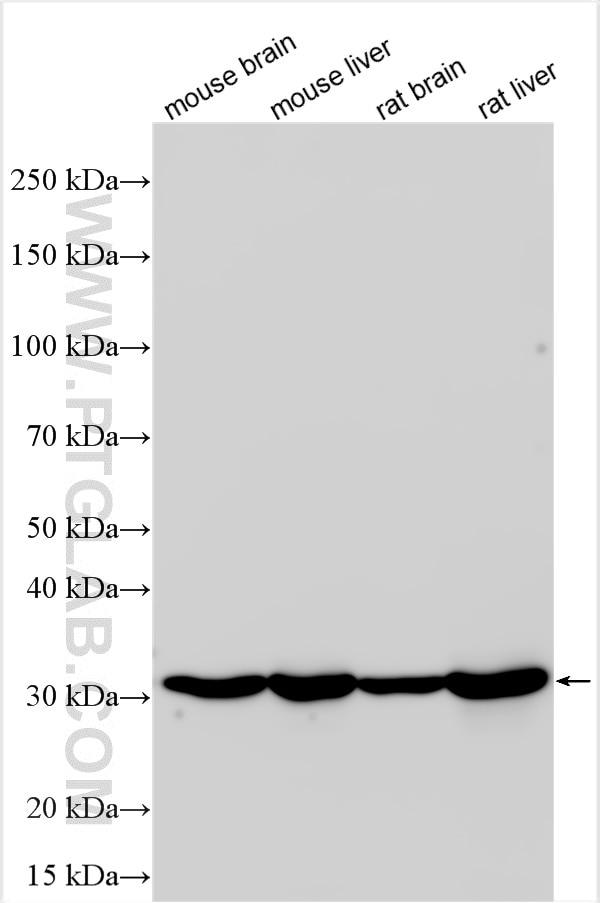
Applications testées
| Résultats positifs en WB | tissu cérébral de souris, tissu cérébral de rat, tissu hépatique de rat, tissu hépatique de souris |
Dilution recommandée
| Application | Dilution |
|---|---|
| Western Blot (WB) | WB : 1:5000-1:50000 |
| It is recommended that this reagent should be titrated in each testing system to obtain optimal results. | |
| Sample-dependent, check data in validation data gallery | |
Informations sur le produit
33209-1-AP cible MPST dans les applications de WB, ELISA et montre une réactivité avec des échantillons Humain, rat, souris
| Réactivité | Humain, rat, souris |
| Hôte / Isotype | Lapin / IgG |
| Clonalité | Polyclonal |
| Type | Anticorps |
| Immunogène | MPST Protéine recombinante Ag38043 |
| Nom complet | mercaptopyruvate sulfurtransferase |
| Masse moléculaire calculée | 33 kDa |
| Poids moléculaire observé | 33 kDa |
| Numéro d’acquisition GenBank | BC016737 |
| Symbole du gène | MPST |
| Identification du gène (NCBI) | 4357 |
| Conjugaison | Non conjugué |
| Forme | Liquide |
| Méthode de purification | Purification par affinité contre l'antigène |
| Tampon de stockage | PBS with 0.02% sodium azide and 50% glycerol |
| Conditions de stockage | Stocker à -20°C. Stable pendant un an après l'expédition. L'aliquotage n'est pas nécessaire pour le stockage à -20oC Les 20ul contiennent 0,1% de BSA. |
Informations générales
3-Mercaptopyruvate sulfurtransferase (MPST) catalyzes the desulfuration of 3-mercaptopyruvate to generate an enzyme-bound hydropersulfide. Subsequently, MPST transfers the persulfide's outer sulfur atom to proteins or small molecule acceptors. MPST activity is known to be involved in hydrogen sulfide generation, tRNA thiolation, protein urmylation and cyanide detoxification. Tissue-specific changes in MPST expression correlate with ageing and the development of metabolic disease. Deletion and overexpression experiments suggest that MPST contributes to oxidative stress resistance, mitochondrial respiratory function and the regulation of fatty acid metabolism (PMID: 33055309).
Protocole
| Product Specific Protocols | |
|---|---|
| WB protocol for MPST antibody 33209-1-AP | Download protocol |
| Standard Protocols | |
|---|---|
| Click here to view our Standard Protocols |

