Anticorps Monoclonal anti-TNF Alpha
TNF Alpha Monoclonal Antibody for Single Cell (Intra)
Hôte / Isotype
Mouse / IgG2b
Réactivité testée
Humain
Applications
Single Cell (Intra)
Conjugaison
5CFLX Fluorescent Dye
CloneNo.
7B8A11
N° de cat : G60291-1-5C
Synonymes
Galerie de données de validation
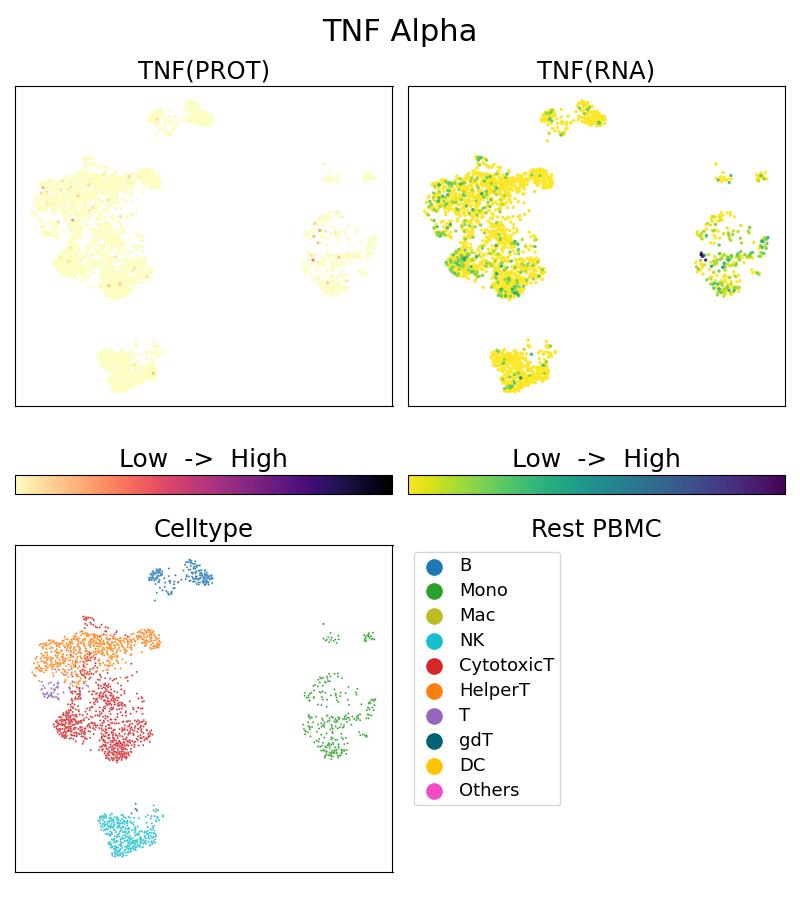
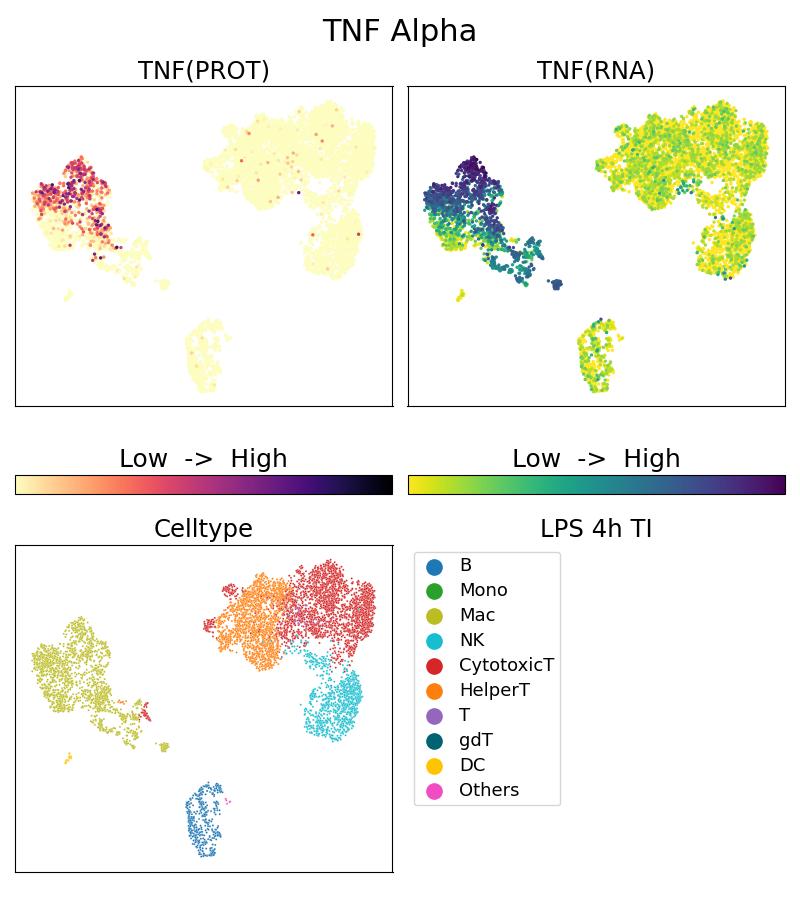
Applications testées
| Résultats positifs en Single Cell (Intra) | 10x Genomics Gene Expression Flex with Feature Barcodes and Multiplexing product. |
Dilution recommandée
| Application | Dilution |
|---|---|
| SINGLE CELL (INTRA) | SINGLE CELL (INTRA) : <0.5ug/test |
| It is recommended that this reagent should be titrated in each testing system to obtain optimal results. | |
| Sample-dependent, check data in validation data gallery | |
Informations sur le produit
G60291-1-5C cible TNF Alpha dans les applications de Single Cell (Intra) et montre une réactivité avec des échantillons Humain
| Réactivité | Humain |
| Hôte / Isotype | Mouse / IgG2b |
| Clonalité | Monoclonal |
| Type | Anticorps |
| Immunogène | TNF Alpha Protéine recombinante Ag11413 |
| Nom complet | tumor necrosis factor (TNF superfamily, member 2) |
| Masse moléculaire calculée | 233 aa, 26 kDa |
| Numéro d’acquisition GenBank | BC028148 |
| Symbole du gène | TNF-alpha |
| Identification du gène (NCBI) | 7124 |
| Conjugaison | 5CFLX Fluorescent Dye |
| Forme | Liquide |
| Méthode de purification | |
| Tampon de stockage | PBS with 1mM EDTA and 0.09% sodium azide |
| Conditions de stockage | 2-8°C Stable for one year after shipment. 20ul contiennent 0,1% de BSA. |
Informations générales
TNF, as also known as TNF-alpha, or cachectin, is a multifunctional proinflammatory cytokine that belongs to the tumor necrosis factor (TNF) superfamily. It is expressed as a 26 kDa membrane bound protein and is then cleaved by TNF-alpha converting enzyme (TACE) to release the soluble 17 kDa monomer, which forms homotrimers in circulation. It is produced chiefly by activated macrophages, although it can be produced by many other cell types such as CD4+ lymphocytes, NK cells, neutrophils, mast cells, eosinophils, and neurons. It can bind to, and thus functions through its receptors TNFRSF1A/TNFR1 and TNFRSF1B/TNFBR. This cytokine is involved in the regulation of a wide spectrum of biological processes including cell proliferation, differentiation, apoptosis, lipid metabolism, and coagulation. This cytokine has been implicated in a variety of diseases, including autoimmune diseases, INS resistance, and cancer.

