Anticorps Polyclonal de lapin anti-NCOA1/SRC-1
NCOA1/SRC-1 Polyclonal Antibody for WB, IHC, Indirect ELISA
Hôte / Isotype
Lapin / IgG
Réactivité testée
Humain, souris
Applications
WB, IHC, Indirect ELISA
Conjugaison
Non conjugué
N° de cat : 21952-1-PBS
Synonymes
Galerie de données de validation
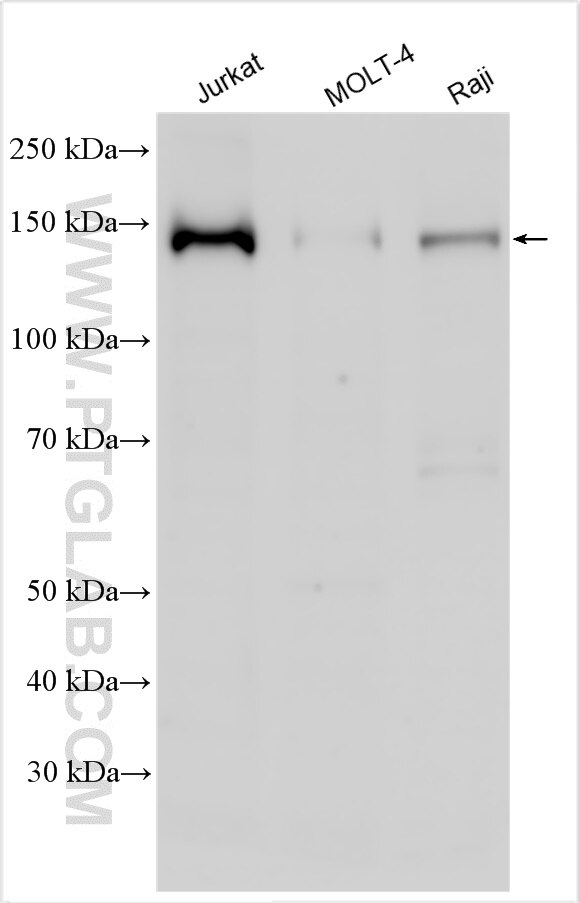
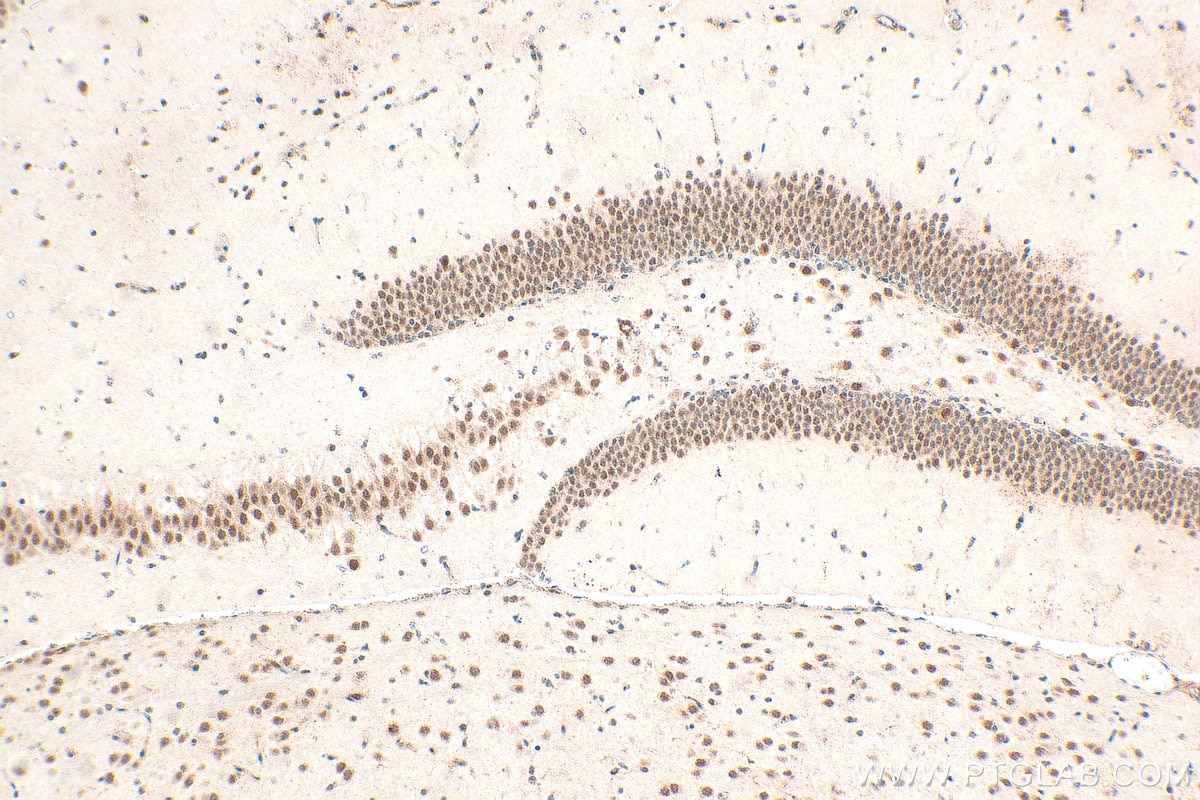
Informations sur le produit
21952-1-PBS cible NCOA1/SRC-1 dans les applications de WB, IHC, Indirect ELISA et montre une réactivité avec des échantillons Humain, souris
| Réactivité | Humain, souris |
| Hôte / Isotype | Lapin / IgG |
| Clonalité | Polyclonal |
| Type | Anticorps |
| Immunogène | NCOA1/SRC-1 Protéine recombinante Ag16603 |
| Nom complet | nuclear receptor coactivator 1 |
| Masse moléculaire calculée | 1441 aa, 157 kDa |
| Poids moléculaire observé | 140-160 kDa |
| Numéro d’acquisition GenBank | BC111533 |
| Symbole du gène | SRC 1/NCOA1 |
| Identification du gène (NCBI) | 8648 |
| Conjugaison | Non conjugué |
| Forme | Liquide |
| Méthode de purification | Purifié par affinité contre l'antigène |
| Tampon de stockage | PBS only |
| Conditions de stockage | Store at -80°C. 20ul contiennent 0,1% de BSA. |
Informations générales
Nuclear receptor coactivator 1, also named SRC-1, directly binds nuclear receptors and stimulates transcriptional activities in a hormone-dependent fashion. Involved in the coactivation of different nuclear receptors, such as for steroids (PGR, GR, and ER), retinoids (RXRs), thyroid hormone (TRs), and prostanoids (PPARs). Also involved in coactivation mediated by STAT3, STAT5A, STAT5B, and STAT6 transcription factors. Displays histone acetyltransferase activity toward H3 and H4; the relevance of such activity remains however unclear. Plays a central role in creating multisubunit coactivator complexes that act via the remodeling of chromatin, and possibly act by participating in both chromatin remodeling and recruitment of general transcription factors. Required with NCOA2 to control energy balance between white and brown adipose tissues. Required for mediating steroid hormone response. Isoform 2 has a higher thyroid hormone-dependent transactivation activity than isoform 1 and isoform 3.


