Anticorps Polyclonal de lapin anti-NIPSNAP1
NIPSNAP1 Polyclonal Antibody for WB, Indirect ELISA
Hôte / Isotype
Lapin / IgG
Réactivité testée
Humain, rat, souris
Applications
WB, Indirect ELISA
Conjugaison
Non conjugué
N° de cat : 33020-1-PBS
Synonymes
Galerie de données de validation
Informations sur le produit
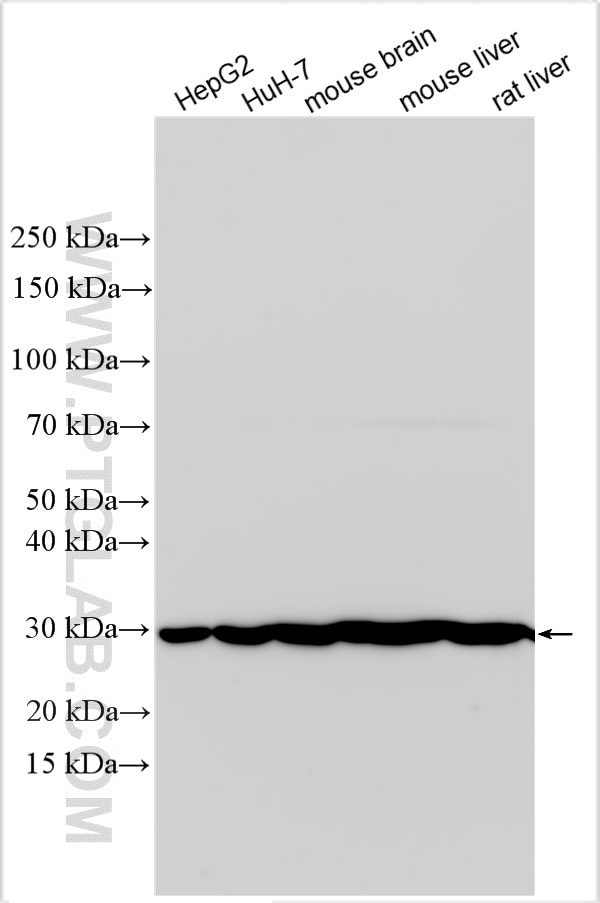
33020-1-PBS cible NIPSNAP1 dans les applications de WB, Indirect ELISA et montre une réactivité avec des échantillons Humain, rat, souris
| Réactivité | Humain, rat, souris |
| Hôte / Isotype | Lapin / IgG |
| Clonalité | Polyclonal |
| Type | Anticorps |
| Immunogène | NIPSNAP1 Protéine recombinante Ag36474 |
| Nom complet | nipsnap homolog 1 (C. elegans) |
| Masse moléculaire calculée | 33kDa,284aa |
| Poids moléculaire observé | 30 kDa |
| Numéro d’acquisition GenBank | NM_003634.3 |
| Symbole du gène | NIPSNAP1 |
| Identification du gène (NCBI) | 8508 |
| Conjugaison | Non conjugué |
| Forme | Liquide |
| Méthode de purification | Purification par affinité contre l'antigène |
| Tampon de stockage | PBS only |
| Conditions de stockage | Store at -80°C. 20ul contiennent 0,1% de BSA. |
Informations générales
NIPSNAP1 has been shown to play a role in regulating synaptic activity in learning and memory but nonetheless, along with the brain, NIPSNAP1 is highly abundant in other organs such as the liver, kidney, and adrenals but its expression is less evident in other tissues such as skeletal muscle. Functional investigations revealed the knockdown of NIPSNAP1 in cancer cells induced cell cycle arrest and inhibited proliferation with the underlying phenotype resulting from senescence. Further analyses revealed that NIPSNAP1 engages in two separate binding interactions that prevent cellular senescence. First, NIPSNAP1 engages with the E3 ubiquitin ligase FBXL14 which otherwise serves to target c-Myc for proteasomal degradation. And moreover, this was shown to be part of a regulatory feedback loop since NIPSNAP1 is subject to transcriptional repression by c-Myc. The second interaction involves NIPSNAP1 binding to superoxide dismutase 2 (SOD2) which enhances its association with SIRT3, thereby deacetylating SOD2 and increasing its activity, in turn, alleviating elevated ROS levels. Consequently, silencing NIPSNAP1 expression contributes to P27-mediated senescence via both decreasing the levels of c-Myc together with increasing ROS levels. Together these findings reveal an important role for NIPSNAP1 as a negative regulator of cancer cell senescence, which functions to sustain the viability of cancer cells under growth factor deprivation stress (PMID: 37340421).


