Anticorps Polyclonal de lapin anti-OLIG1
OLIG1 Polyclonal Antibody for WB, Indirect ELISA
Hôte / Isotype
Lapin / IgG
Réactivité testée
Humain, souris
Applications
WB, Indirect ELISA
Conjugaison
Non conjugué
N° de cat : 26763-1-PBS
Synonymes
Galerie de données de validation
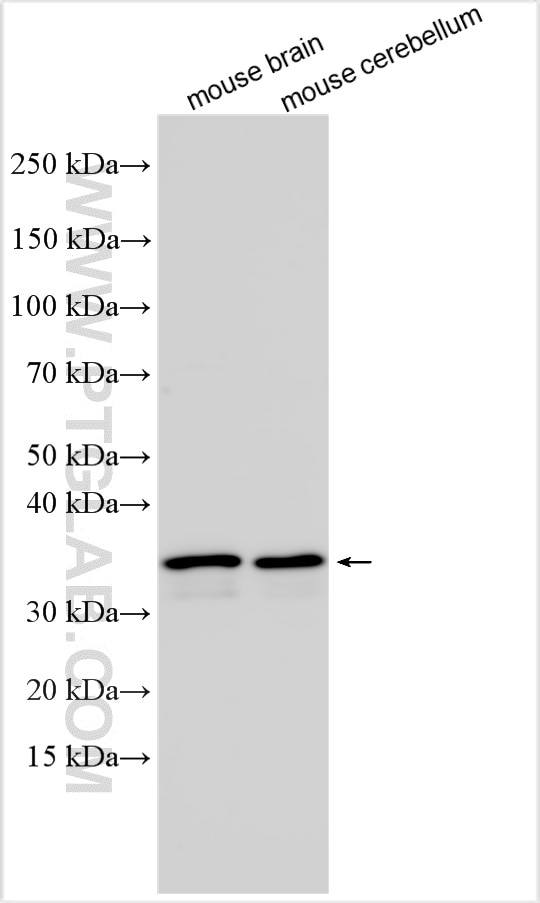


Informations sur le produit
26763-1-PBS cible OLIG1 dans les applications de WB, Indirect ELISA et montre une réactivité avec des échantillons Humain, souris
| Réactivité | Humain, souris |
| Hôte / Isotype | Lapin / IgG |
| Clonalité | Polyclonal |
| Type | Anticorps |
| Immunogène | OLIG1 Protéine recombinante Ag25128 |
| Nom complet | oligodendrocyte transcription factor 1 |
| Masse moléculaire calculée | 28 kDa |
| Poids moléculaire observé | 34 kDa |
| Numéro d’acquisition GenBank | BC026989 |
| Symbole du gène | OLIG1 |
| Identification du gène (NCBI) | 116448 |
| Conjugaison | Non conjugué |
| Forme | Liquide |
| Méthode de purification | Purification par affinité contre l'antigène |
| Tampon de stockage | PBS only |
| Conditions de stockage | Store at -80°C. 20ul contiennent 0,1% de BSA. |
Informations générales
The oligodendrocyte lineage-specific basic helix-loop-helix (OLIG) family of transcription factors includes OLIG1-OLIG3, which differ in tissue expression. OLIG1 and OLIG2 are specifically expressed in nervous tissue as gene regulators of oligodendrogenesis. OLIG1 and OLIG2 interact with the Nkx-2.2 homeodomain protein, which is responsible for directing ventral neuronal patterning in response to graded Sonic hedgehog signaling in the embryonic neural tube. These interactions between OLIG proteins and Nkx-2.2 appear to promote the formation of alternate cell types by inhibiting V3 interneuron development. OLIG1 and OLIG2 are abundantly expressed in oligodendroglioma and nearly absent in astrocytomas. Therefore, OLIG proteins are candidates for molecular markers of human glial brain tumors, which are the most common primary malignancies of the human brain.


