Anticorps Polyclonal de lapin anti-OPN4
OPN4 Polyclonal Antibody for IF-P, Indirect ELISA
Hôte / Isotype
Lapin / IgG
Réactivité testée
Humain, souris
Applications
IF-P, Indirect ELISA
Conjugaison
Non conjugué
N° de cat : 24478-1-PBS
Synonymes
Galerie de données de validation
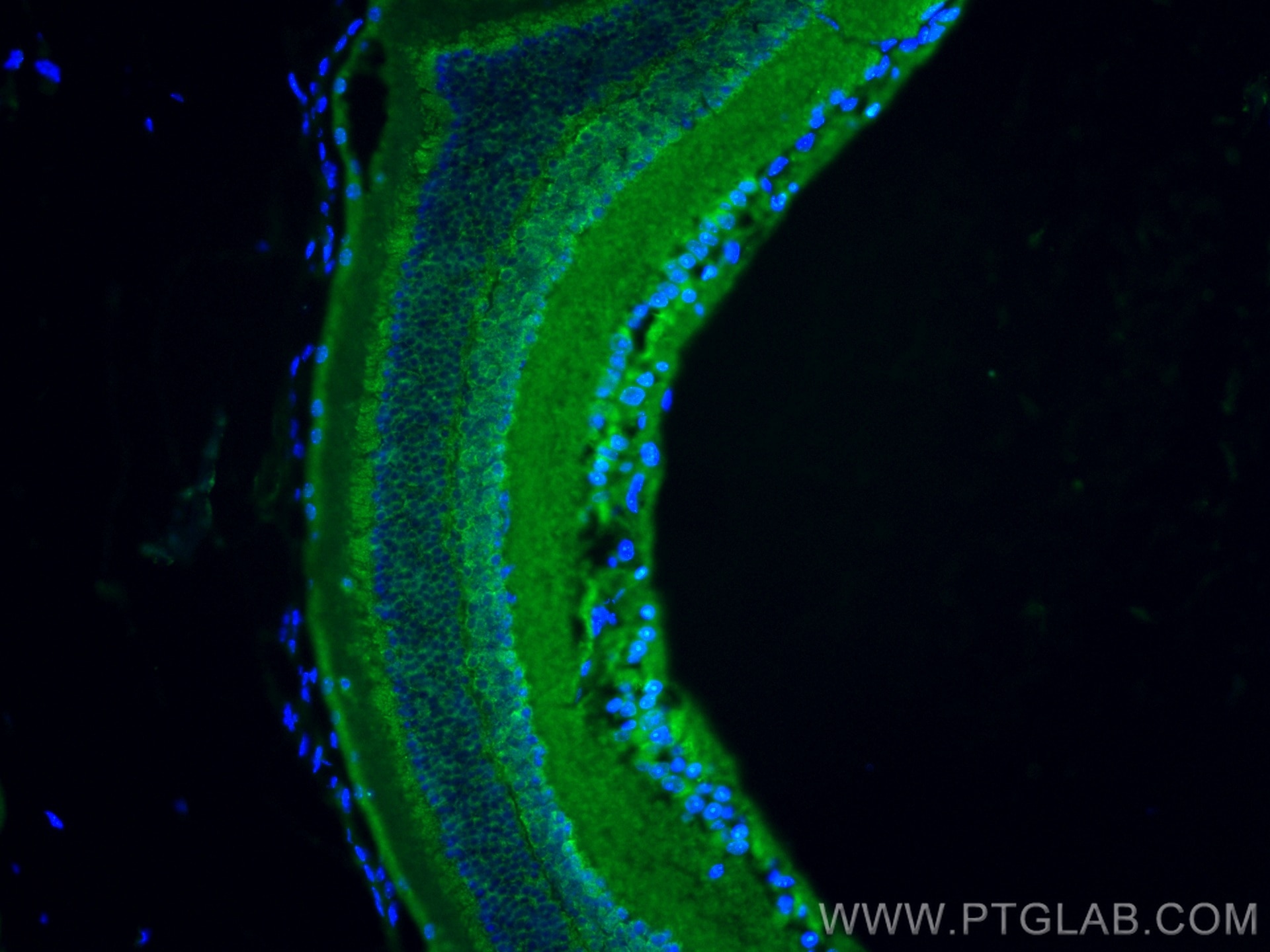
Informations sur le produit
24478-1-PBS cible OPN4 dans les applications de IF-P, Indirect ELISA et montre une réactivité avec des échantillons Humain, souris
| Réactivité | Humain, souris |
| Hôte / Isotype | Lapin / IgG |
| Clonalité | Polyclonal |
| Type | Anticorps |
| Immunogène | OPN4 Protéine recombinante Ag21643 |
| Nom complet | opsin 4 |
| Masse moléculaire calculée | 478 aa, 53 kDa |
| Numéro d’acquisition GenBank | BC113558 |
| Symbole du gène | OPN4 |
| Identification du gène (NCBI) | 94233 |
| Conjugaison | Non conjugué |
| Forme | Liquide |
| Méthode de purification | Purification par affinité contre l'antigène |
| Tampon de stockage | PBS only |
| Conditions de stockage | Store at -80°C. 20ul contiennent 0,1% de BSA. |
Informations générales
OPN4, an opsin that was first isolated from the skin of Xenopus laevis in 1998, belongs not to the vertebrate-type opsin family but rather to the invertebrate-type opsins, which are part of the seven-transmembrane G protein-coupled receptor (GPCR) family (PMID:31989708). In humans, OPN4 is expressed in the retinal ganglion cells in addition to part of the brain (PMID:10632589). Moreover, Opn4 functions as a photoreceptor by detecting brightness levels and discriminating visual signals (PMID:22633808). Opn4 also facilitates visual circuits to acquire optimal settings and light adaptation by measuring irradiance levels (PMID:25517373).


