Anticorps Polyclonal de lapin anti-ORP1L
ORP1L Polyclonal Antibody for WB, Indirect ELISA
Hôte / Isotype
Lapin / IgG
Réactivité testée
Humain, rat, souris
Applications
WB, Indirect ELISA
Conjugaison
Non conjugué
N° de cat : 25268-1-PBS
Synonymes
Galerie de données de validation
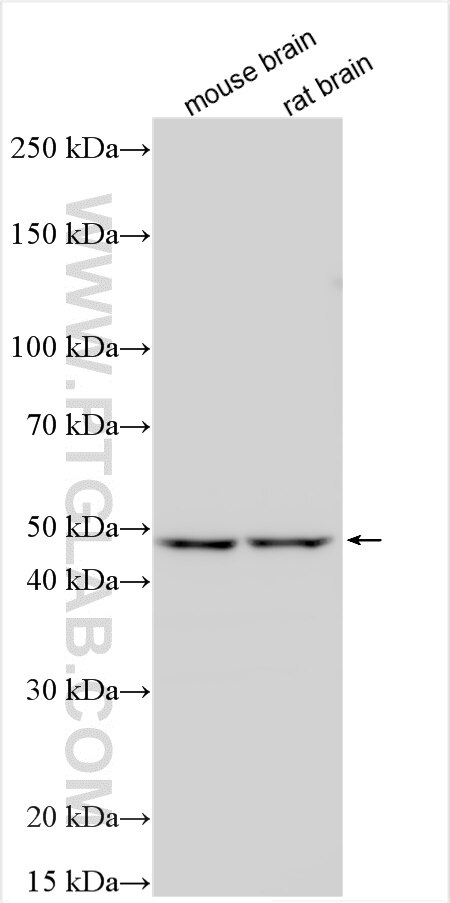
Informations sur le produit
25268-1-PBS cible ORP1L dans les applications de WB, Indirect ELISA et montre une réactivité avec des échantillons Humain, rat, souris
| Réactivité | Humain, rat, souris |
| Hôte / Isotype | Lapin / IgG |
| Clonalité | Polyclonal |
| Type | Anticorps |
| Immunogène | Peptide |
| Nom complet | oxysterol binding protein-like 1A |
| Masse moléculaire calculée | 108 kDa |
| Poids moléculaire observé | 50 kDa, 105-110 kDa |
| Numéro d’acquisition GenBank | NM_018030 |
| Symbole du gène | OSBPL1A |
| Identification du gène (NCBI) | 114876 |
| Conjugaison | Non conjugué |
| Forme | Liquide |
| Méthode de purification | Purification par affinité contre l'antigène |
| Tampon de stockage | PBS only |
| Conditions de stockage | Store at -80°C. 20ul contiennent 0,1% de BSA. |
Informations générales
ORP1L (Oxysterol-binding protein-related protein 1L) is a lipid transfer protein that belongs to the family of OSBP-related proteins (ORPs). It is recruited to lysosomes via its ankyrin repeat domains that bind to Rab7(PMID: 34504082). ORP1L also possesses an FFAT motif, which allows it to interact with the ER resident VAP proteins to aid in establishing the ER-lysosomes contacts. ORP1L is expressed in various tissues, with particularly high expression in the brain, lungs, and macrophages. ORP1L plays a crucial role in cholesterol homeostasis. Disruption of ORP1L function can lead to a block in cholesterol transport to the ER, resulting in the accumulation of cholesterol-enriched LELs in the Golgi/perinuclear region. This can disrupt cellular cholesterol balance, potentially contributing to various metabolic diseases. This suggests that ORP1L is necessary for the normal functioning of cholesterol export from the endo-lysosomal system to the ER, and its dysfunction could be implicated in the progression of diseases related to cholesterol metabolism dysregulation(PMID: 28564600). The molecular weight of ORP1L is 50 kDa.


