Anticorps Polyclonal de lapin anti-OSBPL5
OSBPL5 Polyclonal Antibody for WB, ELISA
Hôte / Isotype
Lapin / IgG
Réactivité testée
Humain, rat, souris
Applications
WB, ELISA
Conjugaison
Non conjugué
N° de cat : 27870-1-AP
Synonymes
Galerie de données de validation
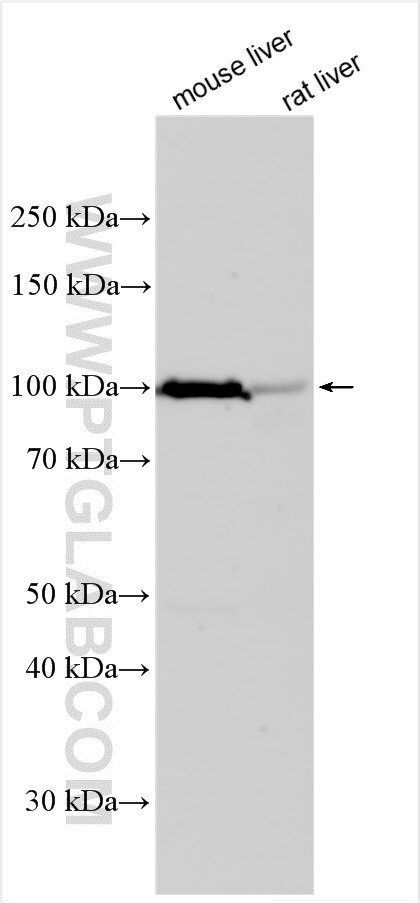
Applications testées
| Résultats positifs en WB | tissu hépatique de souris, tissu hépatique de rat |
Dilution recommandée
| Application | Dilution |
|---|---|
| Western Blot (WB) | WB : 1:2000-1:12000 |
| It is recommended that this reagent should be titrated in each testing system to obtain optimal results. | |
| Sample-dependent, check data in validation data gallery | |
Informations sur le produit
27870-1-AP cible OSBPL5 dans les applications de WB, ELISA et montre une réactivité avec des échantillons Humain, rat, souris
| Réactivité | Humain, rat, souris |
| Hôte / Isotype | Lapin / IgG |
| Clonalité | Polyclonal |
| Type | Anticorps |
| Immunogène | OSBPL5 Protéine recombinante Ag27304 |
| Nom complet | oxysterol binding protein-like 5 |
| Masse moléculaire calculée | 811 aa, 91 kDa |
| Poids moléculaire observé | 100 kDa |
| Numéro d’acquisition GenBank | BC032646 |
| Symbole du gène | OSBPL5 |
| Identification du gène (NCBI) | 114879 |
| Conjugaison | Non conjugué |
| Forme | Liquide |
| Méthode de purification | Purification par affinité contre l'antigène |
| Tampon de stockage | PBS with 0.02% sodium azide and 50% glycerol |
| Conditions de stockage | Stocker à -20°C. Stable pendant un an après l'expédition. L'aliquotage n'est pas nécessaire pour le stockage à -20oC Les 20ul contiennent 0,1% de BSA. |
Informations générales
OSBPL5, also known as oxysterol binding protein like 5, is a protein-coding gene in humans. It is a member of the oxysterol-binding protein (OSBP) family, which consists of intracellular lipid receptors that play a crucial role in maintaining cholesterol balance in the body. It is expressed ubiquitously in various tissues, including the spleen and endometrium. OSBPL5 is classified as a plasma protein and transporter, with a predicted subcellular location in the membrane and intracellular compartments. The protein has been implicated in several biological processes and is involved in the transport of lipids and other molecules between organelles. In terms of disease association, OSBPL5 has been linked to conditions such as Lenz-Majewski hyperostotic dwarfism. Additionally, the OSBPL family of proteins, including OSBPL5, has been suggested to play a role in cancer development, although specific roles in different types of cancer are still being investigated (PMID: 36918840). The molecular weight of OSBPL5 is 98 kDa.
Protocole
| Product Specific Protocols | |
|---|---|
| WB protocol for OSBPL5 antibody 27870-1-AP | Download protocol |
| Standard Protocols | |
|---|---|
| Click here to view our Standard Protocols |

