Anticorps Polyclonal de lapin anti-PAK3
PAK3 Polyclonal Antibody for WB, ELISA
Hôte / Isotype
Lapin / IgG
Réactivité testée
Humain, porc, rat, souris
Applications
WB, ELISA
Conjugaison
Non conjugué
N° de cat : 32848-1-AP
Synonymes
Galerie de données de validation
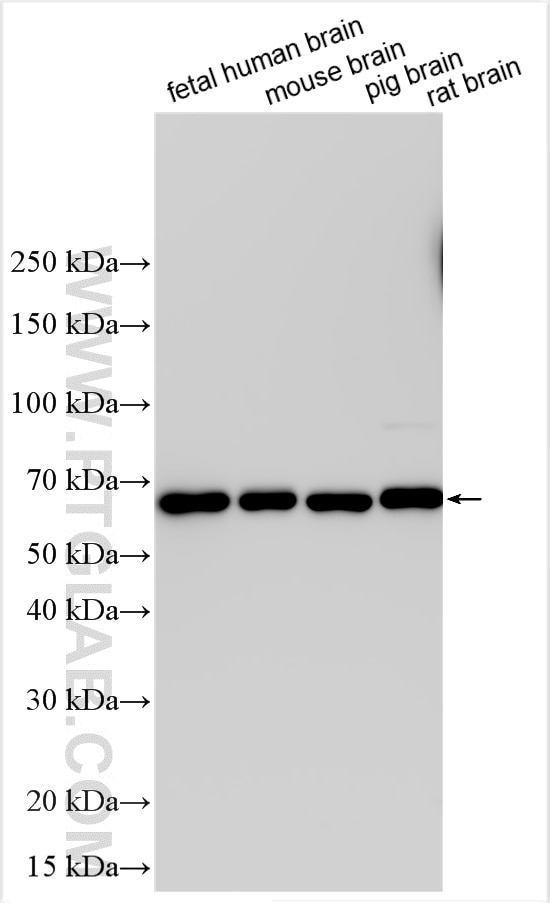
Applications testées
| Résultats positifs en WB | tissu cérébral humain fœtal, tissu cérébral de porc, tissu cérébral de rat, tissu cérébral de souris |
Dilution recommandée
| Application | Dilution |
|---|---|
| Western Blot (WB) | WB : 1:1000-1:6000 |
| It is recommended that this reagent should be titrated in each testing system to obtain optimal results. | |
| Sample-dependent, check data in validation data gallery | |
Informations sur le produit
32848-1-AP cible PAK3 dans les applications de WB, ELISA et montre une réactivité avec des échantillons Humain, porc, rat, souris
| Réactivité | Humain, porc, rat, souris |
| Hôte / Isotype | Lapin / IgG |
| Clonalité | Polyclonal |
| Type | Anticorps |
| Immunogène | PAK3 Protéine recombinante Ag38566 |
| Nom complet | p21 protein (Cdc42/Rac)-activated kinase 3 |
| Masse moléculaire calculée | 62kDa,559aa |
| Poids moléculaire observé | 64 kDa |
| Numéro d’acquisition GenBank | NM_001128173.2 |
| Symbole du gène | PAK3 |
| Identification du gène (NCBI) | 5063 |
| Conjugaison | Non conjugué |
| Forme | Liquide |
| Méthode de purification | Purification par affinité contre l'antigène |
| Tampon de stockage | PBS with 0.02% sodium azide and 50% glycerol |
| Conditions de stockage | Stocker à -20°C. Stable pendant un an après l'expédition. L'aliquotage n'est pas nécessaire pour le stockage à -20oC Les 20ul contiennent 0,1% de BSA. |
Informations générales
PAK3, also known as p21-activated kinase 3, is a member of the PAK family of serine/threonine protein kinases, classified as Group I PAK kinases along with PAK1 and PAK2. PAK3 is predominantly expressed in neural cells, especially in regions such as the brain. PAK3 plays a crucial role in dendritic spine development and synaptic plasticity. PAK3 plays an important role in cell migration and morphology. It regulates dynamic changes in the actomyosin cytoskeleton, microtubules, and adhesion interactions with the microenvironment. In neurons and other cell types, PAK3 contributes to cell migration, neurite growth, and dendritic spine morphogenesis by participating in signaling cascades that control cell adhesion and cell motility. Mutations in PAK3 are associated with X-linked non-syndromic intellectual disability.
Protocole
| Product Specific Protocols | |
|---|---|
| WB protocol for PAK3 antibody 32848-1-AP | Download protocol |
| Standard Protocols | |
|---|---|
| Click here to view our Standard Protocols |

