- Phare
- Validé par KD/KO
Anticorps Recombinant de lapin anti-PAK7
PAK7 Recombinant Antibody for WB, FC (Intra), Indirect ELISA
Hôte / Isotype
Lapin / IgG
Réactivité testée
Humain
Applications
WB, FC (Intra), Indirect ELISA
Conjugaison
Non conjugué
CloneNo.
230201A10
N° de cat : 82935-1-PBS
Synonymes
Galerie de données de validation
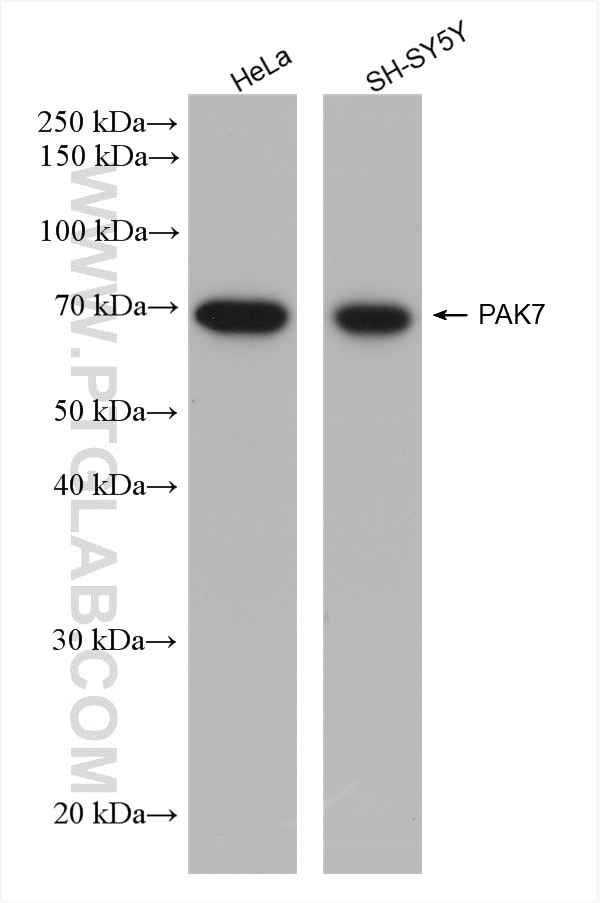
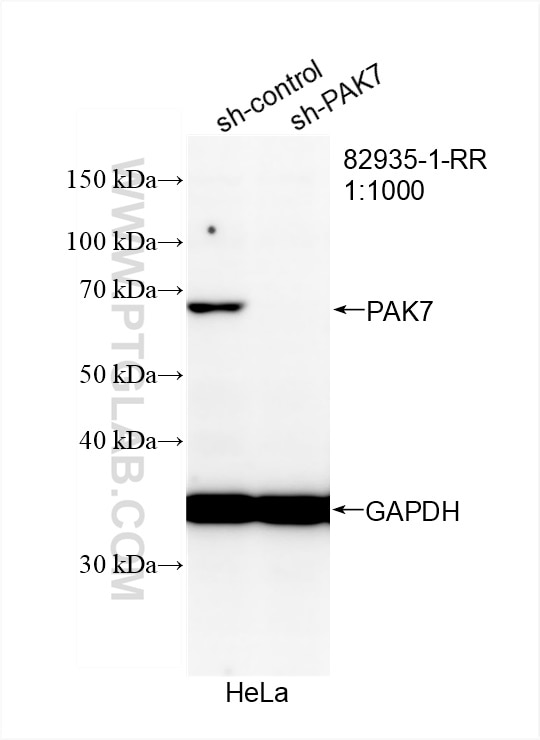
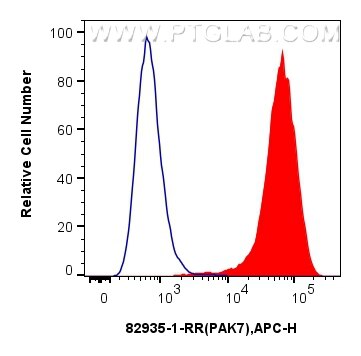
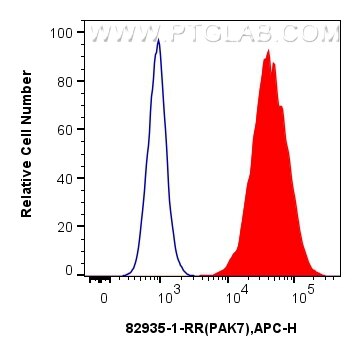
Informations sur le produit
82935-1-PBS cible PAK7 dans les applications de WB, FC (Intra), Indirect ELISA et montre une réactivité avec des échantillons Humain
| Réactivité | Humain |
| Hôte / Isotype | Lapin / IgG |
| Clonalité | Recombinant |
| Type | Anticorps |
| Immunogène | PAK7 Protéine recombinante Ag29190 |
| Nom complet | p21 protein (Cdc42/Rac)-activated kinase 7 |
| Masse moléculaire calculée | 719 aa, 81 kDa |
| Poids moléculaire observé | 70 kDa |
| Numéro d’acquisition GenBank | BC024179 |
| Symbole du gène | PAK7 |
| Identification du gène (NCBI) | 57144 |
| Conjugaison | Non conjugué |
| Forme | Liquide |
| Méthode de purification | Purification par protéine A |
| Tampon de stockage | PBS only |
| Conditions de stockage | Store at -80°C. 20ul contiennent 0,1% de BSA. |
Informations générales
PAK7, also known as PAK5, is a newly found but scarcely researched type II PAKs (PAK4, 5, 6). PAK7 was originally found in the brain, which promotes filopodia formation in nerve cells. Recently, studies have found that the expression level of PAK7 significantly increased in colorectal cancer, ovarian cancer, gastric cancer, neuroglioma, hepatocellular carcinoma, pancreatic cancer, osteosarcoma, and breast cancer. PAK7 plays an important role in tumorigenesis, invasion, and metastasis, mainly related to its mechanism of regulating cytoskeleton, inhibiting apoptosis, and promoting proliferation. The calculated molecular weight of PAK7 is 80 kDa (PMID: 29805709, PMID: 34165002).


