Anticorps Recombinant de lapin anti-PD-1/CD279
PD-1/CD279 Recombinant Antibody for FC
Hôte / Isotype
Rat / IgG2a
Réactivité testée
souris
Applications
FC
Conjugaison
Non conjugué
CloneNo.
29F.1A12
N° de cat : 98080-7-TR
Synonymes
Galerie de données de validation
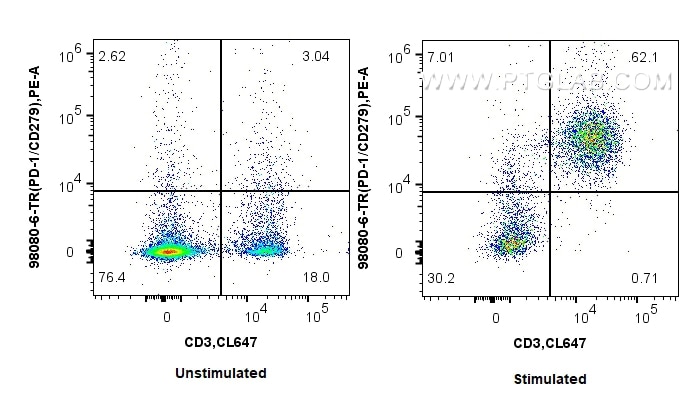
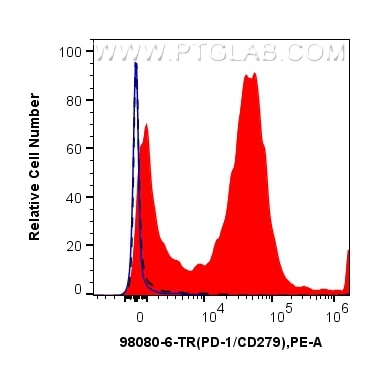
Applications testées
| Résultats positifs en cytométrie | Anti-CD3/CD28 treated mouse splenocytes |
Dilution recommandée
| Application | Dilution |
|---|---|
| This reagent has been tested for flow cytometric analysis. It is recommended that this reagent should be titrated in each testing system to obtain optimal results. | |
| Sample-dependent, check data in validation data gallery | |
Informations sur le produit
98080-7-TR cible PD-1/CD279 dans les applications de FC et montre une réactivité avec des échantillons souris
| Réactivité | souris |
| Hôte / Isotype | Rat / IgG2a |
| Clonalité | Recombinant |
| Type | Anticorps |
| Immunogène | unknow |
| Nom complet | programmed cell death 1 |
| Symbole du gène | PD-1 |
| Identification du gène (NCBI) | 18566 |
| Conjugaison | Non conjugué |
| Forme | Liquide |
| Méthode de purification | Purification par protéine A |
| Tampon de stockage | PBS with 0.09% sodium azide |
| Conditions de stockage | Store at 2 - 8°C. Stable for one year after shipment. |
Informations générales
Programmed cell death 1 (PD-1, also known as CD279) is an immunoinhibitory receptor that belongs to the CD28/CTLA-4 subfamily of the Ig superfamily. It is a 288 amino acid (aa) type I transmembrane protein composed of one Ig superfamily domain, a stalk, a transmembrane domain, and an intracellular domain containing an immunoreceptor tyrosine-based inhibitory motif (ITIM) as well as an immunoreceptor tyrosine-based switch motif (ITSM) (PMID: 18173375). PD-1 is expressed during thymic development and is induced in a variety of hematopoietic cells in the periphery by antigen receptor signaling and cytokines (PMID: 20636820). Engagement of PD-1 by its ligands PD-L1 or PD-L2 transduces a signal that inhibits T-cell proliferation, cytokine production, and cytolytic function (PMID: 19426218). It is critical for the regulation of T cell function during immunity and tolerance. Blockade of PD-1 can overcome immune resistance and also has been shown to have antitumor activity (PMID: 22658127; 23169436). RMP1-14 is a monoclonal antibody that targets the murine PD-1 protein and can be used in mouse models to block the reaction between PD-1 and PD-L1/PD-L2 (PMID: 14764726; 31832706).
Protocole
| Product Specific Protocols | |
|---|---|
| FC protocol for PD-1/CD279 antibody 98080-7-TR | Download protocol |
| Standard Protocols | |
|---|---|
| Click here to view our Standard Protocols |

