Anticorps Recombinant de lapin anti-PLVAP
PLVAP Recombinant Antibody for FC
Hôte / Isotype
Rat / IgG2a
Réactivité testée
souris
Applications
FC
Conjugaison
Non conjugué
CloneNo.
MECA-32
N° de cat : 65664-1-PBS
Synonymes
Galerie de données de validation
Informations sur le produit
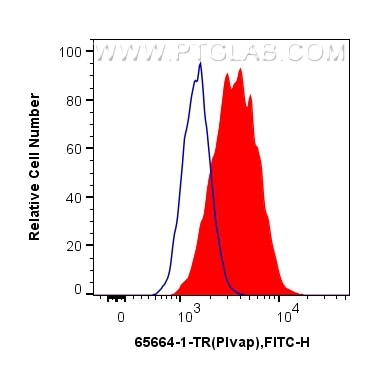
65664-1-PBS cible PLVAP dans les applications de FC et montre une réactivité avec des échantillons souris
| Réactivité | souris |
| Hôte / Isotype | Rat / IgG2a |
| Clonalité | Recombinant |
| Type | Anticorps |
| Immunogène | s/o |
| Nom complet | plasmalemma vesicle associated protein |
| Numéro d’acquisition GenBank | BC013517 |
| Symbole du gène | Plvap |
| Identification du gène (NCBI) | 84094 |
| Conjugaison | Non conjugué |
| Forme | Liquide |
| Méthode de purification | Purification par protéine A |
| Tampon de stockage | PBS only |
| Conditions de stockage | Store at -80°C. |
Informations générales
Plasmalemma vesicle-associated protein (PLVAP), also known as PV-1, PAL-E and MECA-32 antigen, is an endothelial cell-specific type II membrane N-glycosylated glycoprotein with a molecular weight of approximately 50-65 kDa, that forms homodimers in situ (PMID: 7626790; 30231925). The MECA-32 antibody, derived from rats immunized with murine lymph node stroma, shows high specificity for mouse endothelium in both embryonic and mature tissues (PMID: 2683264; 7626790). It recognizes most endothelial cells in the embryonic and in the adult mouse, with the exception of the brain, skeletal, and cardiac muscle, where the MECA-32 antigen has a more restricted distribution. In skeletal and cardiac muscle only small arterioles and venules express the MECA-32 antigen, while in the brain its expression is negatively correlated with the differentiation of the vasculature to form the blood brain barrier (PMID: 7626790).


