- Phare
- Validé par KD/KO
Anticorps Monoclonal anti-PSMA7
PSMA7 Monoclonal Antibody for FC (Intra)
Hôte / Isotype
Mouse / IgG1
Réactivité testée
Humain, rat, souris
Applications
FC (Intra)
Conjugaison
CoraLite® Plus 647 Fluorescent Dye
CloneNo.
1F2C6
N° de cat : CL647-67817
Synonymes
Galerie de données de validation
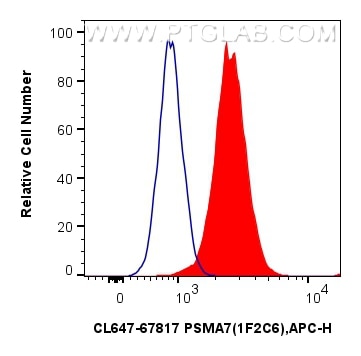
Applications testées
| Résultats positifs en FC (Intra) | cellules HeLa |
Dilution recommandée
| Application | Dilution |
|---|---|
| Flow Cytometry (FC) (INTRA) | FC (INTRA) : 0.40 ug per 10^6 cells in a 100 µl suspension |
| It is recommended that this reagent should be titrated in each testing system to obtain optimal results. | |
| Sample-dependent, check data in validation data gallery | |
Informations sur le produit
CL647-67817 cible PSMA7 dans les applications de FC (Intra) et montre une réactivité avec des échantillons Humain, rat, souris
| Réactivité | Humain, rat, souris |
| Hôte / Isotype | Mouse / IgG1 |
| Clonalité | Monoclonal |
| Type | Anticorps |
| Immunogène | PSMA7 Protéine recombinante Ag7821 |
| Nom complet | proteasome (prosome, macropain) subunit, alpha type, 7 |
| Masse moléculaire calculée | 28 kDa |
| Poids moléculaire observé | 28-30 kDa |
| Numéro d’acquisition GenBank | BC004427 |
| Symbole du gène | PSMA7 |
| Identification du gène (NCBI) | 5688 |
| Conjugaison | CoraLite® Plus 647 Fluorescent Dye |
| Excitation/Emission maxima wavelengths | 654 nm / 674 nm |
| Forme | Liquide |
| Méthode de purification | Purification par protéine G |
| Tampon de stockage | PBS with 50% glycerol, 0.05% Proclin300, 0.5% BSA |
| Conditions de stockage | Stocker à -20 °C. Éviter toute exposition à la lumière. Stable pendant un an après l'expédition. L'aliquotage n'est pas nécessaire pour le stockage à -20oC Les 20ul contiennent 0,1% de BSA. |
Informations générales
PSMA7(Proteasome subunit alpha type-7) is also named as HSPC and belongs to the peptidase T1A family. It is an α-type subunit of the 20S proteasome core complex and participates in degrading proteins through ubiquitin-proteasome pathway (UPP) which plays an important role in the regulation of cell proliferation or cell cycle control, transcriptional regulation, immune and stress response, cell differentiation, and apoptosis.(PMID: 19442227).

