Anticorps Polyclonal de lapin anti-PWWP2B
PWWP2B Polyclonal Antibody for WB, Indirect ELISA
Hôte / Isotype
Lapin / IgG
Réactivité testée
Humain
Applications
WB, Indirect ELISA
Conjugaison
Non conjugué
N° de cat : 32112-1-PBS
Synonymes
Galerie de données de validation
Informations sur le produit
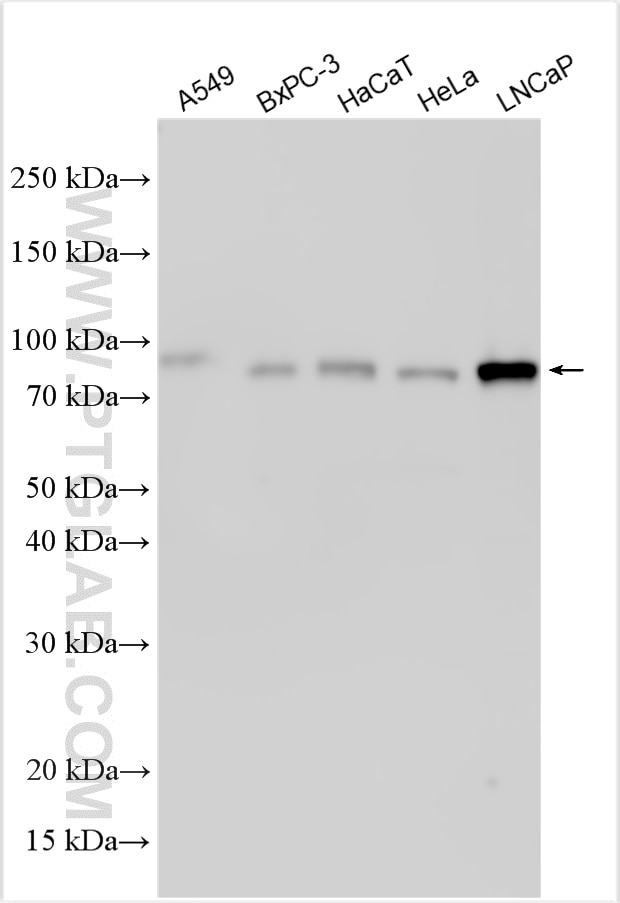
32112-1-PBS cible PWWP2B dans les applications de WB, Indirect ELISA et montre une réactivité avec des échantillons Humain
| Réactivité | Humain |
| Hôte / Isotype | Lapin / IgG |
| Clonalité | Polyclonal |
| Type | Anticorps |
| Immunogène | PWWP2B Protéine recombinante Ag36839 |
| Nom complet | PWWP domain containing 2B |
| Poids moléculaire observé | 90 kDa |
| Numéro d’acquisition GenBank | BC068574 |
| Symbole du gène | PWWP2B |
| Identification du gène (NCBI) | 170394 |
| Conjugaison | Non conjugué |
| Forme | Liquide |
| Méthode de purification | Purification par affinité contre l'antigène |
| Tampon de stockage | PBS only |
| Conditions de stockage | Store at -80°C. 20ul contiennent 0,1% de BSA. |
Informations générales
PWWP2B (PWWP structural domain protein 2B) is a PWWP structural domain-containing protein involved in a variety of cellular functions and biological processes. PWWP2B is highly expressed in brown and beige adipose tissue and its expression is induced by cold stimulation. It has been shown that PWWP2B negatively regulates adipose tissue thermogenesis by recruiting and stabilizing the histone deacetylase HDAC1/2, which binds to the promoter regions of thermogenic genes and reduces histone acetylation levels. In adipocytes, PWWP2B acts as part of the nucleosome remodeling and deacetylation complex (NuRD) to inhibit the expression of thermogenic genes and avoid overactivation of thermogenic functions. In addition, PWWP2B plays an important role in DNA damage repair, as its PWWP structural domain moves to DNA damage sites, interacts with UHRF1 and recruits MRE11 to promote DNA end resection and homologous recombination repair. In pathology, downregulation of PWWP2B is associated with recurrent gastric cancer and promotes cell proliferation and migration.


