Anticorps Recombinant de lapin anti-Phospho-AKT (Thr308)
Phospho-AKT (Thr308) Recombinant Antibody for WB, FC (Intra), ELISA
Hôte / Isotype
Lapin / IgG
Réactivité testée
Humain
Applications
WB, FC (Intra), ELISA
Conjugaison
Non conjugué
CloneNo.
241845F1
N° de cat : 81232-8-RR
Synonymes
Galerie de données de validation
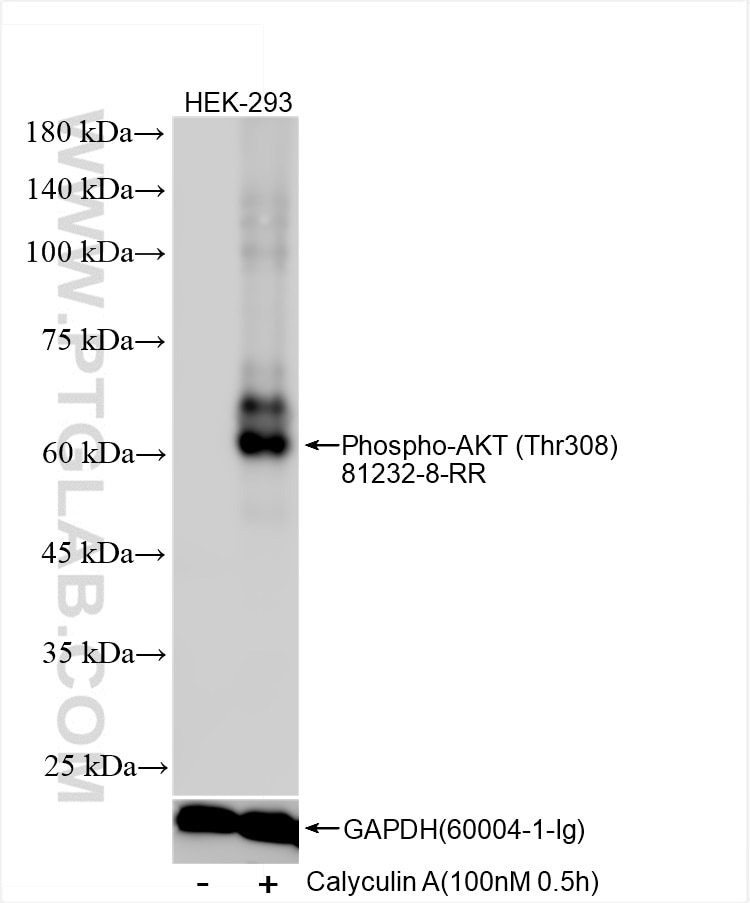
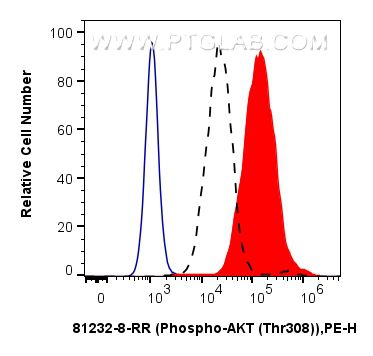
Applications testées
| Résultats positifs en WB | cellules HEK-293 traitées à la calyculine A, |
| Résultats positifs en FC (Intra) | cellules HeLa traitées à la calyculine A, |
Dilution recommandée
| Application | Dilution |
|---|---|
| Western Blot (WB) | WB : 1:1000-1:4000 |
| Flow Cytometry (FC) (INTRA) | FC (INTRA) : 0.25 ug per 10^6 cells in a 100 µl suspension |
| It is recommended that this reagent should be titrated in each testing system to obtain optimal results. | |
| Sample-dependent, check data in validation data gallery | |
Informations sur le produit
81232-8-RR cible Phospho-AKT (Thr308) dans les applications de WB, FC (Intra), ELISA et montre une réactivité avec des échantillons Humain
| Réactivité | Humain |
| Hôte / Isotype | Lapin / IgG |
| Clonalité | Recombinant |
| Type | Anticorps |
| Immunogène | Peptide |
| Nom complet | v-akt murine thymoma viral oncogene homolog 1 |
| Masse moléculaire calculée | 56 kDa |
| Poids moléculaire observé | 60 kDa |
| Numéro d’acquisition GenBank | BC000479 |
| Symbole du gène | AKT1 |
| Identification du gène (NCBI) | 207 |
| Conjugaison | Non conjugué |
| Forme | Liquide |
| Méthode de purification | Protein A purfication |
| Tampon de stockage | PBS with 0.02% sodium azide and 50% glycerol |
| Conditions de stockage | Stocker à -20°C. Stable pendant un an après l'expédition. L'aliquotage n'est pas nécessaire pour le stockage à -20oC Les 20ul contiennent 0,1% de BSA. |
Informations générales
The serine-threonine kinase Akt, also known as protein kinase B (PKB), contributes to a broad range of cellular functions including cell survival, proliferation, gene expression and migration of cells of most lineages. AKT has a wide range of cellular substrates, and the oncogenicity of AKT arises from activation of both proliferative and anti-apoptotic signaling, thus making this kinase an attractive target for cancer therapy. Activation of mammalian AKT depends on its recruitment to the membrane through binding of phosphatidylinositol-3,4,5-trisphosphate (PIP3) to the PH domain of AKT, and subsequent phosphorylation at two key residues, Thr308 and Ser473, located at the catalytic domain and C-terminal regulatory domain, respectively. (PMID: 34740102, PMID: 29017516)
Protocole
| Product Specific Protocols | |
|---|---|
| WB protocol for Phospho-AKT (Thr308) antibody 81232-8-RR | Download protocol |
| Standard Protocols | |
|---|---|
| Click here to view our Standard Protocols |

