Anticorps Recombinant de lapin anti-Phospho-INSR (Tyr1146)/IGF1R (Tyr1131)
Phospho-INSR (Tyr1146)/IGF1R (Tyr1131) Recombinant Antibody for WB, ELISA
Hôte / Isotype
Lapin / IgG
Réactivité testée
Humain, rat, souris
Applications
WB, ELISA
Conjugaison
Non conjugué
CloneNo.
243066C4
N° de cat : 82830-15-RR
Synonymes
Galerie de données de validation
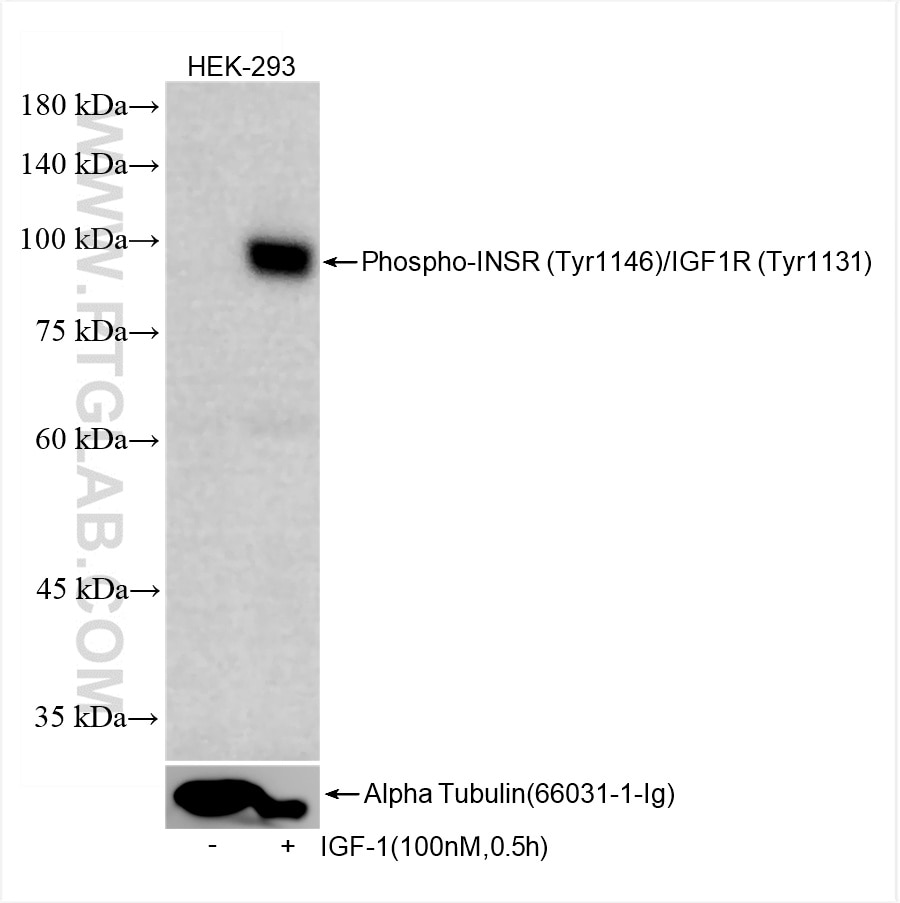
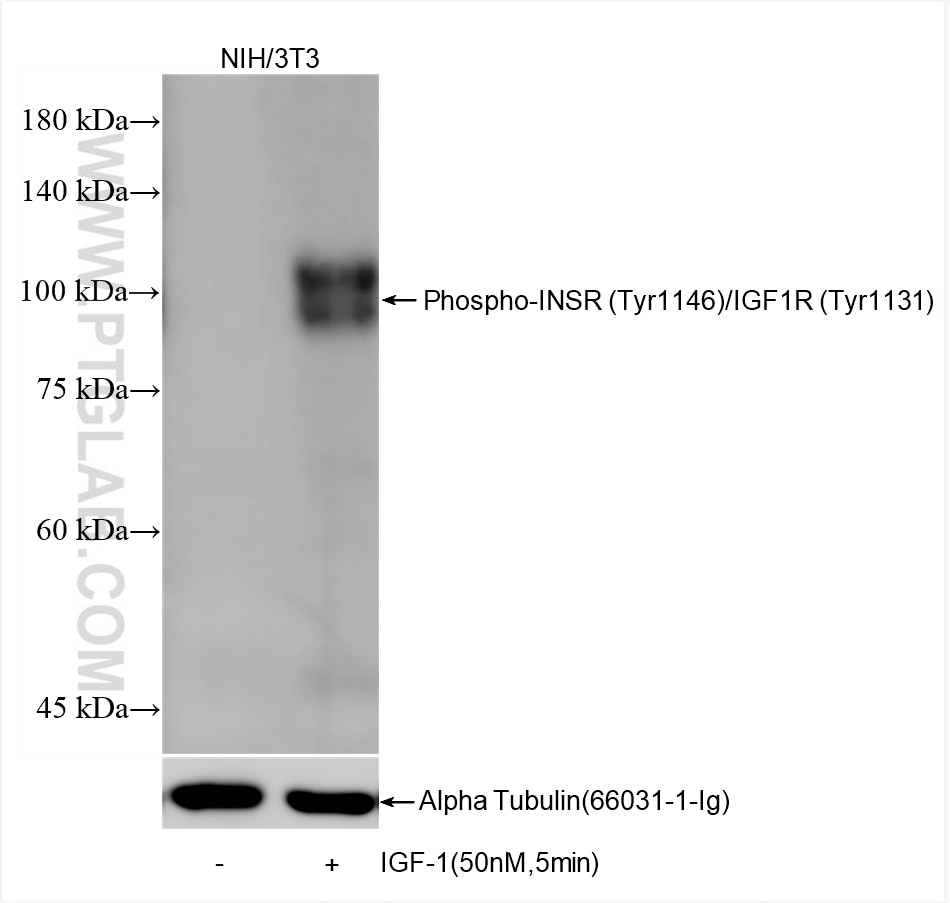
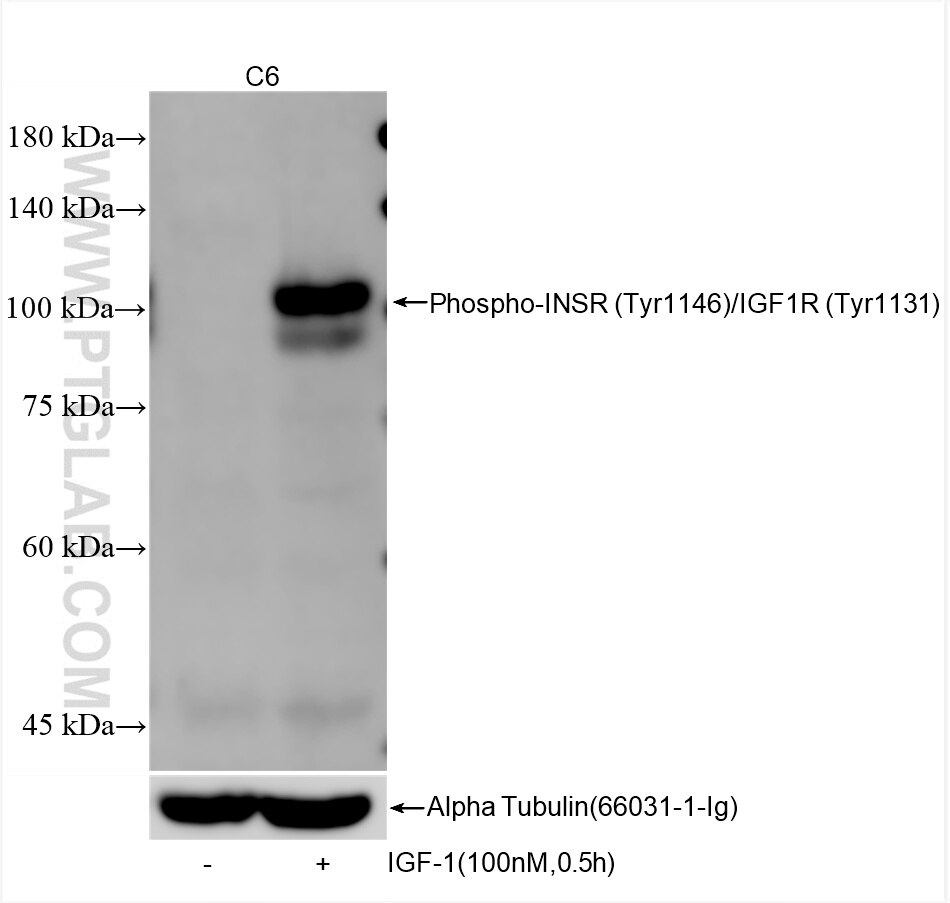
Applications testées
| Résultats positifs en WB | IGF-1 treated HEK-293 cells, IGF-1 treated C6 cells, IGF-1 treated NIH/3T3 cells |
Dilution recommandée
| Application | Dilution |
|---|---|
| Western Blot (WB) | WB : 1:1000-1:8000 |
| It is recommended that this reagent should be titrated in each testing system to obtain optimal results. | |
| Sample-dependent, check data in validation data gallery | |
Informations sur le produit
82830-15-RR cible Phospho-INSR (Tyr1146)/IGF1R (Tyr1131) dans les applications de WB, ELISA et montre une réactivité avec des échantillons Humain, rat, souris
| Réactivité | Humain, rat, souris |
| Hôte / Isotype | Lapin / IgG |
| Clonalité | Recombinant |
| Type | Anticorps |
| Immunogène | Peptide |
| Nom complet | INSR |
| Poids moléculaire observé | 95 kDa |
| Numéro d’acquisition GenBank | BC117172 |
| Symbole du gène | INSR |
| Identification du gène (NCBI) | 3643 |
| Conjugaison | Non conjugué |
| Forme | Liquide |
| Méthode de purification | Purification par protéine A |
| Tampon de stockage | PBS with 0.02% sodium azide and 50% glycerol |
| Conditions de stockage | Stocker à -20°C. Stable pendant un an après l'expédition. L'aliquotage n'est pas nécessaire pour le stockage à -20oC Les 20ul contiennent 0,1% de BSA. |
Informations générales
Insulin binding to the insulin receptor (INSR) triggers sequential conformational changes and autophosphorylation of the receptor, followed by activation of a kinase signaling cascade that plays essential roles in a wide variety of biological processes. INSR belongs to a class of receptor tyrosine kinases (RTKs) that comprises 58 receptors in humans. The INSR shares a high structural homology with the IGF1R (84% similarity in the tyrosine kinase domain, 45-65% in the ligand-binding domain, and more than 50% in the overall amino acid sequence). In addition, ligand-dependent activation of the INSR and IGF1R activates almost identical downstream signaling cascades. Insulin binds to INSR in peripheral tissues, initiating receptor activation followed by intracellular signaling cascades. The first step in INSR activation is the autophosphorylation of intracellular tyrosine residues in the JM domain, kinase activation loop, and CT domain. Phosphorylation of three tyrosine residues (Tyr1146, Tyr1150, and Tyr1151, based on INSR isoform A numbering) located in the kinase activation loop plays a crucial role in kinase activity regulation. Insulin binding also induces INSR kinase-mediated phosphorylation of four tyrosine residues located in the JM (Tyr953 and Tyr960) and CT domain (Tyr1316 and Tyr1322). (PMID: 37779149,PMID:24434591)
Protocole
| Product Specific Protocols | |
|---|---|
| WB protocol for Phospho-INSR (Tyr1146)/IGF1R (Tyr1131) antibody 82830-15-RR | Download protocol |
| Standard Protocols | |
|---|---|
| Click here to view our Standard Protocols |

