Anticorps Recombinant de lapin anti-Phospho-MST1 (Thr183)/MST2 (Thr180)
Phospho-MST1 (Thr183)/MST2 (Thr180) Recombinant Antibody for WB, FC (Intra), Indirect ELISA
Hôte / Isotype
Lapin / IgG
Réactivité testée
Humain, souris
Applications
WB, FC (Intra), Indirect ELISA
Conjugaison
Non conjugué
CloneNo.
1P6
N° de cat : 80093-1-PBS
Synonymes
Galerie de données de validation
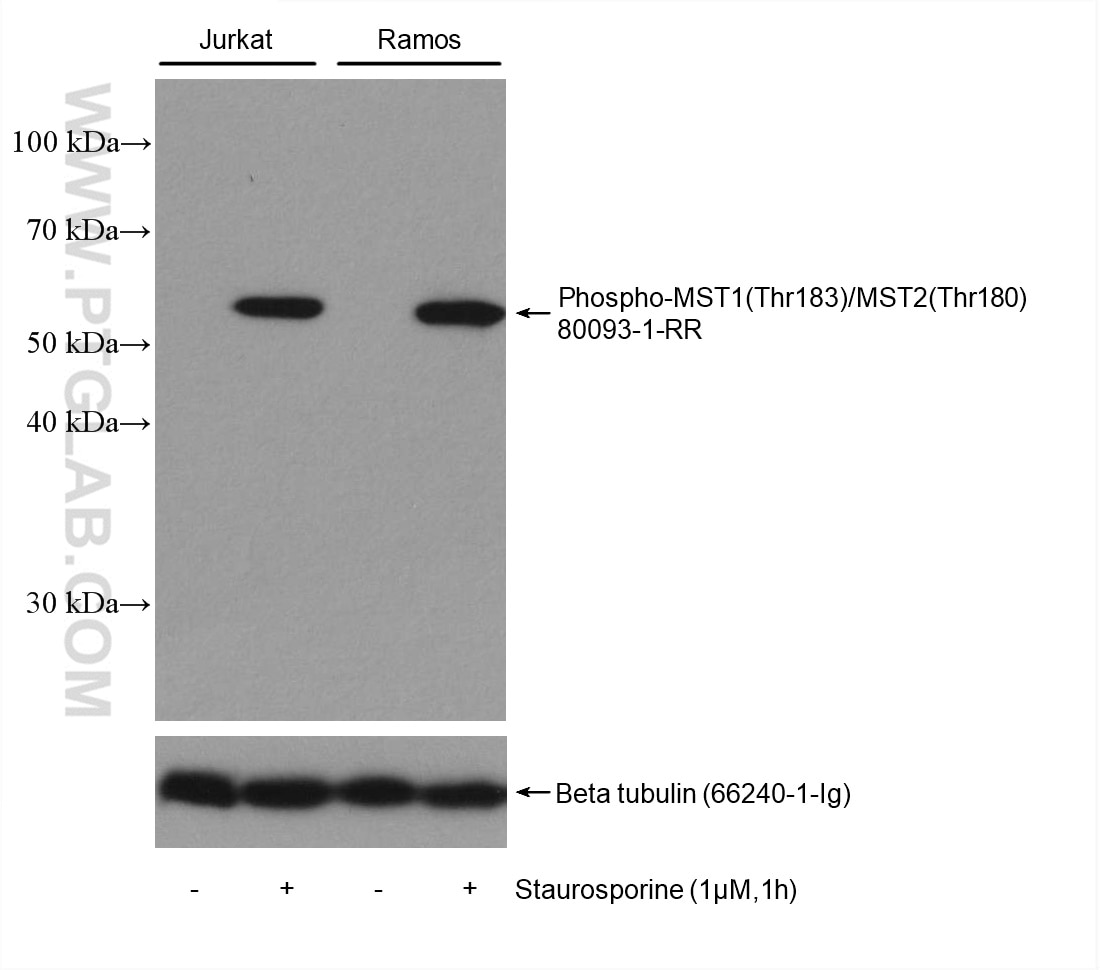
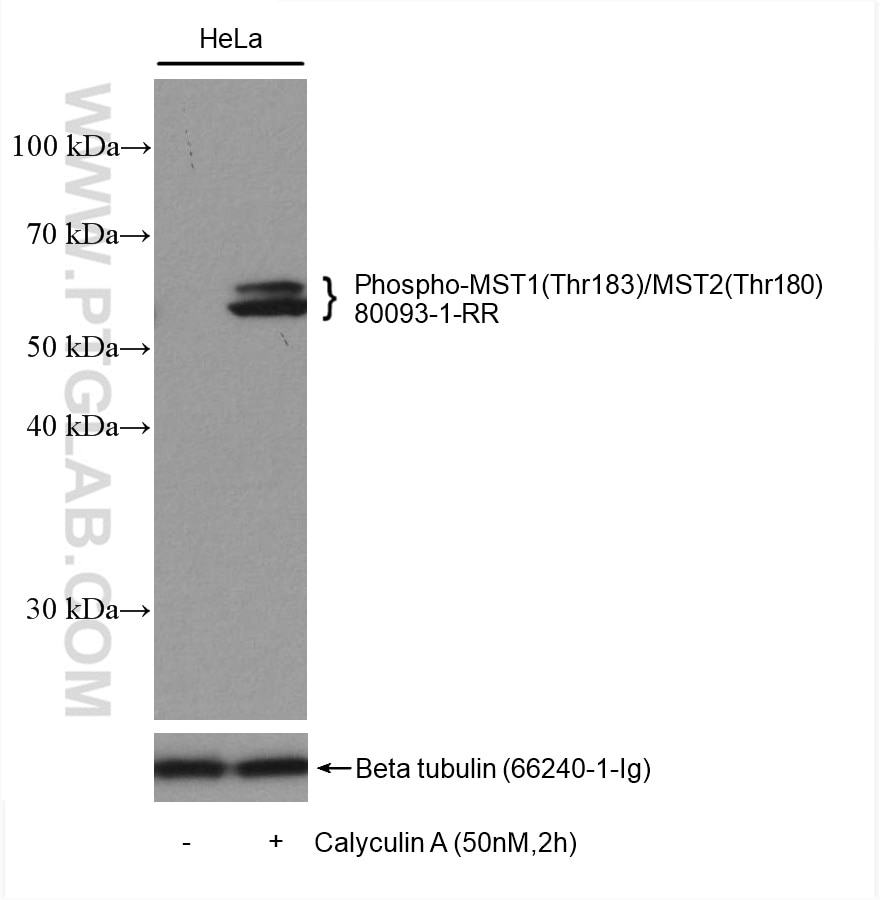
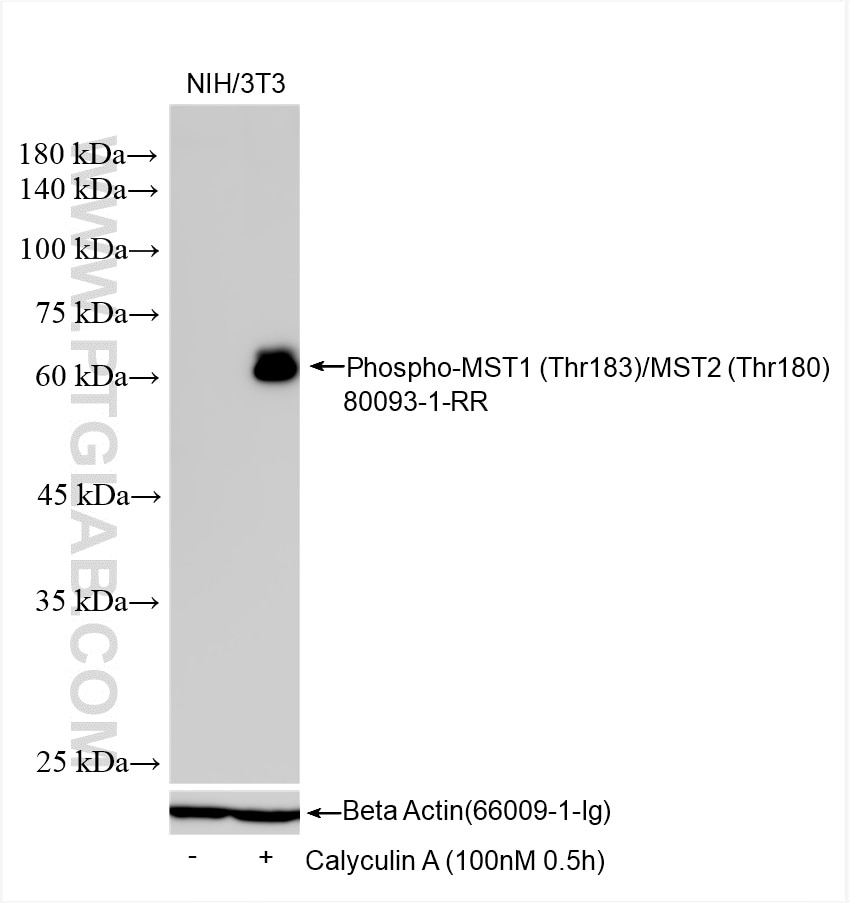
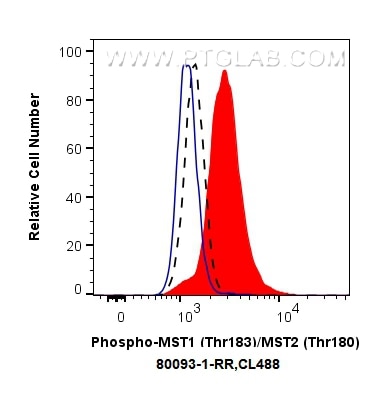
Informations sur le produit
80093-1-PBS cible Phospho-MST1 (Thr183)/MST2 (Thr180) dans les applications de WB, FC (Intra), Indirect ELISA et montre une réactivité avec des échantillons Humain, souris
| Réactivité | Humain, souris |
| Hôte / Isotype | Lapin / IgG |
| Clonalité | Recombinant |
| Type | Anticorps |
| Immunogène | Peptide |
| Nom complet | serine/threonine kinase 4 |
| Masse moléculaire calculée | 56 kDa |
| Poids moléculaire observé | 59 kDa |
| Numéro d’acquisition GenBank | BC005231 |
| Symbole du gène | MST1 |
| Identification du gène (NCBI) | 6789 |
| Conjugaison | Non conjugué |
| Forme | Liquide |
| Méthode de purification | Purification par protéine A |
| Tampon de stockage | PBS only |
| Conditions de stockage | Store at -80°C. 20ul contiennent 0,1% de BSA. |
Informations générales
Mammalian STE20-like serine-threonine kinase MST1, encoded by the STK4 gene, is a multifunctional protein. MST1 and its closest paralogs MST2 (encoded by the STK3 gene), MST3, and MST4 are members of the Class II Germinal Center Family of Protein Kinases . STK3/4 and LATS1/2 (large tumor suppressor 1 and 2) are core kinase components of the Hippo tumor suppressor pathway in mammalians . In the conventional Hippo pathway, the STK3/4 and LATS1/2 signaling cascade phosphorylates and inactivates the transcriptional coactivator YAP1 (yes associated protein 1) and its close paralog WWTR1]. YAP1 and WWTR1 do not have DNA binding domains and they exert their biological outputs, such as cell proliferation and survival, by interacting with the TEAD1-4 transcription factors. Lines of evidence have indicated that dysregulation or loss of STK4/Hippo signaling is linked to developmental disorders and carcinogenesis with poor prognosis. STK4 is a stress-induced kinase and it can be activated in response to cell-death inducers. Autophosphorylation of STK4 at Thr183 (Thr180 in STK3) in the activation loop is a key activation mechanism for STK4/3 because phosphorylation of Thr183/180 causes the cleavage of STK4 by caspases under apoptotic conditions. The caspase-cleavage results in a more active STK4 protein (STK4-N, an amino-terminally truncated STK4), which localizes into the nucleus and induces apoptosis through histone modifications and chromatin condensations.


