Anticorps Recombinant de lapin anti-Phospho-P53 (Ser392)
Phospho-P53 (Ser392) Recombinant Antibody for WB, FC (Intra), ELISA
Hôte / Isotype
Lapin / IgG
Réactivité testée
Humain
Applications
WB, FC (Intra), ELISA
Conjugaison
Non conjugué
CloneNo.
241575F6
N° de cat : 80077-2-RR
Synonymes
Galerie de données de validation
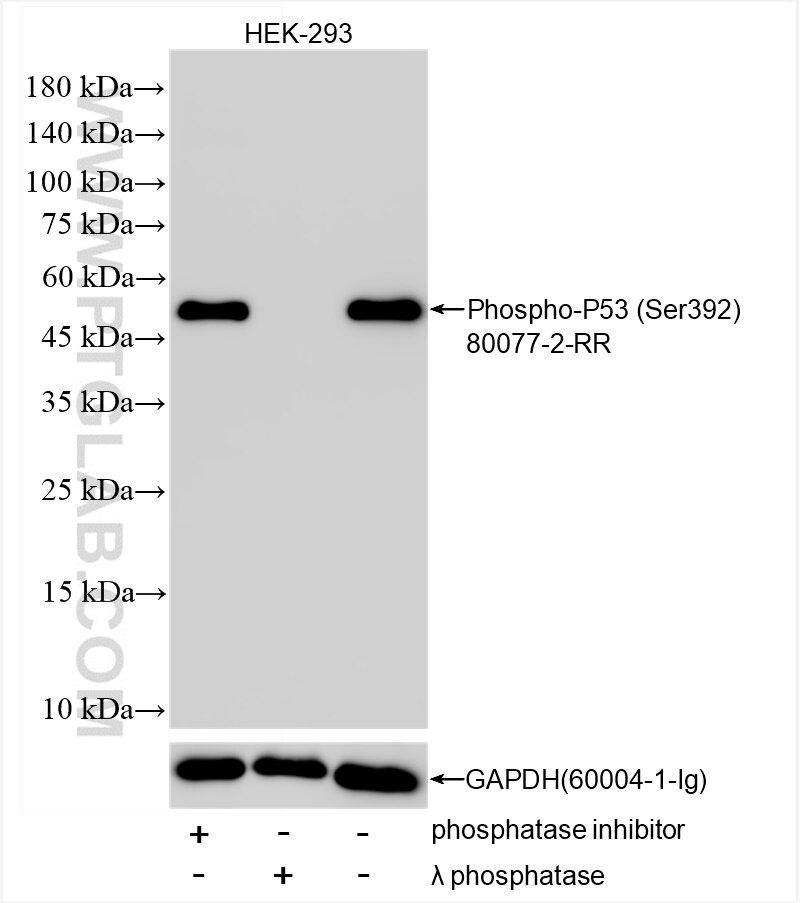
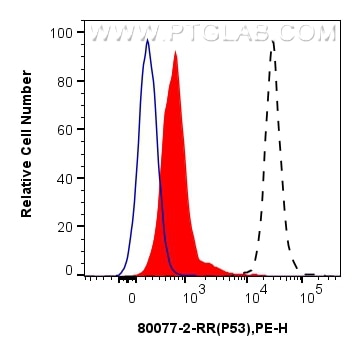
Applications testées
| Résultats positifs en WB | λ phosphatase treated HEK-293 cells, |
| Résultats positifs en FC (Intra) | cellules HeLa traitées à la λ phosphatase, |
Dilution recommandée
| Application | Dilution |
|---|---|
| Western Blot (WB) | WB : 1:5000-1:50000 |
| Flow Cytometry (FC) (INTRA) | FC (INTRA) : 0.20 ug per 10^6 cells in a 100 µl suspension |
| It is recommended that this reagent should be titrated in each testing system to obtain optimal results. | |
| Sample-dependent, check data in validation data gallery | |
Informations sur le produit
80077-2-RR cible Phospho-P53 (Ser392) dans les applications de WB, FC (Intra), ELISA et montre une réactivité avec des échantillons Humain
| Réactivité | Humain |
| Hôte / Isotype | Lapin / IgG |
| Clonalité | Recombinant |
| Type | Anticorps |
| Immunogène | Peptide |
| Nom complet | tumor protein p53 |
| Masse moléculaire calculée | 44 kDa |
| Poids moléculaire observé | 53 kDa |
| Numéro d’acquisition GenBank | BC003596 |
| Symbole du gène | P53 |
| Identification du gène (NCBI) | 7157 |
| Conjugaison | Non conjugué |
| Forme | Liquide |
| Méthode de purification | Protein A purfication |
| Tampon de stockage | PBS with 0.02% sodium azide and 50% glycerol |
| Conditions de stockage | Stocker à -20°C. Stable pendant un an après l'expédition. L'aliquotage n'est pas nécessaire pour le stockage à -20oC Les 20ul contiennent 0,1% de BSA. |
Informations générales
P53 is activated in response to alteration of normal cell homeostasis, including DNA damage, nutrient starvation, heat shock, virus infection, pH change, hypoxia, and oncogene activation. P53 maintains genetic stability by regulating different processes, such as cell-cycle arrest, DNA synthesis and repair, programmed cell death, and energy metabolism. In non-stressed conditions these proteins bind p53, ubiquitylate it and target it for degradation by the proteasome. In stressed conditions the function of the MdM2-MdM4 complex is blocked by phosphorylation, protein-binding events and/or enhanced degradation. (PMID: 19935675, PMID: 24379683)
Protocole
| Product Specific Protocols | |
|---|---|
| WB protocol for Phospho-P53 (Ser392) antibody 80077-2-RR | Download protocol |
| Standard Protocols | |
|---|---|
| Click here to view our Standard Protocols |

