Anticorps Recombinant de lapin anti-Phospho-PAK1 (Ser144)/PAK2 (Ser141)
Phospho-PAK1 (Ser144)/PAK2 (Ser141) Recombinant Antibody for WB, Indirect ELISA
Hôte / Isotype
Lapin / IgG
Réactivité testée
Humain, rat, souris
Applications
WB, Indirect ELISA
Conjugaison
Non conjugué
CloneNo.
242123D12
N° de cat : 85044-1-PBS
Synonymes
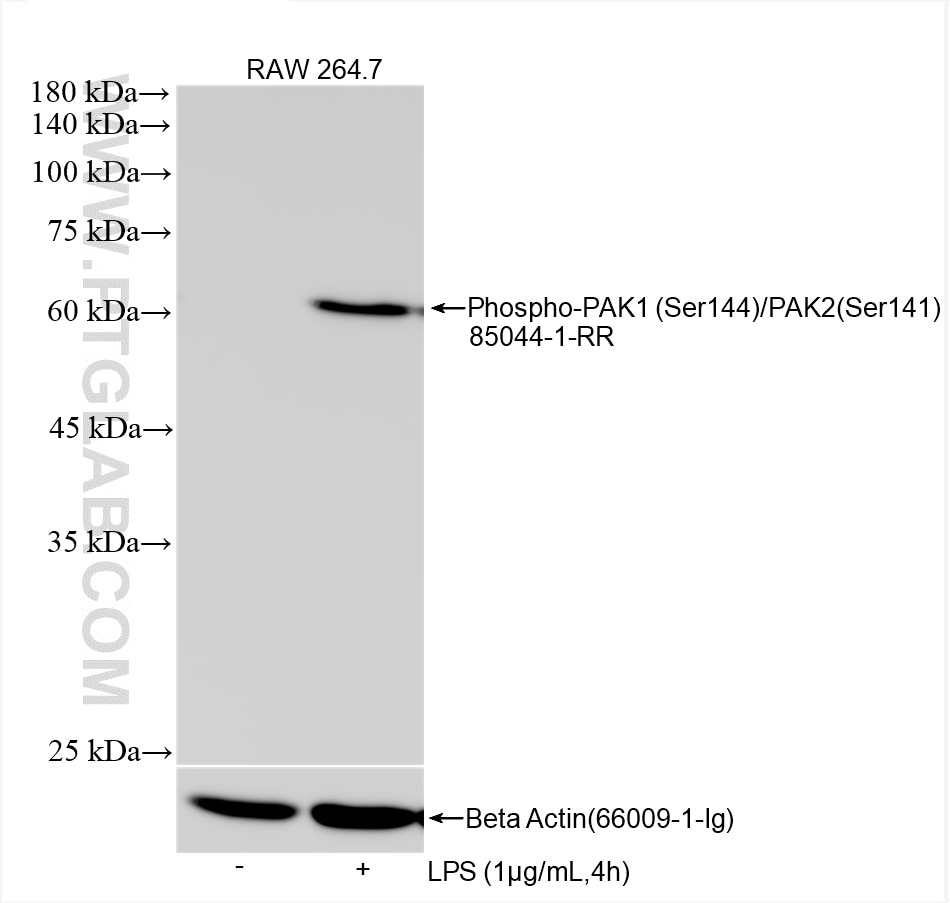
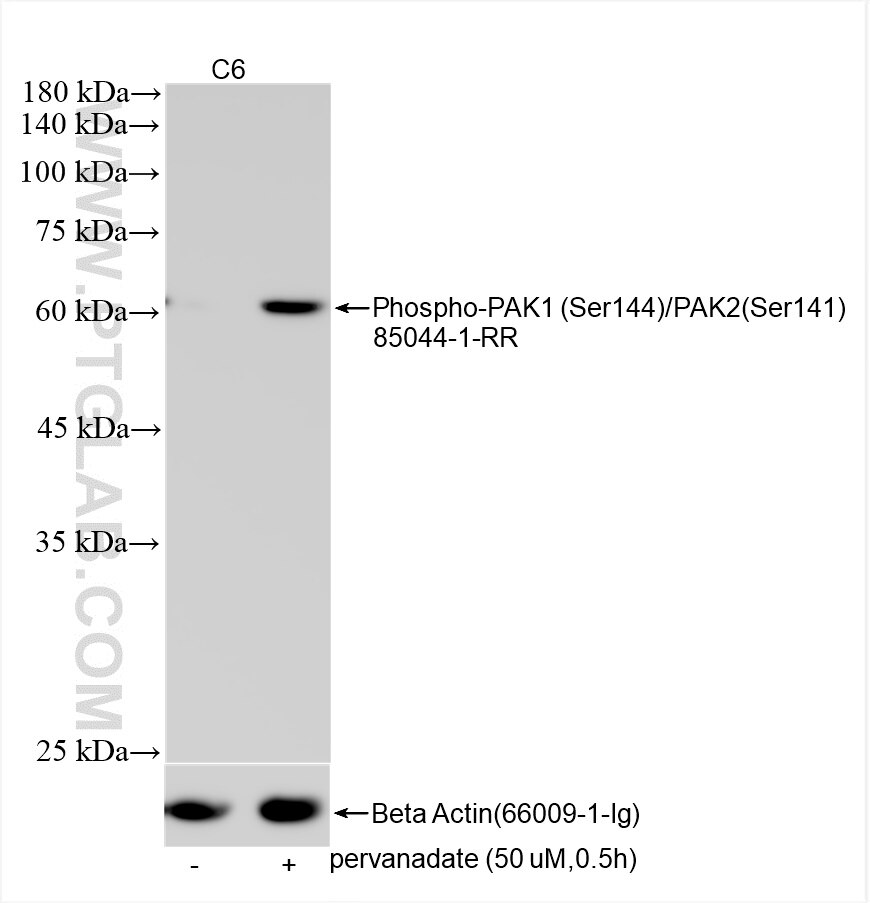
Galerie de données de validation
Informations sur le produit
85044-1-PBS cible Phospho-PAK1 (Ser144)/PAK2 (Ser141) dans les applications de WB, Indirect ELISA et montre une réactivité avec des échantillons Humain, rat, souris
| Réactivité | Humain, rat, souris |
| Hôte / Isotype | Lapin / IgG |
| Clonalité | Recombinant |
| Type | Anticorps |
| Immunogène | Peptide |
| Nom complet | p21 protein (Cdc42/Rac)-activated kinase 1 |
| Masse moléculaire calculée | 553 aa, 62 kDa |
| Poids moléculaire observé | 61 kDa |
| Numéro d’acquisition GenBank | BC109299 |
| Symbole du gène | PAK1 |
| Identification du gène (NCBI) | 5058 |
| Conjugaison | Non conjugué |
| Forme | Liquide |
| Méthode de purification | Protein A purfication |
| Tampon de stockage | PBS only |
| Conditions de stockage | Store at -80°C. 20ul contiennent 0,1% de BSA. |
Informations générales
The human PAK family is divided into the group I (PAK1 to PAK3) and group II (PAK4 to PAK6). Group I PAK share some domains that are not present in the group II members. In particular, the autoinhibitory domain (AID) is important for regulation of the kinase activity of the group I family members. Autophosphorylation at PAK1 Ser144, or at the equivalent sites for the other PAK, stabilizes the open conformation and sustains high kinase activity. Mutation of tyrosines 131 or 429 is associated with reduced dimerization and enhanced kinase activity. (PMID: 31748572)


