Anticorps Recombinant de lapin anti-Podoplanin
Podoplanin Recombinant Antibody for FC
Hôte / Isotype
Lapin / IgG
Réactivité testée
souris
Applications
FC
Conjugaison
Non conjugué
CloneNo.
250618A2
N° de cat : 98492-3-PBS
Synonymes
Galerie de données de validation
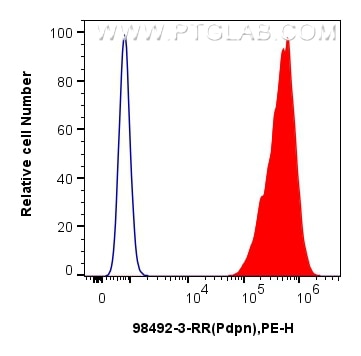
Informations sur le produit
98492-3-PBS cible Podoplanin dans les applications de FC et montre une réactivité avec des échantillons souris
| Réactivité | souris |
| Hôte / Isotype | Lapin / IgG |
| Clonalité | Recombinant |
| Type | Anticorps |
| Immunogène | Podoplanin Protéine recombinante Eg2861 |
| Nom complet | podoplanin |
| Masse moléculaire calculée | 18 kDa |
| Numéro d’acquisition GenBank | NM_010329.3 |
| Symbole du gène | Pdpn |
| Identification du gène (NCBI) | 14726 |
| Conjugaison | Non conjugué |
| Forme | Liquide |
| Méthode de purification | Purification par protéine A |
| Tampon de stockage | PBS only |
| Conditions de stockage | Store at -80°C. |
Informations générales
Podoplanin was identified as a glycoprotein found in the cell membranes of glomerular epithelial cells (podocyte) (PMID: 9327748). It is a lymphatic marker because the expression of podoplanin has been detected in lymphatic but not blood vascular endothelium, and is useful as the marker of tumor-associated Lymphangiogenesis. Podoplanin has a function in developing testis, most likely at the level of cell-cell interactions among pre-meiotic germ cells and immature Sertoli cells. It may be involved in cell migration and/or actin cytoskeleton organization. When expressed in keratinocytes, Podoplanin induces changes in cell morphology with transfected cells showing an elongated shape, numerous membrane protrusions, major reorganization of the actin cytoskeleton, increased motility and decreased cell adhesion. It is required for normal lung cell proliferation and alveolus formation at birth. Podoplanin induces platelet aggregation. It does not have any effect on folic acid or amino acid transport and does not function as a water channel or as a regulator of aquaporin-type water channels.


