Anticorps Recombinant de lapin anti-Prolactin
Prolactin Recombinant Antibody for WB, IHC, IF-P, ELISA
Hôte / Isotype
Lapin / IgG
Réactivité testée
Humain, souris
Applications
WB, IHC, IF-P, ELISA
Conjugaison
Non conjugué
CloneNo.
242898A8
N° de cat : 85765-3-RR
Synonymes
Galerie de données de validation
Applications testées
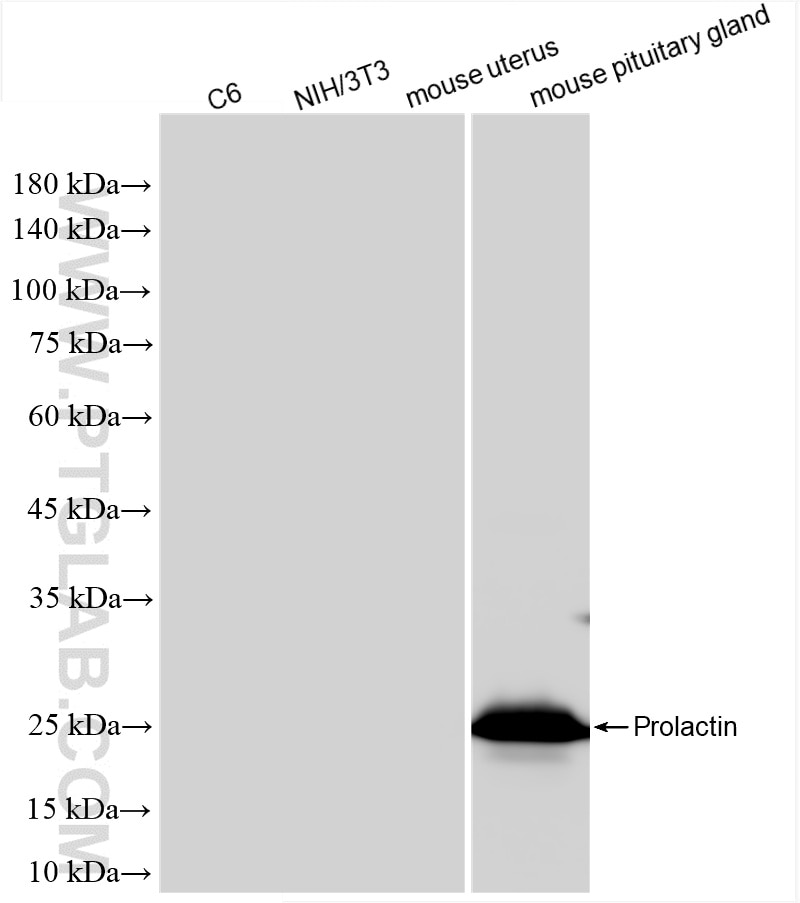
| Résultats positifs en WB | mouse pituitary gland tissue, cellules NIH/3T3, tissu utérin de souris |
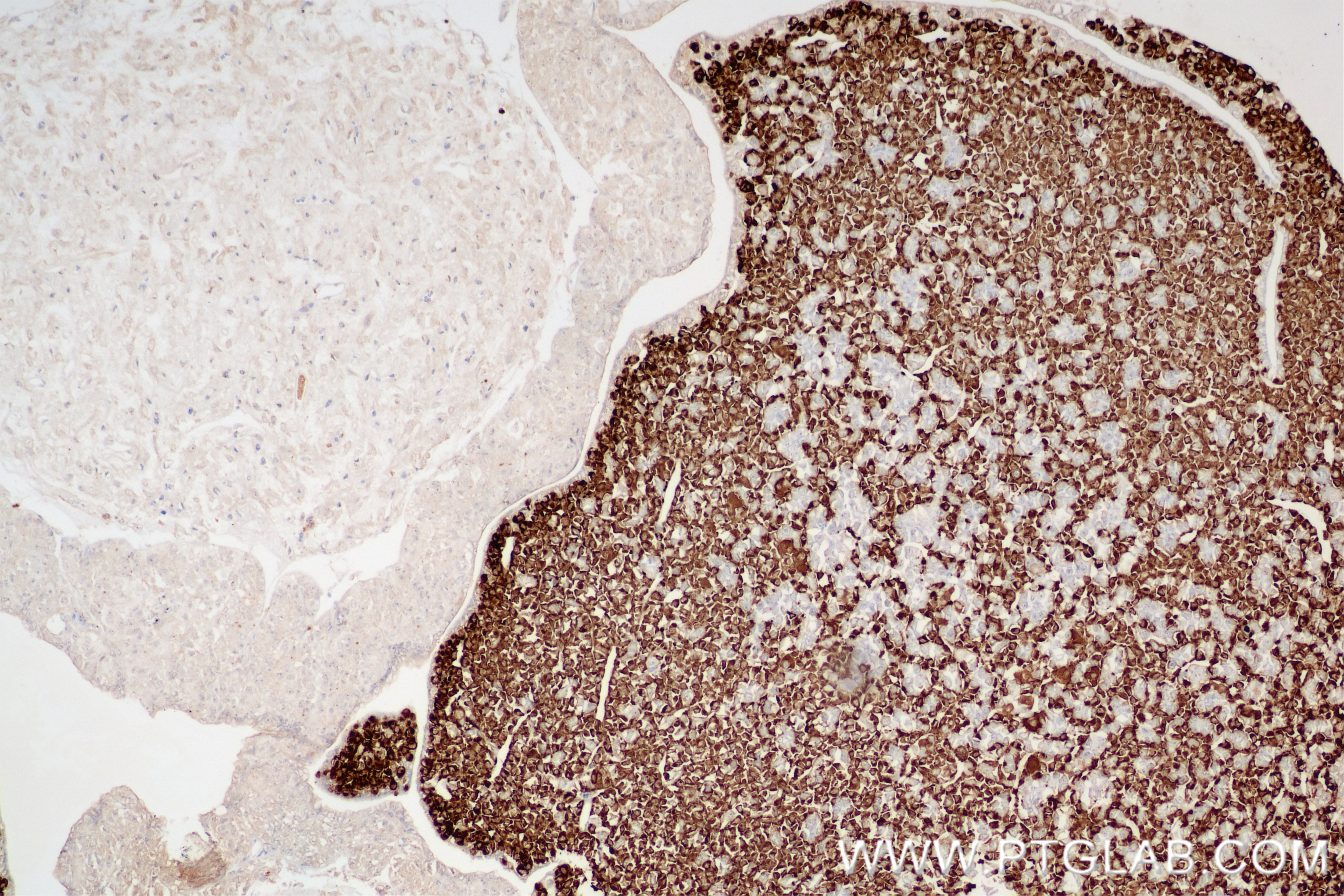
| Résultats positifs en IHC | mouse pituitary gland tissue, il est suggéré de démasquer l'antigène avec un tampon de TE buffer pH 9.0; (*) À défaut, 'le démasquage de l'antigène peut être 'effectué avec un tampon citrate pH 6,0. |
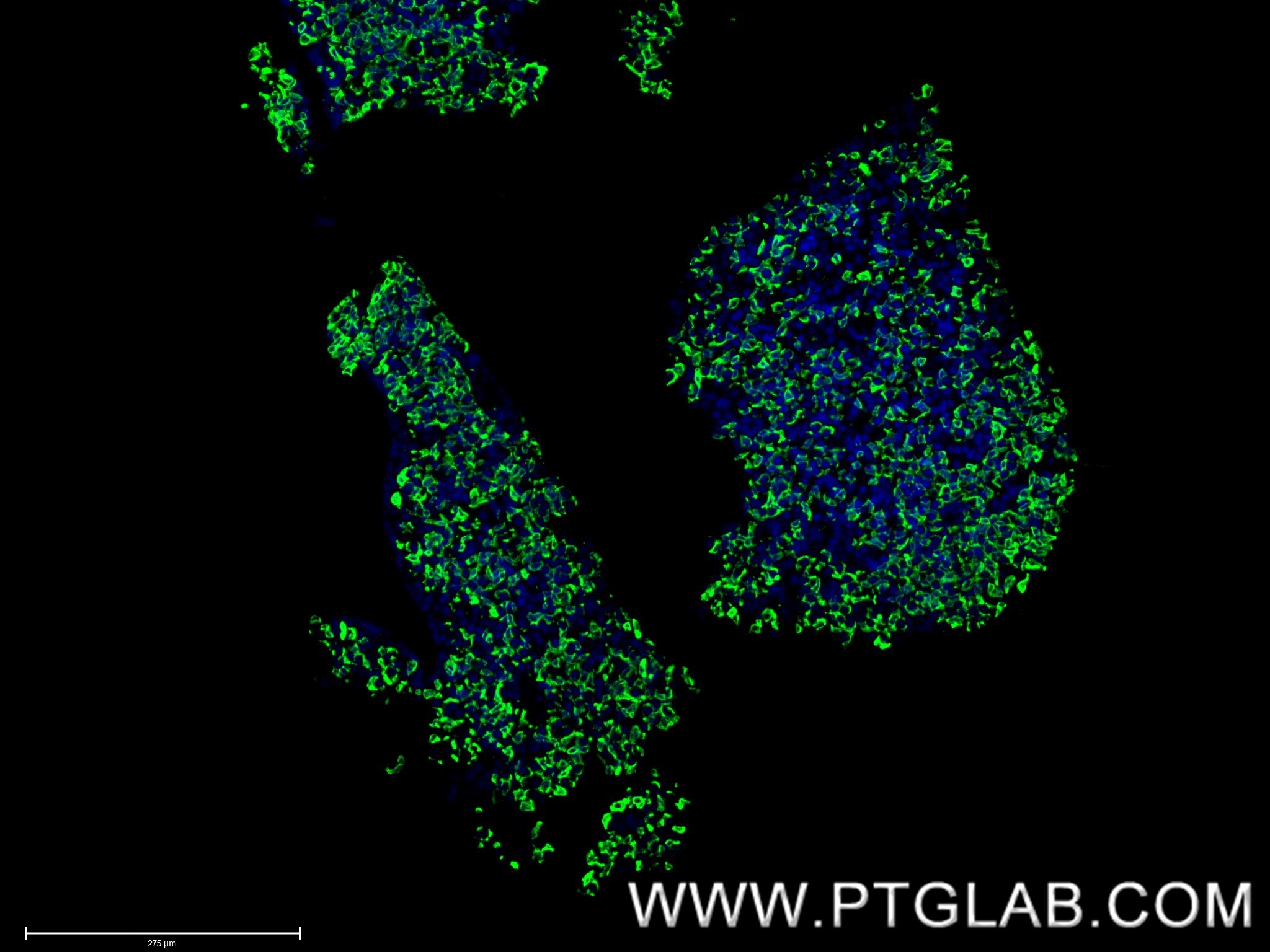
| Résultats positifs en IF-P | mouse pituitary gland tissue, |
Dilution recommandée
| Application | Dilution |
|---|---|
| Western Blot (WB) | WB : 1:5000-1:50000 |
| Immunohistochimie (IHC) | IHC : 1:500-1:2000 |
| Immunofluorescence (IF)-P | IF-P : 1:500-1:2000 |
| It is recommended that this reagent should be titrated in each testing system to obtain optimal results. | |
| Sample-dependent, check data in validation data gallery | |
Informations sur le produit
85765-3-RR cible Prolactin dans les applications de WB, IHC, IF-P, ELISA et montre une réactivité avec des échantillons Humain, souris
| Réactivité | Humain, souris |
| Hôte / Isotype | Lapin / IgG |
| Clonalité | Recombinant |
| Type | Anticorps |
| Immunogène | Prolactin Protéine recombinante Ag9764 |
| Nom complet | prolactin |
| Masse moléculaire calculée | 227 aa, 26 kDa |
| Poids moléculaire observé | 26 kDa |
| Numéro d’acquisition GenBank | BC015850 |
| Symbole du gène | Prolactin/PRL |
| Identification du gène (NCBI) | 5617 |
| Conjugaison | Non conjugué |
| Forme | Liquide |
| Méthode de purification | Purification par protéine A |
| Tampon de stockage | PBS with 0.02% sodium azide and 50% glycerol |
| Conditions de stockage | Stocker à -20°C. Stable pendant un an après l'expédition. L'aliquotage n'est pas nécessaire pour le stockage à -20oC Les 20ul contiennent 0,1% de BSA. |
Informations générales
Prolactin is also named as PRL and belongs to the somatotropin/prolactin family. The proteins encoded by PRL are secreted into the cell surroundings. And they are abundantly expressed in pituitary gland, adenohypophysis, decidua and testis. Indeed, chemically, prolactin appears in a multiplicity of posttranslational forms ranging from size variants to chemical modifications such as phosphorylation or glycosylation. It is not only synthesized in the pituitary gland, as originally described, but also within the central nervous system, the immune system, the uterus and its associated tissues of conception, and even the mammary gland itself (PMID: 11015620). Prolactin acts primarily on the mammary gland by promoting lactation (PMID: 30546056). The major form of prolactin found in the pituitary gland is 23 kDa, variants of prolactin have been characterized in many mammals, including humans. Of the cleaved forms that have been characterized, 14 kDa, 16 kDa, and 22 kDa prolactin variants have been most widely studied (PMID: 7937959) (PMID: 8425495).
Protocole
| Product Specific Protocols | |
|---|---|
| WB protocol for Prolactin antibody 85765-3-RR | Download protocol |
| IHC protocol for Prolactin antibody 85765-3-RR | Download protocol |
| IF protocol for Prolactin antibody 85765-3-RR | Download protocol |
| Standard Protocols | |
|---|---|
| Click here to view our Standard Protocols |


