Anticorps Polyclonal de lapin anti-RBP4
RBP4 Polyclonal Antibody for WB, ELISA
Hôte / Isotype
Lapin / IgG
Réactivité testée
rat, souris
Applications
WB, ELISA
Conjugaison
Non conjugué
N° de cat : 32392-1-AP
Synonymes
Galerie de données de validation
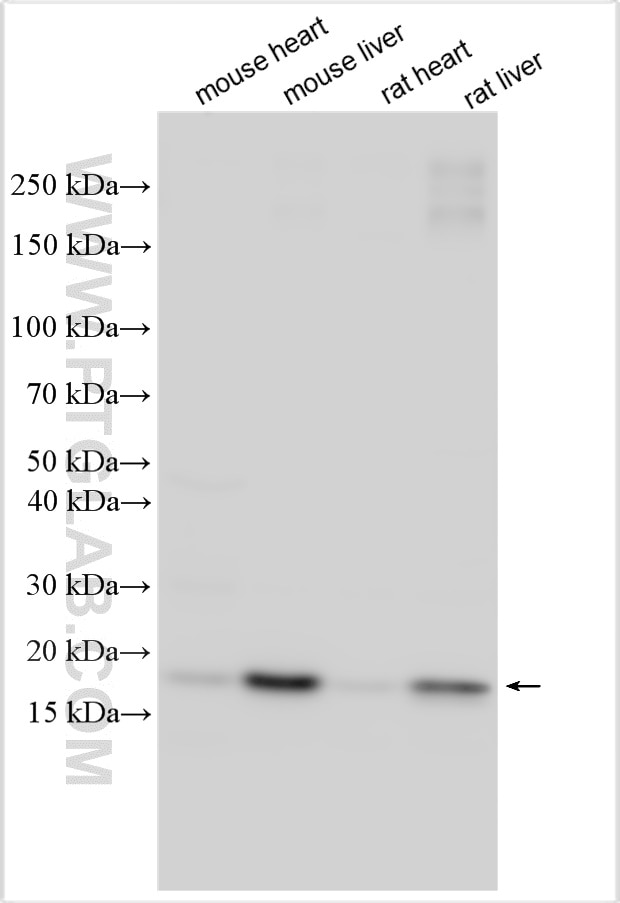
Applications testées
| Résultats positifs en WB | tissu cardiaque de souris, tissu cardiaque de rat, tissu hépatique de rat, tissu hépatique de souris |
Dilution recommandée
| Application | Dilution |
|---|---|
| Western Blot (WB) | WB : 1:500-1:3000 |
| It is recommended that this reagent should be titrated in each testing system to obtain optimal results. | |
| Sample-dependent, check data in validation data gallery | |
Informations sur le produit
32392-1-AP cible RBP4 dans les applications de WB, ELISA et montre une réactivité avec des échantillons rat, souris
| Réactivité | rat, souris |
| Hôte / Isotype | Lapin / IgG |
| Clonalité | Polyclonal |
| Type | Anticorps |
| Immunogène | RBP4 Protéine recombinante Eg1140 |
| Nom complet | retinol binding protein 4, plasma |
| Masse moléculaire calculée | 23kDa |
| Poids moléculaire observé | 17-21 kDa |
| Numéro d’acquisition GenBank | NM_011255.3 |
| Symbole du gène | Rbp4 |
| Identification du gène (NCBI) | 19662 |
| Conjugaison | Non conjugué |
| Forme | Liquide |
| Méthode de purification | Purification par affinité contre l'antigène |
| Tampon de stockage | PBS with 0.02% sodium azide and 50% glycerol |
| Conditions de stockage | Stocker à -20°C. Stable pendant un an après l'expédition. L'aliquotage n'est pas nécessaire pour le stockage à -20oC Les 20ul contiennent 0,1% de BSA. |
Informations générales
RBP4 (retinol-binding protein 4) is a carrier protein that transports vitamin A (retinol) from the liver to the peripheral tissues. Synthesized primarily by hepatocytes and adipocytes as a 21 kDa non-glycosylated protein, RBP4 is secreted into the circulation as a retinol-RBP4 complex. In plasma the RBP4-retinol complex is bound to transthyretin (TRR), which prevents prevent kidney filtration. Two truncated forms of RBP4, RBP4-L (truncated at Leu-183) and RBP4-LL (truncated at Leu-182 and Leu-183), exist by proteolytic process. RBP4-L and RBP4-LL, which do not bind TTR, are normally excreted into the urine but accumulate in the serum during renal failure. Urinary RBP4 has been reported as marker for glomerular disease. RBP4 also was identified as an adipokine that elevated in some INS-resistant states. Measurement of serum RBP4 could be used to assess the risk of INS resistance, type 2 diabetes, obesity, and cardiovascular disease. (18752671, 16034410)
Protocole
| Product Specific Protocols | |
|---|---|
| WB protocol for RBP4 antibody 32392-1-AP | Download protocol |
| Standard Protocols | |
|---|---|
| Click here to view our Standard Protocols |

