- Phare
- Validé par KD/KO
Anticorps Monoclonal anti-REDD1
REDD1 Monoclonal Antibody for WB, Indirect ELISA
Hôte / Isotype
Mouse / IgG1
Réactivité testée
Humain, souris
Applications
WB, Indirect ELISA
Conjugaison
Non conjugué
CloneNo.
3A2C10
N° de cat : 67059-1-PBS
Synonymes
Galerie de données de validation
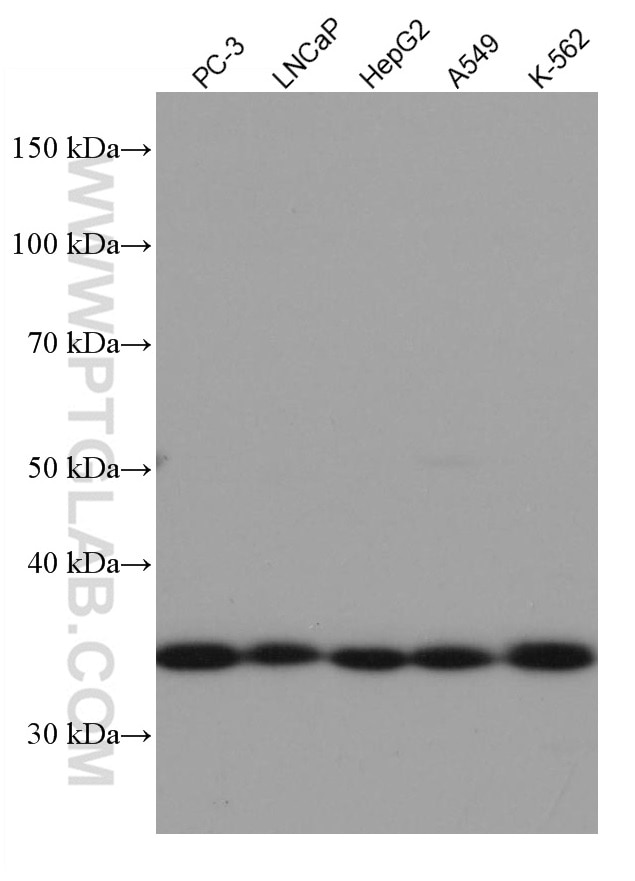
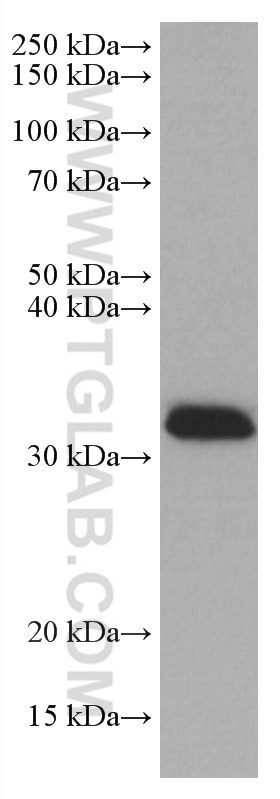
Informations sur le produit
67059-1-PBS cible REDD1 dans les applications de WB, Indirect ELISA et montre une réactivité avec des échantillons Humain, souris
| Réactivité | Humain, souris |
| Hôte / Isotype | Mouse / IgG1 |
| Clonalité | Monoclonal |
| Type | Anticorps |
| Immunogène | REDD1 Protéine recombinante Ag0965 |
| Nom complet | DNA-damage-inducible transcript 4 |
| Masse moléculaire calculée | 25 kDa |
| Poids moléculaire observé | 32-35 kDa |
| Numéro d’acquisition GenBank | BC007714 |
| Symbole du gène | REDD1/DDIT4 |
| Identification du gène (NCBI) | 54541 |
| Conjugaison | Non conjugué |
| Forme | Liquide |
| Méthode de purification | Purification par protéine G |
| Tampon de stockage | PBS only |
| Conditions de stockage | Store at -80°C. 20ul contiennent 0,1% de BSA. |
Informations générales
REDD1, also named as RTP801 and DDIT4, belongs to the DDIT4 family. REDD1 promotes neuronal cell death. It is a novel transcriptional target of p53 implicated ROS in the p53-dependent DNA damage response. REDD1 controlled cell growth under energy stress, as an essential regulator of TOR activity through the TSC1/2 complex. REDD-1 expression has also been linked to apoptosis, Aβ toxicity and the pathogenesis of ischemic diseases. As an HIF-1-responsive gene, REDD-1 exhibits strong hypoxia-dependent upregulation in ischemic cells of neuronal origin[PMID: 19996311]. In response to stress due to DNA damage and glucocorticoid treatment, REDD-1 is upregulated at the transcriptional level[PMID: 21733849]. REDD-1 negatively regulates the mammalian target of Rapamycin, a serine/threonine kinase often referred to as mTOR[PMID: 22951983]. It is crucial in the coupling of extra- and intracellular cues to mTOR regulation. The absence of REDD-1 is associated with the development of retinopathy, a major cause of blindness[PMID: 22304497]. REDD1 is a new host defense factor, and chemical activation of REDD1 expression represents a potent antiviral intervention strategy[PMID: 21909097]. The calculated molecular weight of REDD1 is 25 kDa. Because of multiple lysines in the proteins, REDD1 offen migrates around 35 kDa on Western blot[PMID: 19221489].


