Anticorps Polyclonal de lapin anti-RETSAT
RETSAT Polyclonal Antibody for WB, Indirect ELISA
Hôte / Isotype
Lapin / IgG
Réactivité testée
Humain
Applications
WB, Indirect ELISA
Conjugaison
Non conjugué
N° de cat : 16895-1-PBS
Synonymes
Galerie de données de validation
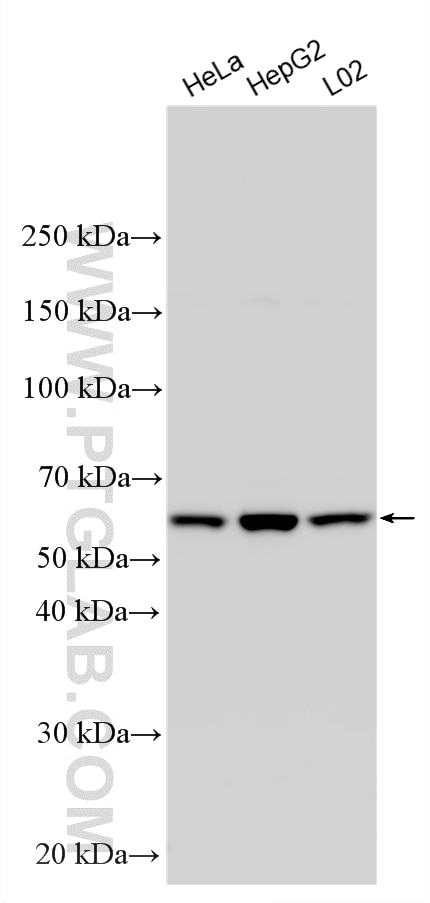
Informations sur le produit
16895-1-PBS cible RETSAT dans les applications de WB, Indirect ELISA et montre une réactivité avec des échantillons Humain
| Réactivité | Humain |
| Hôte / Isotype | Lapin / IgG |
| Clonalité | Polyclonal |
| Type | Anticorps |
| Immunogène | RETSAT Protéine recombinante Ag10420 |
| Nom complet | retinol saturase (all-trans-retinol 13,14-reductase) |
| Masse moléculaire calculée | 610 aa, 69 kDa |
| Poids moléculaire observé | 62-67 kDa |
| Numéro d’acquisition GenBank | BC011418 |
| Symbole du gène | RETSAT |
| Identification du gène (NCBI) | 54884 |
| Conjugaison | Non conjugué |
| Forme | Liquide |
| Méthode de purification | Purification par affinité contre l'antigène |
| Tampon de stockage | PBS only |
| Conditions de stockage | Store at -80°C. 20ul contiennent 0,1% de BSA. |
Informations générales
RETSAT (Retinol Saturase) is an enzyme-encoding gene that plays a critical role in cellular metabolism, primarily involved in the saturation of retinol (vitamin A) and other molecules. It catalyzes the conversion of all-trans-retinol to all-trans-13,14-dihydroretinol, a process that links vitamin A metabolism to lipid and glucose homeostasis. It is highly expressed in the liver, adipose tissue, and kidney and is regulated by the PPARγ master regulator of adipogenesis (PMID: 28855500; 38128827). RETSAT also has a role in cancer cell survival, particularly in hypoxic tumor environments, by enhancing resistance to replication stress (PMID: 36109793).


