Anticorps Polyclonal de lapin anti-RGS9
RGS9 Polyclonal Antibody for WB, Indirect ELISA
Hôte / Isotype
Lapin / IgG
Réactivité testée
Humain, rat, souris
Applications
WB, Indirect ELISA
Conjugaison
Non conjugué
N° de cat : 17970-1-PBS
Synonymes
Galerie de données de validation
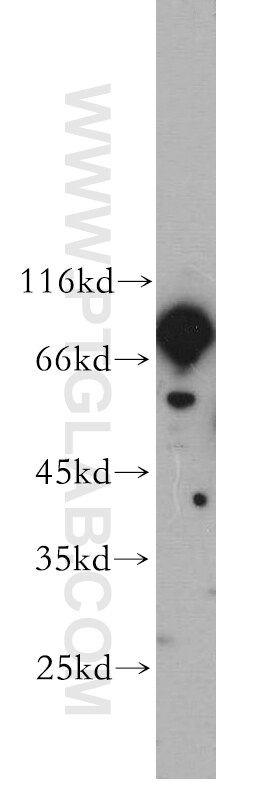
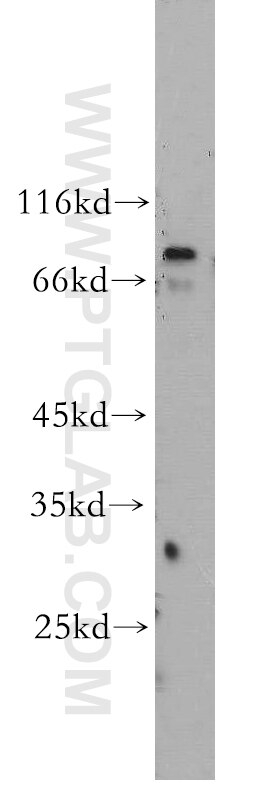
Informations sur le produit
17970-1-PBS cible RGS9 dans les applications de WB, Indirect ELISA et montre une réactivité avec des échantillons Humain, rat, souris
| Réactivité | Humain, rat, souris |
| Hôte / Isotype | Lapin / IgG |
| Clonalité | Polyclonal |
| Type | Anticorps |
| Immunogène | RGS9 Protéine recombinante Ag11976 |
| Nom complet | regulator of G-protein signaling 9 |
| Masse moléculaire calculée | 622 aa, 71 kDa |
| Poids moléculaire observé | 58 kDa, 70-75 kDa |
| Numéro d’acquisition GenBank | BC022504 |
| Symbole du gène | RGS9 |
| Identification du gène (NCBI) | 8787 |
| Conjugaison | Non conjugué |
| Forme | Liquide |
| Méthode de purification | Purification par affinité contre l'antigène |
| Tampon de stockage | PBS only |
| Conditions de stockage | Store at -80°C. 20ul contiennent 0,1% de BSA. |
Informations générales
RGS9 is a member of the RGS family of signaling proteins that suppress the activity of G proteins by promoting their deactivation. There are two splice isoforms of RGS9 with quite different properties and patterns of expression. RGS9-1 is mainly found in the eye and is involved in regulation of phototransduction in rod and cone cells of the retina, while RGS9-2 is is expressed specifically in the striatum, a brain region involved in controlling movement, motivation, mood and addition. This antibody got about 58kD in the mouse eye and 70kD in the mouse brain in western blotting, both in line with their expected masses. Defects in RGS9 are a cause of prolonged electroretinal response suppression (PERRS).


