Anticorps Recombinant de lapin anti-RNF20
RNF20 Recombinant Antibody for WB, IF/ICC, Indirect ELISA
Hôte / Isotype
Lapin / IgG
Réactivité testée
Humain, souris
Applications
WB, IF/ICC, Indirect ELISA
Conjugaison
Non conjugué
CloneNo.
243078G12
N° de cat : 85630-6-PBS
Synonymes
Galerie de données de validation
Informations sur le produit
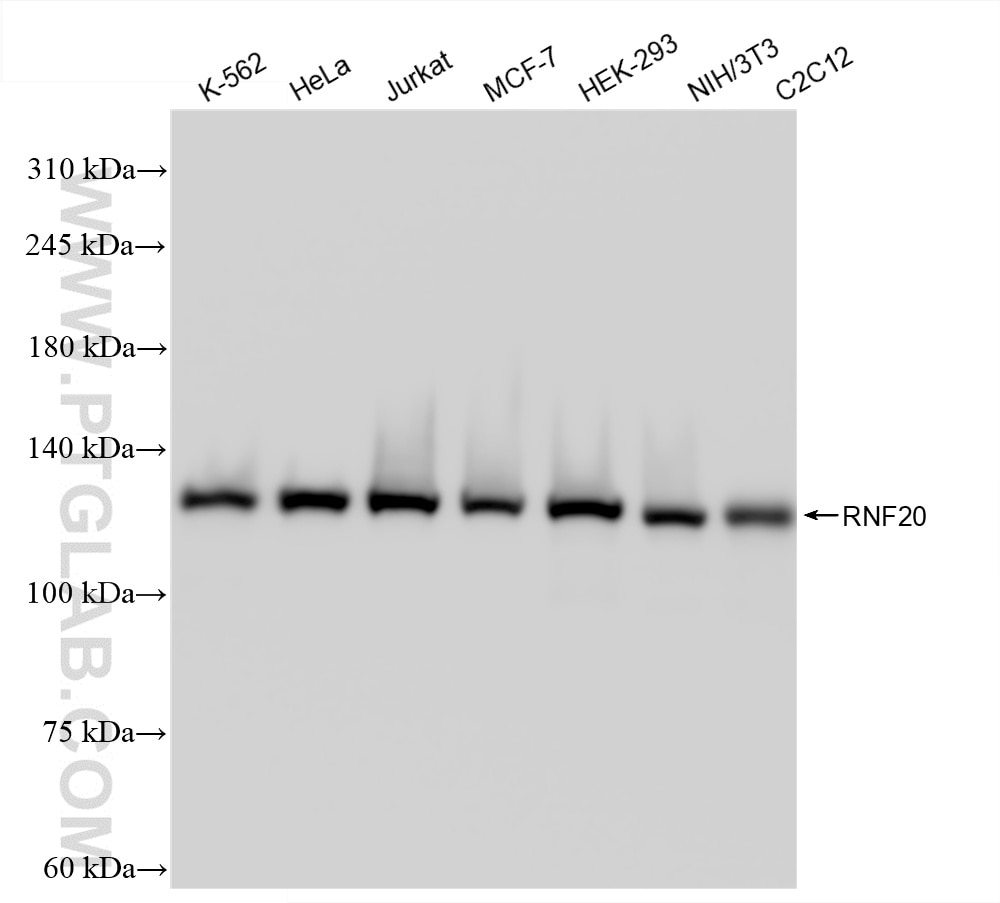
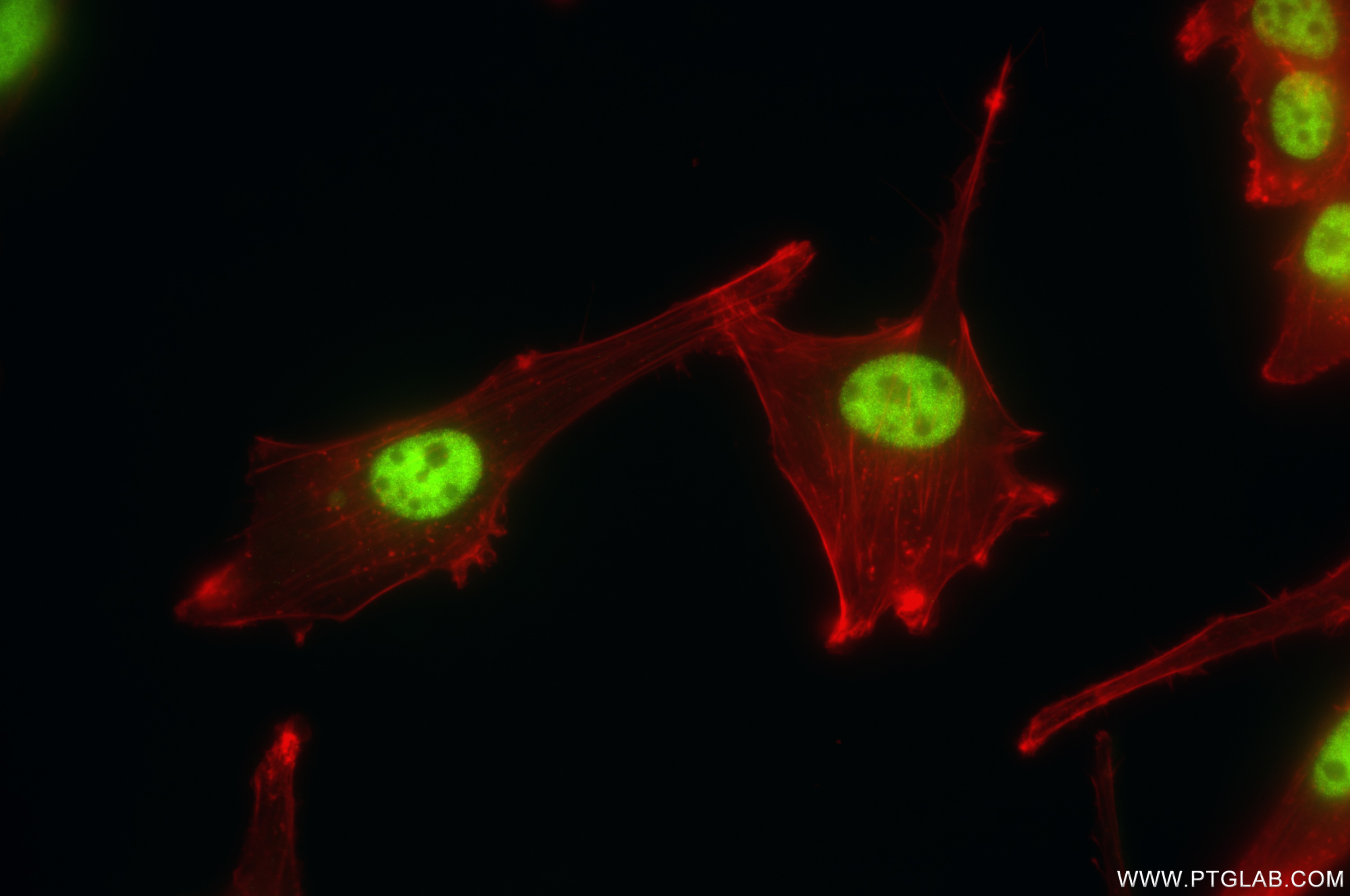
85630-6-PBS cible RNF20 dans les applications de WB, IF/ICC, Indirect ELISA et montre une réactivité avec des échantillons Humain, souris
| Réactivité | Humain, souris |
| Hôte / Isotype | Lapin / IgG |
| Clonalité | Recombinant |
| Type | Anticorps |
| Immunogène | RNF20 Protéine recombinante Ag16066 |
| Nom complet | ring finger protein 20 |
| Masse moléculaire calculée | 975 aa, 114 kDa |
| Poids moléculaire observé | 114 kDa |
| Numéro d’acquisition GenBank | BC110585 |
| Symbole du gène | RNF20 |
| Identification du gène (NCBI) | 56254 |
| Conjugaison | Non conjugué |
| Forme | Liquide |
| Méthode de purification | Purification par protéine A |
| Tampon de stockage | PBS only |
| Conditions de stockage | Store at -80°C. 20ul contiennent 0,1% de BSA. |
Informations générales
RNF20, also named as E3 ubiquitin-protein ligase BRE1A, is a 975 amino acid protein, which contains 1 RING-type zinc finger and belongs to the BRE1 family. RNF20 is a component of the RNF20/40 complex and localizes in the nucleus. RNF20 is a component of the RNF20/40 E3 ubiquitin-protein ligase complex that mediates monoubiquitination of 'Lys-120' of histone H2B (H2BK120ub1). H2BK120ub1 gives a specific tag for epigenetic transcriptional activation and is also prerequisite for histone H3 'Lys-4' and 'Lys-79' methylation (H3K4me and H3K79me, respectively). The RNF20/40 complex forms a H2B ubiquitin ligase complex in cooperation with the E2 enzyme UBE2A or UBE2B. RNF20 is required for transcriptional activation of Hox genes and recruited to the MDM2 promoter, probably by being recruited by p53/TP53, and thereby acts as a transcriptional coactivator. RNF20/40 complex monoubiquitinates and stabilizes Eg5. Loss of RNF20/40 results in spindle assembly defects, cell cycle arrest and apoptosis. Spindle assembly role of the RNF20/40 complex, and implicates the RNF20/40-Eg5 axis in breast carcinogenesis, supporting the pursuit of these proteins as potential targets for breast cancer therapeutic interventions.


