Anticorps Recombinant de lapin anti-SAMD4A
SAMD4A Recombinant Antibody for WB, Indirect ELISA
Hôte / Isotype
Lapin / IgG
Réactivité testée
Humain, rat, souris
Applications
WB, Indirect ELISA
Conjugaison
Non conjugué
CloneNo.
251369F11
N° de cat : 86530-1-PBS
Synonymes
Galerie de données de validation
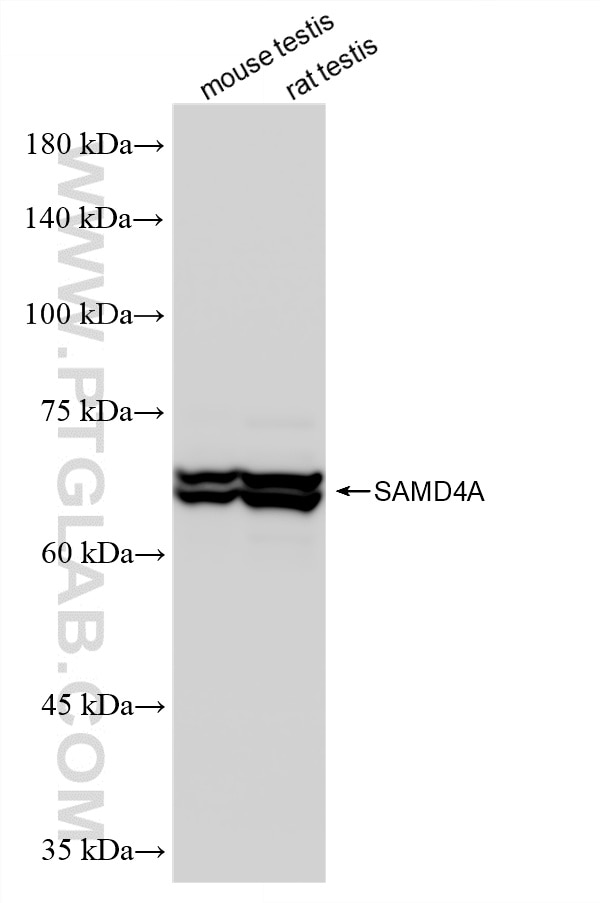
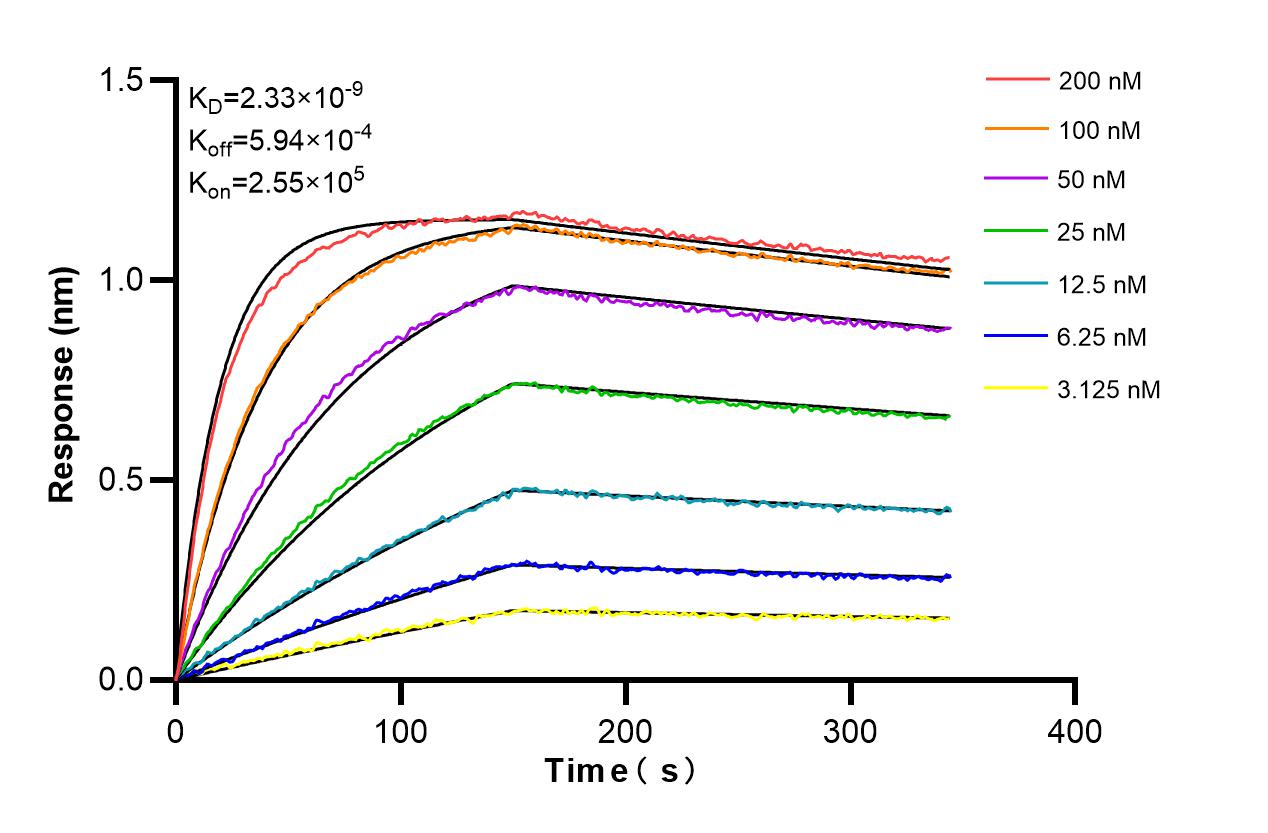
Informations sur le produit
86530-1-PBS cible SAMD4A dans les applications de WB, Indirect ELISA et montre une réactivité avec des échantillons Humain, rat, souris
| Réactivité | Humain, rat, souris |
| Hôte / Isotype | Lapin / IgG |
| Clonalité | Recombinant |
| Type | Anticorps |
| Immunogène | SAMD4A Protéine recombinante Ag11273 |
| Nom complet | sterile alpha motif domain containing 4A |
| Masse moléculaire calculée | 529 aa, 59 kDa |
| Poids moléculaire observé | 70-71 kDa |
| Numéro d’acquisition GenBank | BC021726 |
| Symbole du gène | SAMD4A |
| Identification du gène (NCBI) | 23034 |
| Conjugaison | Non conjugué |
| Forme | Liquide |
| Méthode de purification | Purification par protéine A |
| Tampon de stockage | PBS only |
| Conditions de stockage | Store at -80°C. 20ul contiennent 0,1% de BSA. |
Informations générales
SAMD4A is also named as KIAA1053, SAMD4, SMAUG1, hSmaug1 and belongs to the SMAUG family. SAMD4A acts as a translational repressor of SRE-containing messengers. (PMID:16221671). In particular, as orthologous alternative splicing isoforms, mouse Samd4a E-form and human SAMD4A C-form containing the SAM domain were specific to testes. Samd4a/SAMD4A plays an essential role in normal spermatogenesis, and SAMD4A, as a spermatid specific marker, can be used for subcategorizing nonobstructive azoospermia patients (PMID:36274854). In mammalian cells, human SAMD4A can form a kind of mRNA‐silencing foci in the cytoplasm, acting differently from processing body and stress granules. Recently, it was reported that human SAMD4A can protect the host from viral infection by degrading viral RNA (PMID: 32341522). Indition, 14-3-3s negatively regulate the localization of the RNA-binding protein SAMD4A to cytoplasmic granules and inhibit its activity as a translational repressor (PMID: 36931259).


