Anticorps Polyclonal de lapin anti-SCAI
SCAI Polyclonal Antibody for WB, Indirect ELISA
Hôte / Isotype
Lapin / IgG
Réactivité testée
Humain, rat, souris
Applications
WB, Indirect ELISA
Conjugaison
Non conjugué
N° de cat : 33449-1-PBS
Synonymes
Galerie de données de validation
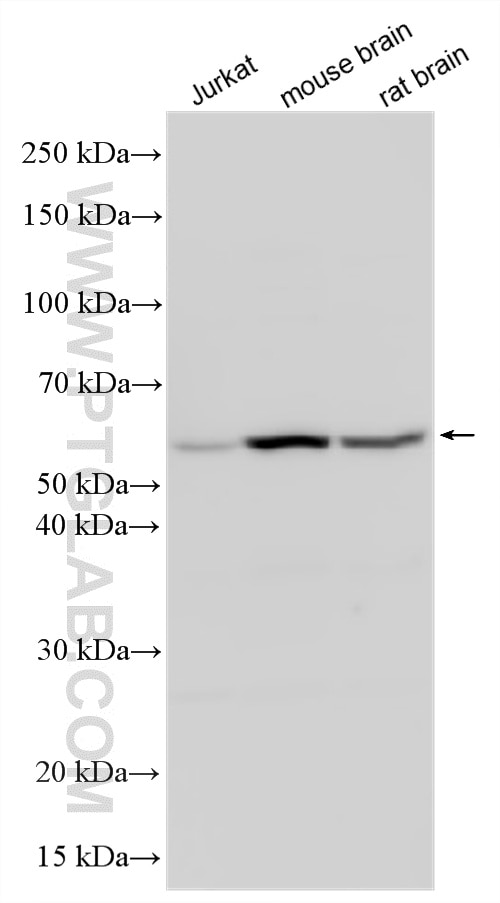
Informations sur le produit
33449-1-PBS cible SCAI dans les applications de WB, Indirect ELISA et montre une réactivité avec des échantillons Humain, rat, souris
| Réactivité | Humain, rat, souris |
| Hôte / Isotype | Lapin / IgG |
| Clonalité | Polyclonal |
| Type | Anticorps |
| Immunogène | SCAI Protéine recombinante Ag38169 |
| Nom complet | chromosome 9 open reading frame 126 |
| Masse moléculaire calculée | 70kDa,606aa |
| Poids moléculaire observé | 60 kDa |
| Numéro d’acquisition GenBank | NM_001144877.2 |
| Symbole du gène | C9orf126 |
| Identification du gène (NCBI) | 286205 |
| Conjugaison | Non conjugué |
| Forme | Liquide |
| Méthode de purification | Purification par affinité contre l'antigène |
| Tampon de stockage | PBS only |
| Conditions de stockage | Store at -80°C. 20ul contiennent 0,1% de BSA. |
Informations générales
SCAI (suppressor of cancer cell invasion) is a conserved protein that regulates invasive cell migration through three-dimensional matrices. SCAI acts on the RhoA-Dia1 signal transduction pathway and localizes in the nucleus, where it binds and inhibits the myocardin-related transcription factor MAL by forming a ternary complex with serum response factor (SRF). Genome-wide expression analysis surprisingly reveals that one of the strongest upregulated genes after suppression of SCAI is beta1-integrin. Decreased levels of SCAI are tightly correlated with increased invasive cell migration, and SCAI is downregulated in several human tumours. Functional analysis of the beta1-integrin gene strongly argues that SCAI is a novel transcriptional cofactor that controls gene expression downstream of Dia1 to dictate changes in cell invasive behaviour (PMID: 19350017).


