- Phare
- Validé par KD/KO
Anticorps Monoclonal anti-SIRT6
SIRT6 Monoclonal Antibody for WB, Indirect ELISA
Hôte / Isotype
Mouse / IgG1
Réactivité testée
Humain, souris
Applications
WB, Indirect ELISA
Conjugaison
Non conjugué
CloneNo.
2H4G8
N° de cat : 67510-1-PBS
Synonymes
Galerie de données de validation
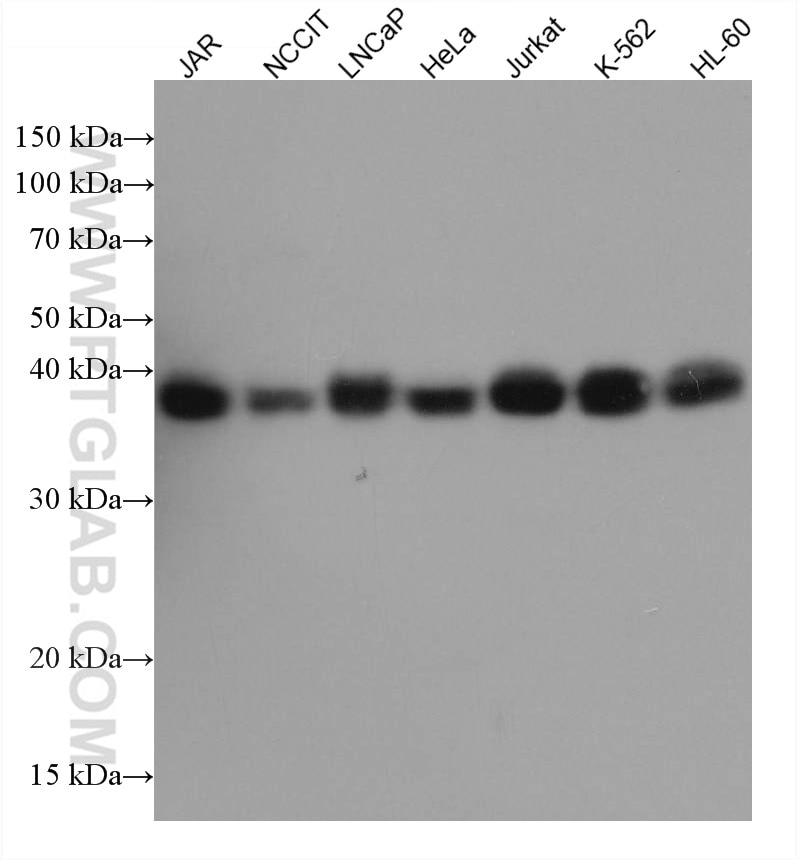
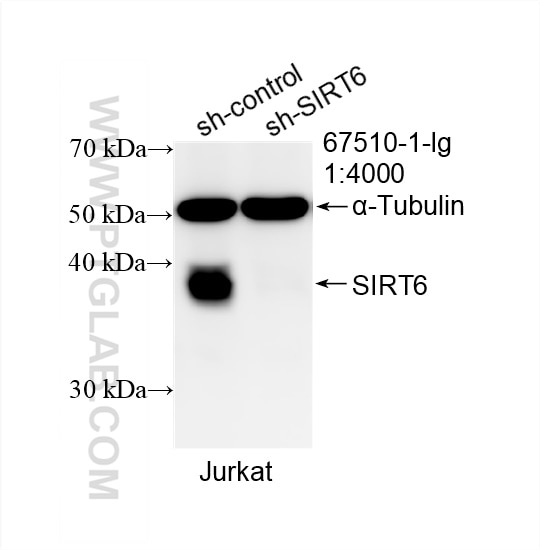
Informations sur le produit
67510-1-PBS cible SIRT6 dans les applications de WB, Indirect ELISA et montre une réactivité avec des échantillons Humain, souris
| Réactivité | Humain, souris |
| Hôte / Isotype | Mouse / IgG1 |
| Clonalité | Monoclonal |
| Type | Anticorps |
| Immunogène | SIRT6 Protéine recombinante Ag24103 |
| Nom complet | sirtuin (silent mating type information regulation 2 homolog) 6 (S. cerevisiae) |
| Masse moléculaire calculée | 39 kDa |
| Poids moléculaire observé | 40 kDa |
| Numéro d’acquisition GenBank | BC028220 |
| Symbole du gène | SIRT6 |
| Identification du gène (NCBI) | 51548 |
| Conjugaison | Non conjugué |
| Forme | Liquide |
| Méthode de purification | Purification par protéine G |
| Tampon de stockage | PBS only |
| Conditions de stockage | Store at -80°C. 20ul contiennent 0,1% de BSA. |
Informations générales
SIRT6, also named as SIR2L6, belongs to the sirtuin family. It is known to deacetylate H3K9, H3K56 and CtIP in vivo. SIRT6 regulates the expression of a large number of stress-responsive and metabolism related genes, promotes genomic stability and stimulates base excision and double strand break DNA repair(PMID: 20729089). By maintaining both the integrity and the expression of the mammalian genome, SIRT6 thus serves several roles that parallel Sir2 function(PMID: 20729089). In addtion, Sirt6-deficient animals develop normally for several weeks after birth, but succumb to an acute multi-organ degenerative syndrome that is uniformly lethal by one month of age(PMID: 19135889).


