- Phare
- Validé par KD/KO
Anticorps Polyclonal de lapin anti-SQLE
SQLE Polyclonal Antibody for IF/ICC
Hôte / Isotype
Lapin / IgG
Réactivité testée
Humain, rat, souris
Applications
IF/ICC
Conjugaison
CoraLite® Plus 488 Fluorescent Dye
N° de cat : CL488-12544
Synonymes
Galerie de données de validation
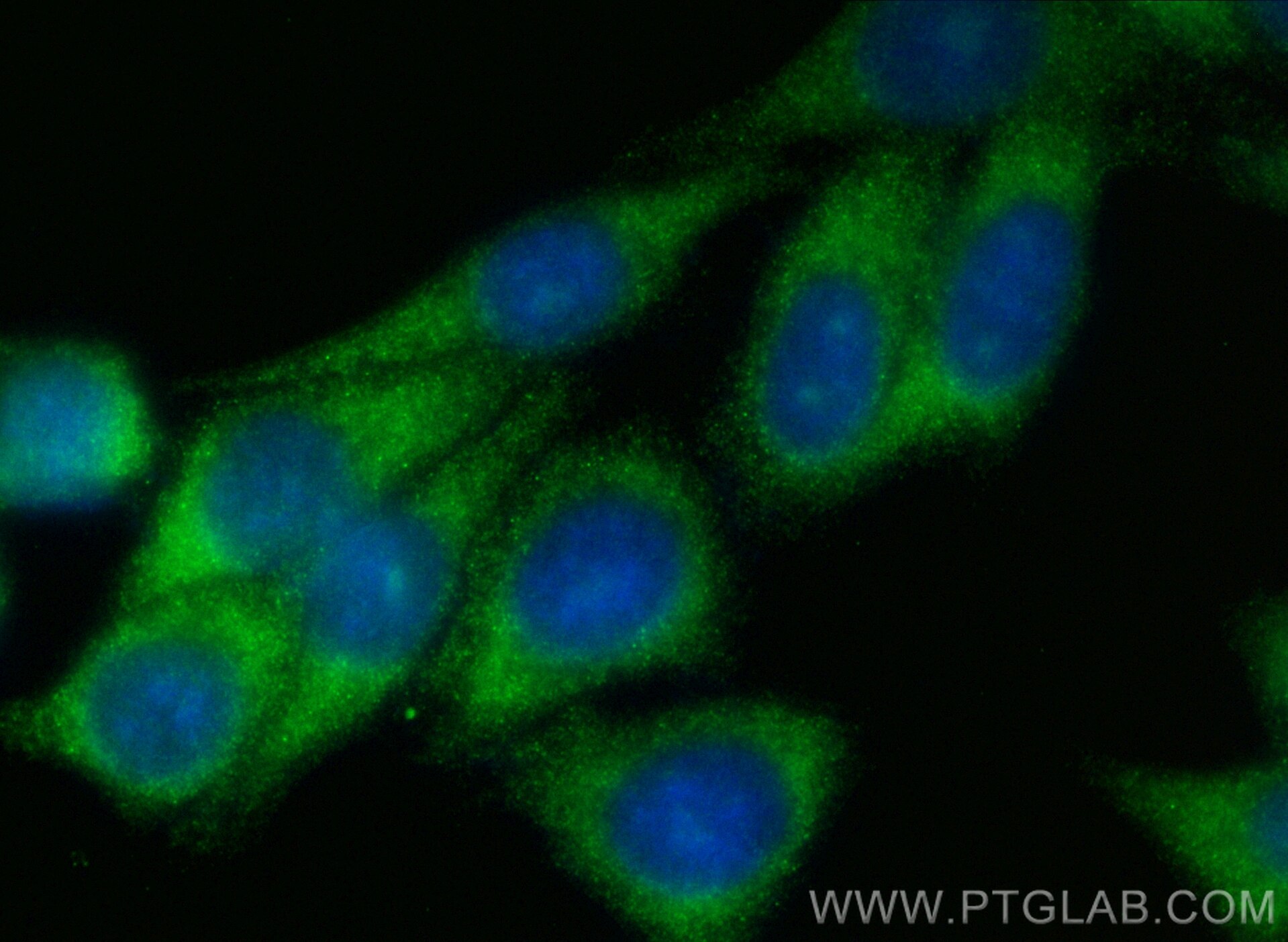
Applications testées
| Résultats positifs en IF/ICC | cellules HepG2, |
Dilution recommandée
| Application | Dilution |
|---|---|
| Immunofluorescence (IF)/ICC | IF/ICC : 1:50-1:500 |
| It is recommended that this reagent should be titrated in each testing system to obtain optimal results. | |
| Sample-dependent, check data in validation data gallery | |
Informations sur le produit
CL488-12544 cible SQLE dans les applications de IF/ICC et montre une réactivité avec des échantillons Humain, rat, souris
| Réactivité | Humain, rat, souris |
| Hôte / Isotype | Lapin / IgG |
| Clonalité | Polyclonal |
| Type | Anticorps |
| Immunogène | SQLE Protéine recombinante Ag3266 |
| Nom complet | squalene epoxidase |
| Masse moléculaire calculée | 574 aa, 64 kDa |
| Poids moléculaire observé | 50-64 kDa |
| Numéro d’acquisition GenBank | BC017033 |
| Symbole du gène | SQLE |
| Identification du gène (NCBI) | 6713 |
| Conjugaison | CoraLite® Plus 488 Fluorescent Dye |
| Excitation/Emission maxima wavelengths | 493 nm / 522 nm |
| Forme | Liquide |
| Méthode de purification | Purification par affinité contre l'antigène |
| Tampon de stockage | PBS with 50% glycerol, 0.05% Proclin300, 0.5% BSA |
| Conditions de stockage | Stocker à -20 °C. Éviter toute exposition à la lumière. Stable pendant un an après l'expédition. L'aliquotage n'est pas nécessaire pour le stockage à -20oC Les 20ul contiennent 0,1% de BSA. |
Informations générales
SQLE, also named as ERG1, SE and SM, belongs to the squalene monooxygenase family. It catalyzes the first oxygenation step in cholesterol synthesis, acting on squalene before cyclization into the basic steroid structure. SQLE may serve as a flux-controlling enzyme beyond 3-hydroxy-3-methylglutaryl-coenzyme A reductase (HMGR, considered as rate limiting). It is also posttranslationally regulated by cholesterol-dependent proteasomal degradation. SQLE is subject to feedback regulation via cholesterol-induced degradation, which depends on its lipid-sensing N terminal regulatory domain. Truncation of SQLE occurs during its endoplasmic reticulum-associated degradation and requires the proteasome, which partially degrades the SQLE N-terminus and eliminates cholesterol-sensing elements within this region. The MW of SQLE is about 50-64 kDa. (PMID:21356516, PMID: 28972164)
Protocole
| Product Specific Protocols | |
|---|---|
| IF protocol for CL Plus 488 SQLE antibody CL488-12544 | Download protocol |
| Standard Protocols | |
|---|---|
| Click here to view our Standard Protocols |

