- Phare
- Validé par KD/KO
Anticorps Polyclonal de lapin anti-SRRM1
SRRM1 Polyclonal Antibody for WB, IP, Indirect ELISA
Hôte / Isotype
Lapin / IgG
Réactivité testée
Humain, rat, souris
Applications
WB, IP, Indirect ELISA
Conjugaison
Non conjugué
N° de cat : 12822-1-PBS
Synonymes
Galerie de données de validation
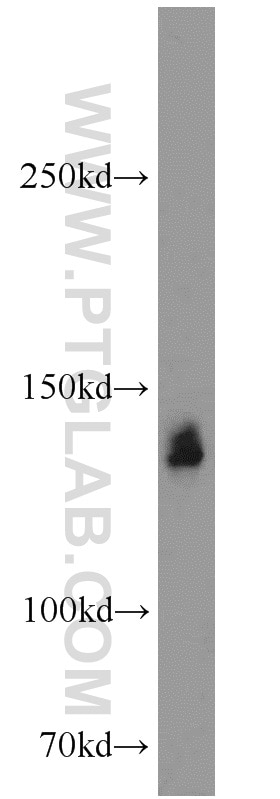
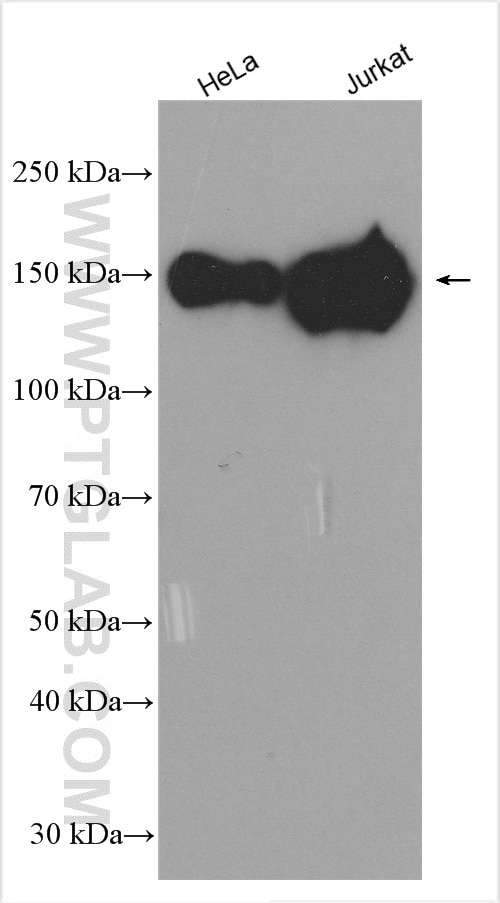
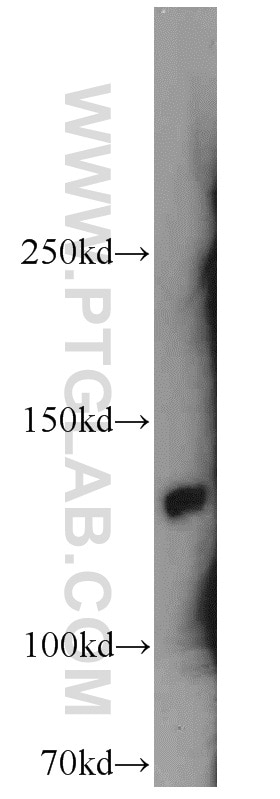
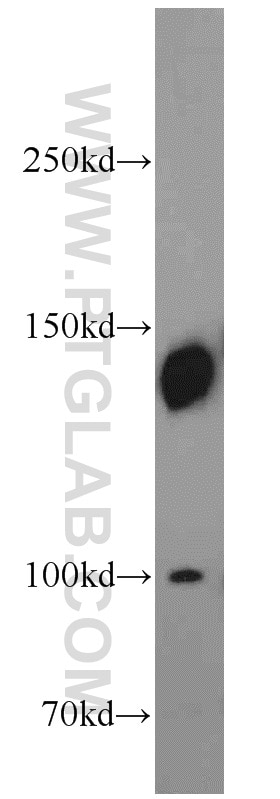
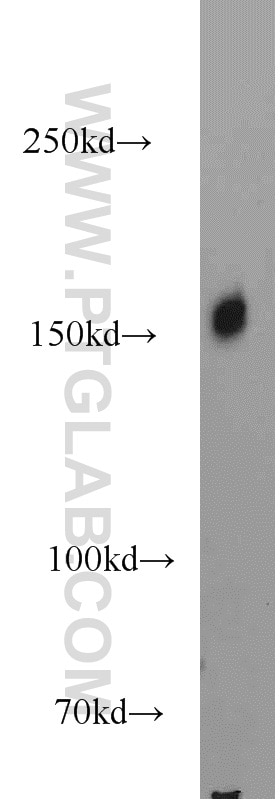
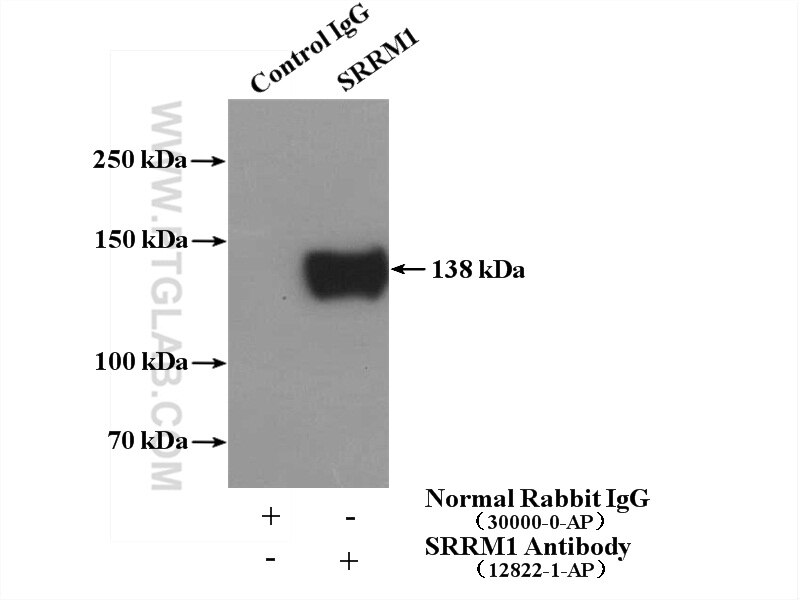
Informations sur le produit
12822-1-PBS cible SRRM1 dans les applications de WB, IP, Indirect ELISA et montre une réactivité avec des échantillons Humain, rat, souris
| Réactivité | Humain, rat, souris |
| Hôte / Isotype | Lapin / IgG |
| Clonalité | Polyclonal |
| Type | Anticorps |
| Immunogène | SRRM1 Protéine recombinante Ag3513 |
| Nom complet | serine/arginine repetitive matrix 1 |
| Masse moléculaire calculée | 904 aa, 102 kDa |
| Poids moléculaire observé | 120-160 kDa |
| Numéro d’acquisition GenBank | BC036187 |
| Symbole du gène | SRRM1 |
| Identification du gène (NCBI) | 10250 |
| Conjugaison | Non conjugué |
| Forme | Liquide |
| Méthode de purification | Purification par affinité contre l'antigène |
| Tampon de stockage | PBS only |
| Conditions de stockage | Store at -80°C. 20ul contiennent 0,1% de BSA. |
Informations générales
SRRM1, also named as SRM160 and POP101, contains one PWI domain and belongs to the splicing factor SR family. As part of pre- and post-splicing multiprotein mRNP complexes, SRRM1 is involved in numerous pre-mRNA processing events. It promotes constitutive and exonic splicing enhancer (ESE)-dependent splicing activation by bridging together sequence-specific (SR family proteins, SFRS4, SFRS5 and TRA2B/SFRS10) and basal snRNP (SNRP70 and SNRPA1) factors of the spliceosome. SRRM1 stimulates mRNA 3'-end cleavage independently of the formation of an exon junction complex. It binds both pre-mRNA and spliced mRNA 20-25 nt upstream of exon-exon junctions. SRRM1 binds RNA and DNA with low sequence specificity and has similar preference for either double- or single-stranded nucleic acid substrates. SRRM1, a protein of high molecular weight(120-160kd), has a heavy glycosylation level and is normally highly phosphorylated. This antibody is a rabbit polyclonal antibody raised against residues near the N terminus of human SRRM1.


