Anticorps Recombinant de lapin anti-Serpin A4/Kallistatin
Serpin A4/Kallistatin Recombinant Antibody for WB, Indirect ELISA
Hôte / Isotype
Lapin / IgG
Réactivité testée
Humain
Applications
WB, Indirect ELISA
Conjugaison
Non conjugué
CloneNo.
251716C12
N° de cat : 86758-3-PBS
Synonymes
Galerie de données de validation
Informations sur le produit
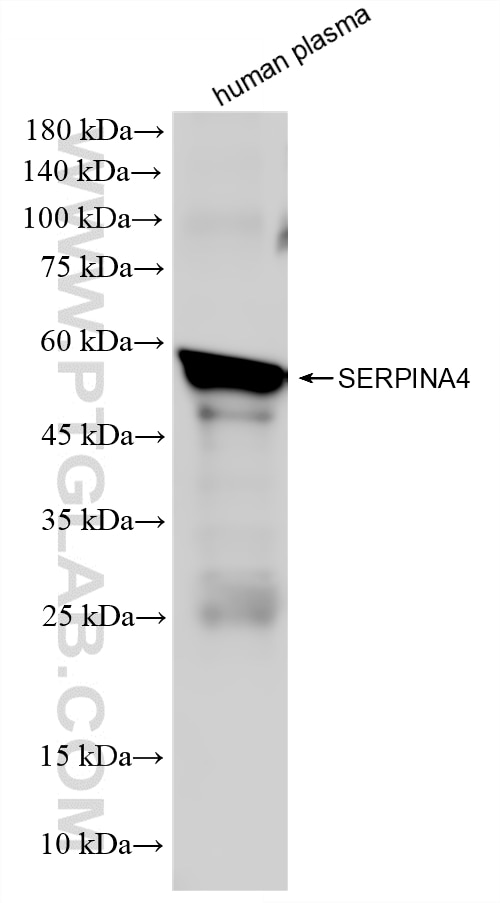
86758-3-PBS cible Serpin A4/Kallistatin dans les applications de WB, Indirect ELISA et montre une réactivité avec des échantillons Humain
| Réactivité | Humain |
| Hôte / Isotype | Lapin / IgG |
| Clonalité | Recombinant |
| Type | Anticorps |
| Immunogène | Serpin A4/Kallistatin Protéine recombinante Eg4707 |
| Nom complet | serpin peptidase inhibitor, clade A (alpha-1 antiproteinase, antitrypsin), member 4 |
| Masse moléculaire calculée | 49 kDa |
| Poids moléculaire observé | 49 kDa |
| Numéro d’acquisition GenBank | NM_001289033.1 |
| Symbole du gène | Kallistatin |
| Identification du gène (NCBI) | 5267 |
| Conjugaison | Non conjugué |
| Forme | Liquide |
| Méthode de purification | Purification par protéine A |
| Tampon de stockage | PBS only |
| Conditions de stockage | Store at -80°C. 20ul contiennent 0,1% de BSA. |
Informations générales
Serpin A4 is also named Kallistatin and Peptidase inhibitor 4 (PI-4). Kallistatin was first identified in human plasma as a tissue kallikrein-binding protein and a serine proteinase inhibitor. Kallistatin via its two structural elements regulates differential signaling cascades, and thus a wide spectrum of biological functions (PMID: 28427524). Kallistatin via the active site promotes neovascularization by stimulating VEGF levels in endothelial progenitor cells. Second, kallistatin inhibits or induces apoptosis depending on cell types. Kallistatin via its heparin-binding site inhibits angiogenesis by blocking vascular endothelial growth factor (VEGF)-induced growth, migration and adhesion of endothelial cells. Kallistatin can act as an antioxidant or pro-oxidant (PMID: 28742513).


