Anticorps Recombinant de lapin anti-TGFBI/BIGH3
TGFBI/BIGH3 Recombinant Antibody for WB, ELISA
Hôte / Isotype
Lapin / IgG
Réactivité testée
Humain
Applications
WB, ELISA
Conjugaison
Non conjugué
CloneNo.
243108F7
N° de cat : 80805-4-RR
Synonymes
Galerie de données de validation
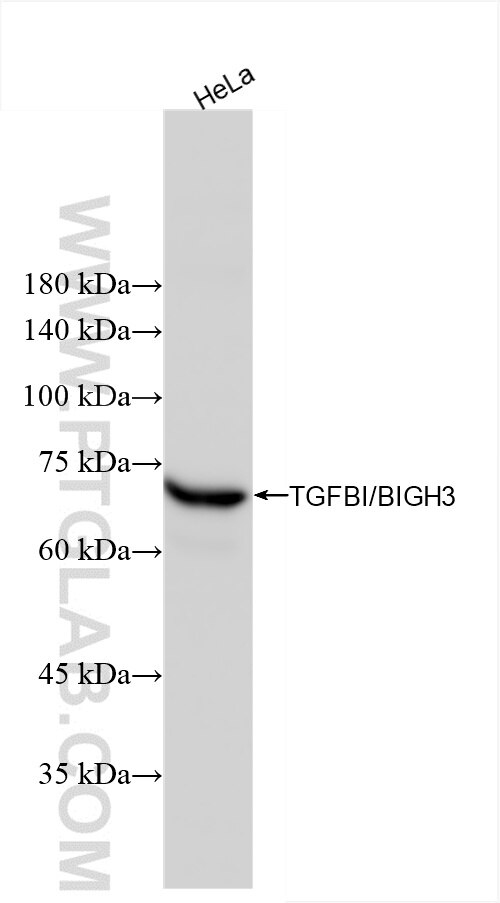
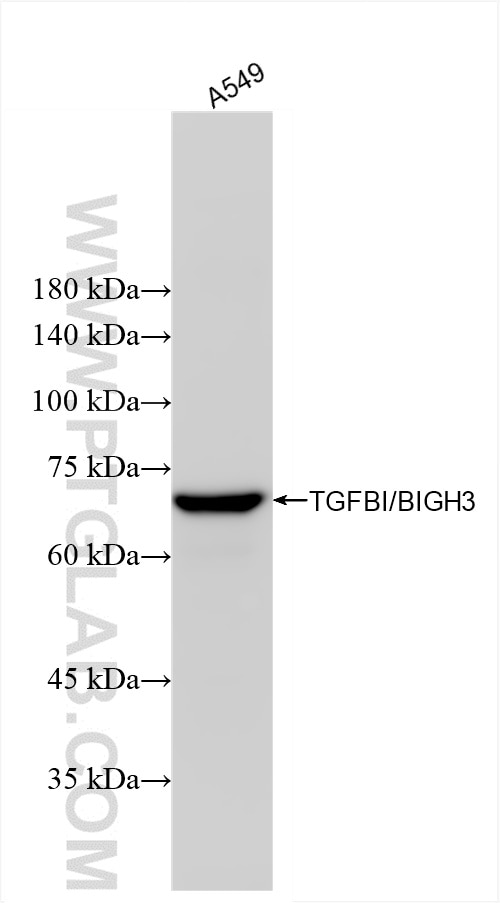
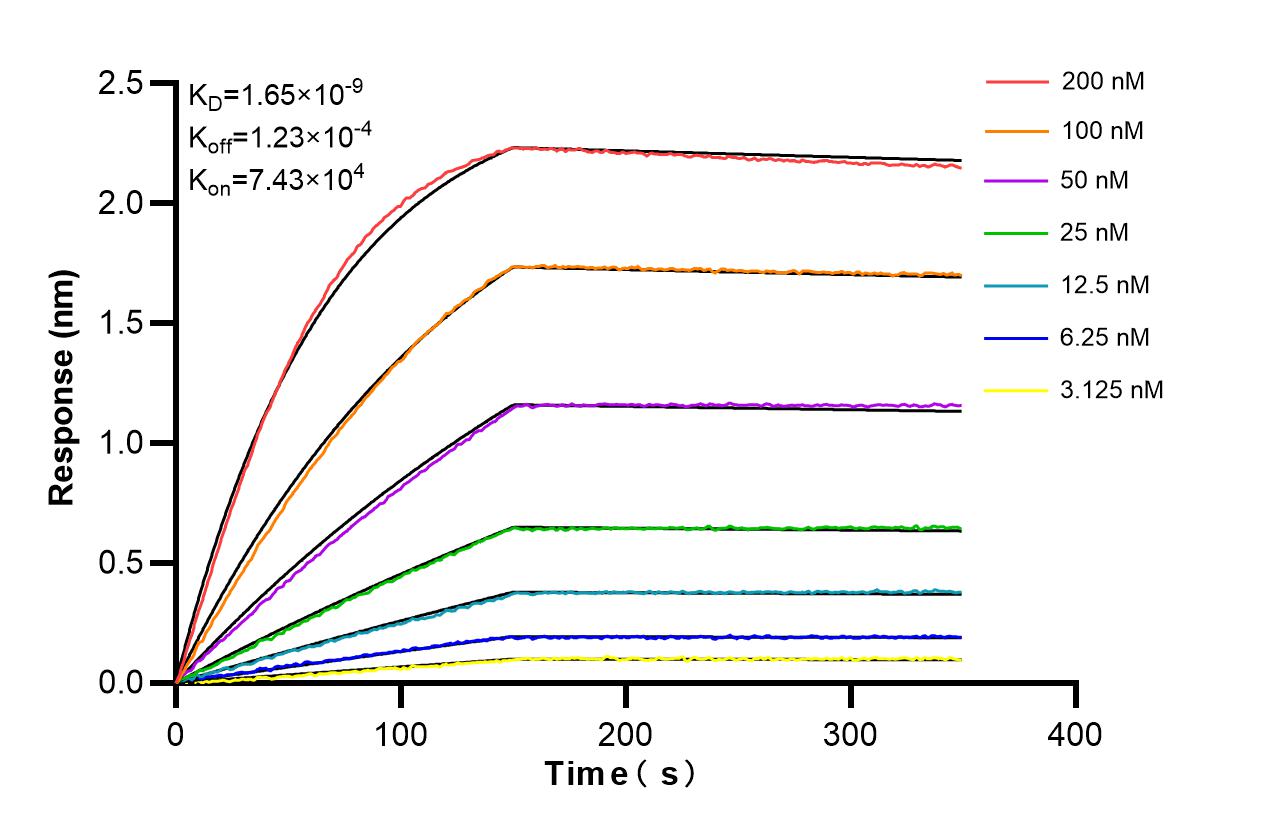
Applications testées
| Résultats positifs en WB | cellules HeLa, cellules A549 |
Dilution recommandée
| Application | Dilution |
|---|---|
| Western Blot (WB) | WB : 1:2000-1:10000 |
| It is recommended that this reagent should be titrated in each testing system to obtain optimal results. | |
| Sample-dependent, check data in validation data gallery | |
Informations sur le produit
80805-4-RR cible TGFBI/BIGH3 dans les applications de WB, ELISA et montre une réactivité avec des échantillons Humain
| Réactivité | Humain |
| Hôte / Isotype | Lapin / IgG |
| Clonalité | Recombinant |
| Type | Anticorps |
| Immunogène | TGFBI/BIGH3 Protéine recombinante Eg1233 |
| Nom complet | transforming growth factor, beta-induced, 68kDa |
| Masse moléculaire calculée | 75kDa |
| Poids moléculaire observé | 68 kDa |
| Numéro d’acquisition GenBank | NM_000358.3 |
| Symbole du gène | TGFBI |
| Identification du gène (NCBI) | 7045 |
| Conjugaison | Non conjugué |
| Forme | Liquide |
| Méthode de purification | Purification par protéine A |
| Tampon de stockage | PBS with 0.02% sodium azide and 50% glycerol |
| Conditions de stockage | Stocker à -20°C. Stable pendant un an après l'expédition. L'aliquotage n'est pas nécessaire pour le stockage à -20oC Les 20ul contiennent 0,1% de BSA. |
Informations générales
TGFBI, also named as BIGH3, Kerato-epithelin and RGD-CAP, binds to type I, II, and IV collagens. TGFBI is an adhesion protein which may play an important role in cell-collagen interactions. In cartilage, it may be involved in endochondral bone formation. TGFBI is an extracellular matrix adaptor protein, it has been reported to be differentially expressed in transformed tissues. TGFBI is a predictive factor of the response to chemotherapy, and suggest the use of TGFBI-derived peptides as possible therapeutic adjuvants for the enhancement of responses to chemotherapy.(PMID:20509890) Defects in TGFBI are the cause of epithelial basement membrane corneal dystrophy (EBMD). Defects in TGFBI are the cause of corneal dystrophy Groenouw type 1 (CDGG1). Defects in TGFBI are the cause of corneal dystrophy lattice type 1 (CDL1). Defects in TGFBI are a cause of corneal dystrophy Thiel-Behnke type (CDTB). Defects in TGFBI are the cause of Reis-Buecklers corneal dystrophy (CDRB). Defects in TGFBI are the cause of lattice corneal dystrophy type 3A (CDL3A). Defects in TGFBI are the cause of Avellino corneal dystrophy (ACD).
Protocole
| Product Specific Protocols | |
|---|---|
| WB protocol for TGFBI/BIGH3 antibody 80805-4-RR | Download protocol |
| Standard Protocols | |
|---|---|
| Click here to view our Standard Protocols |


