Anticorps Polyclonal de lapin anti-TMEM26
TMEM26 Polyclonal Antibody for WB, ELISA
Hôte / Isotype
Lapin / IgG
Réactivité testée
Humain
Applications
WB, ELISA
Conjugaison
Non conjugué
N° de cat : 27267-1-AP
Synonymes
Galerie de données de validation
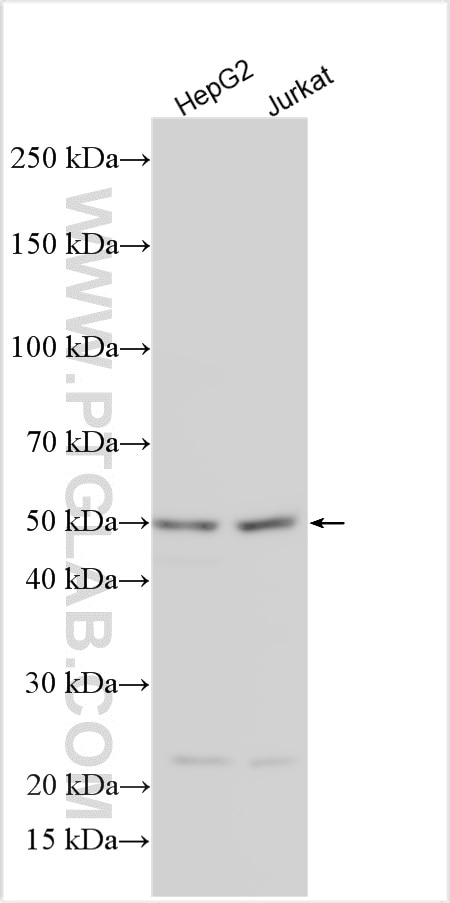
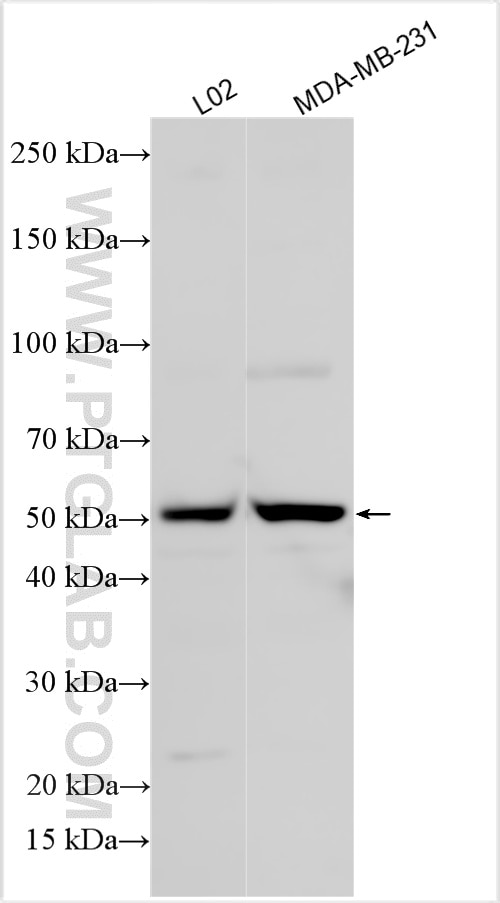
Applications testées
| Résultats positifs en WB | cellules L02, cellules HepG2, cellules Jurkat, cellules MDA-MB-231 |
Dilution recommandée
| Application | Dilution |
|---|---|
| Western Blot (WB) | WB : 1:4000-1:8000 |
| It is recommended that this reagent should be titrated in each testing system to obtain optimal results. | |
| Sample-dependent, check data in validation data gallery | |
Informations sur le produit
27267-1-AP cible TMEM26 dans les applications de WB, ELISA et montre une réactivité avec des échantillons Humain
| Réactivité | Humain |
| Hôte / Isotype | Lapin / IgG |
| Clonalité | Polyclonal |
| Type | Anticorps |
| Immunogène | TMEM26 Protéine recombinante Ag24409 |
| Nom complet | transmembrane protein 26 |
| Masse moléculaire calculée | 368 aa, 42 kDa |
| Poids moléculaire observé | 50 kDa |
| Numéro d’acquisition GenBank | BC042872 |
| Symbole du gène | TMEM26 |
| Identification du gène (NCBI) | 219623 |
| Conjugaison | Non conjugué |
| Forme | Liquide |
| Méthode de purification | Purification par affinité contre l'antigène |
| Tampon de stockage | PBS with 0.02% sodium azide and 50% glycerol |
| Conditions de stockage | Stocker à -20°C. Stable pendant un an après l'expédition. L'aliquotage n'est pas nécessaire pour le stockage à -20oC Les 20ul contiennent 0,1% de BSA. |
Informations générales
The Transmembrane protein 26 (TMEM26) gene encodes a protein containing multiple transmembrane fragments. Immunostaining indicated elevated TMEM26 expression in ESCC tumors. Various ESCC cell lines showed a high TMEM26 expression, where its plasma membrane localization was confirmed. The RNAi depletion of TMEM26 in TMEM26-high ESCC cells suppressed EMT-related alterations, including invasion, migration, and marker gene expression. Conversely, TMEM26 overexpression in TMEM26-low ESCC cells promoted these EMT-related alterations. Interestingly, TMEM26 depletion or overexpression did not affect cell growth, indicating its specific involvement in the EMT process. The animal study demonstrated the contributive role of TMEM26 in metastatic ESCC. Mechanistically, TMEM26 promoted NF-κB signaling to accelerate EMT in ESCC cells. The plasma membrane presentation and TJ protein assembly were impaired by TMEM26, which was likely to be another mechanism for EMT regulation by TMEM26 in ESCC. Therefore, TMEM26 disrupted TJ formation and promoted NF-κB signaling during the EMT activation in ESCC (PMID: 37611445). TMEM26 shows features for chain, glycosylation, modified residue (large scale data).
Protocole
| Product Specific Protocols | |
|---|---|
| WB protocol for TMEM26 antibody 27267-1-AP | Download protocol |
| Standard Protocols | |
|---|---|
| Click here to view our Standard Protocols |

