Anticorps Polyclonal de lapin anti-TNN
TNN Polyclonal Antibody for WB, Indirect ELISA
Hôte / Isotype
Lapin / IgG
Réactivité testée
Humain, rat, souris
Applications
WB, Indirect ELISA
Conjugaison
Non conjugué
N° de cat : 24839-1-PBS
Synonymes
Galerie de données de validation
Informations sur le produit
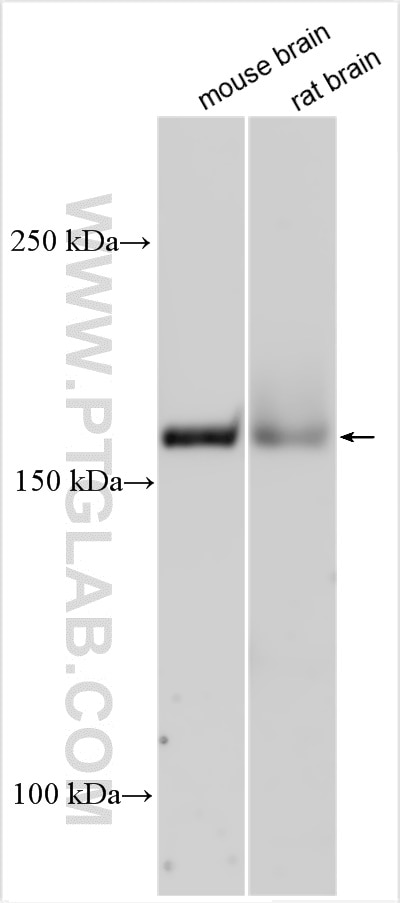
24839-1-PBS cible TNN dans les applications de WB, Indirect ELISA et montre une réactivité avec des échantillons Humain, rat, souris
| Réactivité | Humain, rat, souris |
| Hôte / Isotype | Lapin / IgG |
| Clonalité | Polyclonal |
| Type | Anticorps |
| Immunogène | TNN Protéine recombinante Ag18127 |
| Nom complet | tenascin N |
| Masse moléculaire calculée | 1299 aa, 144 kDa |
| Poids moléculaire observé | 144 kDa, 173 kDa |
| Numéro d’acquisition GenBank | BC136619 |
| Symbole du gène | TNN |
| Identification du gène (NCBI) | 63923 |
| Conjugaison | Non conjugué |
| Forme | Liquide |
| Méthode de purification | Purification par affinité contre l'antigène |
| Tampon de stockage | PBS only |
| Conditions de stockage | Store at -80°C. 20ul contiennent 0,1% de BSA. |
Informations générales
TNN (Tenascin-W), also known as TNW. It is expected to be located in the extracellular space. The protein is not detected in normal adult mammary tissues or brain but expressed in most breast tumors and brain tumors, such as glioblastomas, astrocytomas and oligodendrogliomas, tested (PMID:17909022). And in brain tumors, detected around the endothelial cell layer of the clood vessels (PMID: 19884327). TNN is the fourth and final member of the extracellular matrix protein family of tenascins. In vitro, the presence of tenascin-W increased the proportion of elongated human umbilical vein endothelial cells (HUVECs) and augmented the mean speed of cell migration. Furthermore, tenascin-W triggered sprouting of HUVEC spheroids to a similar extent as the proangiogenic factor tenascin-C. Tenascin-W is a specific marker of glioma-associated blood vessels and stimulates angiogenesis in vitro(PMID: 19884327). The predicted molecular weight of the protein is 144 kDa in human and 173 kDa in mouse.


