Anticorps Polyclonal de lapin anti-TXLNB
TXLNB Polyclonal Antibody for WB, ELISA
Hôte / Isotype
Lapin / IgG
Réactivité testée
Humain, souris
Applications
WB, ELISA
Conjugaison
Non conjugué
N° de cat : 22090-1-AP
Synonymes
Galerie de données de validation
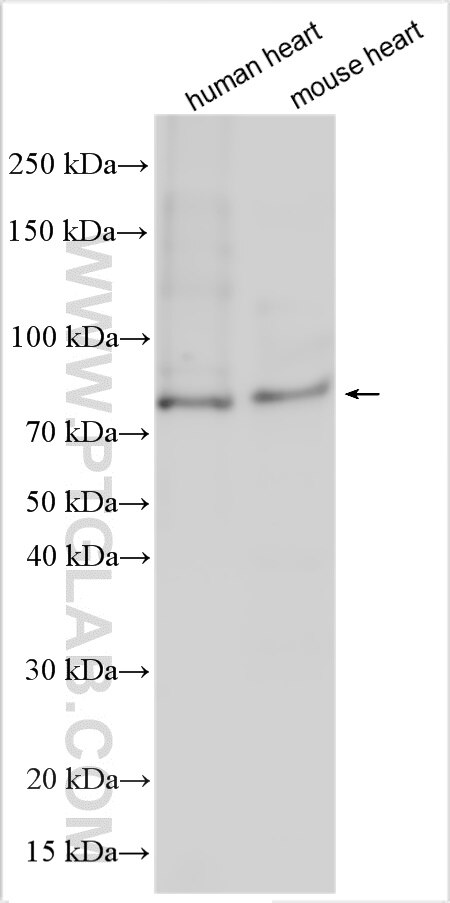
Applications testées
| Résultats positifs en WB | tissu cardiaque humain, tissu cardiaque de souris |
Dilution recommandée
| Application | Dilution |
|---|---|
| Western Blot (WB) | WB : 1:500-1:3000 |
| It is recommended that this reagent should be titrated in each testing system to obtain optimal results. | |
| Sample-dependent, check data in validation data gallery | |
Informations sur le produit
22090-1-AP cible TXLNB dans les applications de WB, ELISA et montre une réactivité avec des échantillons Humain, souris
| Réactivité | Humain, souris |
| Hôte / Isotype | Lapin / IgG |
| Clonalité | Polyclonal |
| Type | Anticorps |
| Immunogène | TXLNB Protéine recombinante Ag17295 |
| Nom complet | taxilin beta |
| Masse moléculaire calculée | 684 aa, 77 kDa |
| Poids moléculaire observé | 75 kDa |
| Numéro d’acquisition GenBank | BC115383 |
| Symbole du gène | TXLNB |
| Identification du gène (NCBI) | 167838 |
| Conjugaison | Non conjugué |
| Forme | Liquide |
| Méthode de purification | Purification par affinité contre l'antigène |
| Tampon de stockage | PBS with 0.02% sodium azide and 50% glycerol |
| Conditions de stockage | Stocker à -20°C. Stable pendant un an après l'expédition. L'aliquotage n'est pas nécessaire pour le stockage à -20oC Les 20ul contiennent 0,1% de BSA. |
Informations générales
TXLNB (Taxilin beta, gliding protein beta) is a protein enriched predominantly in cardiomyocytes and belongs to the centrosome articulating protein family. It is localized in the perinuclear region of the centrosome and is closely associated with the microtubule organizing center (MTOC) and the ubiquitin-proteasome system (UPS). TXLNB plays an important role in protein homeostasis in cardiomyocytes, affecting intracellular protein degradation and quality control by regulating the interactions between centrosomes and proteasomes. TXLNB was found to have a key role in cardiomyocyte hypertrophy and cardiac proteotoxicity, and its overexpression enhances proteasome activity and reduces the accumulation of ubiquitylated proteins, whereas knockdown leads to proteasome insufficiency and a decline in cardiac function with age. In addition, TXLNB may be involved in the dynamic regulation of the cytoskeleton and microtubules.
Protocole
| Product Specific Protocols | |
|---|---|
| WB protocol for TXLNB antibody 22090-1-AP | Download protocol |
| Standard Protocols | |
|---|---|
| Click here to view our Standard Protocols |

