Anticorps Polyclonal de lapin anti-Transferrin Receptor 2/TFR2
Transferrin Receptor 2/TFR2 Polyclonal Antibody for WB, IHC, ELISA
Hôte / Isotype
Lapin / IgG
Réactivité testée
Humain, rat, souris
Applications
WB, IHC, ELISA
Conjugaison
Non conjugué
N° de cat : 32381-1-AP
Synonymes
Galerie de données de validation
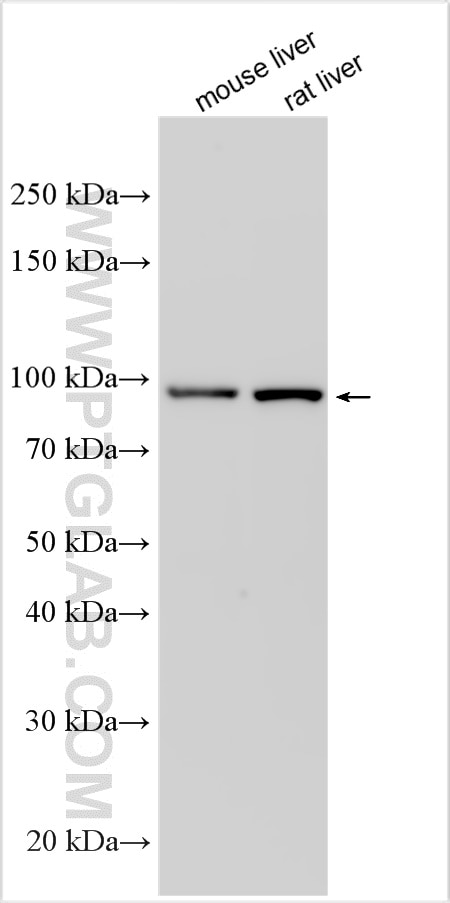
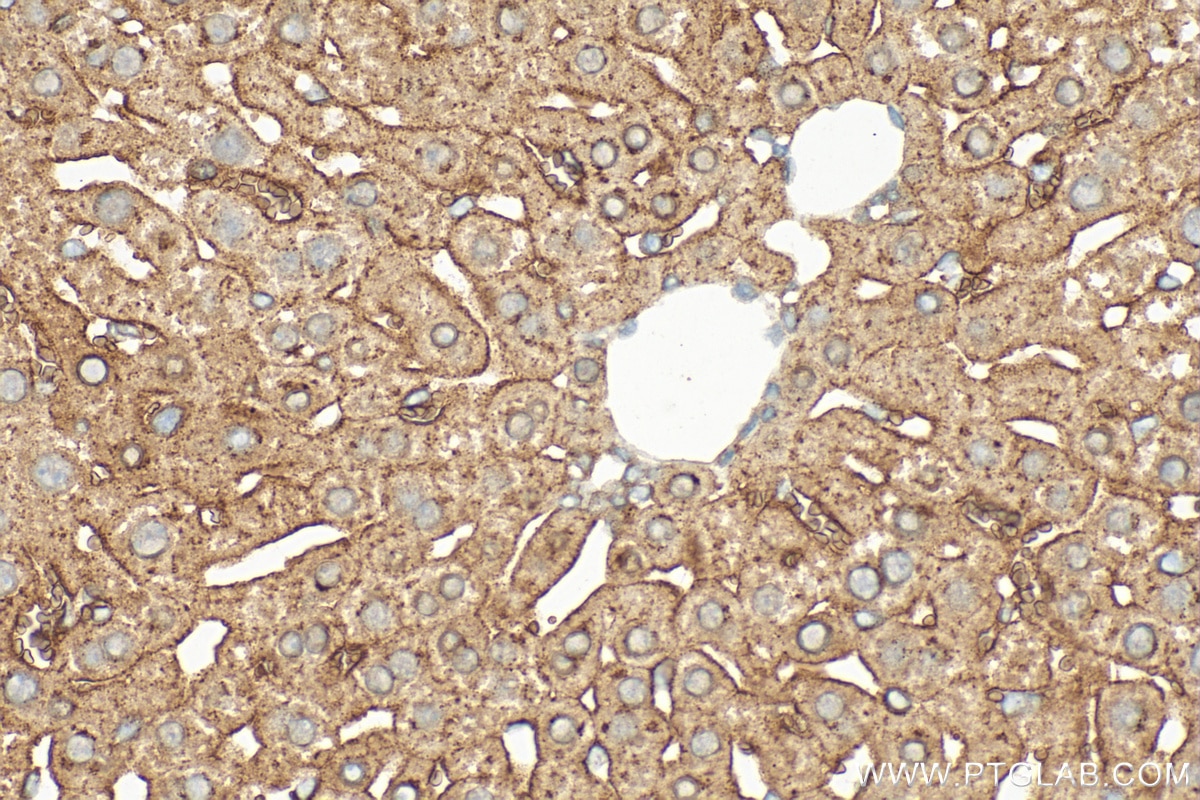
Applications testées
| Résultats positifs en WB | tissu hépatique de souris, tissu hépatique de rat |
| Résultats positifs en IHC | tissu hépatique de souris, il est suggéré de démasquer l'antigène avec un tampon de TE buffer pH 9.0; (*) À défaut, 'le démasquage de l'antigène peut être 'effectué avec un tampon citrate pH 6,0. |
Dilution recommandée
| Application | Dilution |
|---|---|
| Western Blot (WB) | WB : 1:1000-1:4000 |
| Immunohistochimie (IHC) | IHC : 1:200-1:800 |
| It is recommended that this reagent should be titrated in each testing system to obtain optimal results. | |
| Sample-dependent, check data in validation data gallery | |
Informations sur le produit
32381-1-AP cible Transferrin Receptor 2/TFR2 dans les applications de WB, IHC, ELISA et montre une réactivité avec des échantillons Humain, rat, souris
| Réactivité | Humain, rat, souris |
| Hôte / Isotype | Lapin / IgG |
| Clonalité | Polyclonal |
| Type | Anticorps |
| Immunogène | Transferrin Receptor 2/TFR2 Protéine recombinante Ag37959 |
| Nom complet | transferrin receptor 2 |
| Masse moléculaire calculée | 801 aa, 89 kDa |
| Poids moléculaire observé | 88-97 kDa |
| Numéro d’acquisition GenBank | BC142630 |
| Symbole du gène | TFR2 |
| Identification du gène (NCBI) | 7036 |
| Conjugaison | Non conjugué |
| Forme | Liquide |
| Méthode de purification | Purification par affinité contre l'antigène |
| Tampon de stockage | PBS with 0.02% sodium azide and 50% glycerol |
| Conditions de stockage | Stocker à -20°C. Stable pendant un an après l'expédition. L'aliquotage n'est pas nécessaire pour le stockage à -20oC Les 20ul contiennent 0,1% de BSA. |
Informations générales
Transferrin Receptor 2 (TFR2) is a type II transmembrane glycoprotein that plays a crucial role in iron homeostasis. It is highly homologous to Transferrin Receptor 1 (TFR1) and is primarily expressed in the liver and erythroid precursor cells. TFR2 is involved in the regulation of hepcidin, a hormone that controls iron absorption and distribution in the body. It helps mediate the cellular uptake of iron-bound transferrin, although its affinity for iron is lower than that of TFR1 (PMID: 24658816). It is more involved in sensing iron levels and regulating hepcidin expression rather than direct iron uptake. TFR2 is predominantly expressed in hepatocytes (liver cells) and erythroid precursors (cells that give rise to red blood cells). It is also found in the enterocytes of the small intestine (PMID: 29969719). In the liver, TFR2 acts as a sensor for circulating iron-bound transferrin and helps regulate hepcidin production. Hepcidin, in turn, controls iron absorption from the diet and iron release from macrophages. The molecular weight of TFR2 is 88 kDa, its observed molecular weight is 88-97 kDa.
Protocole
| Product Specific Protocols | |
|---|---|
| WB protocol for Transferrin Receptor 2/TFR2 antibody 32381-1-AP | Download protocol |
| IHC protocol for Transferrin Receptor 2/TFR2 antibody 32381-1-AP | Download protocol |
| Standard Protocols | |
|---|---|
| Click here to view our Standard Protocols |

