Anticorps Polyclonal de lapin anti-UHRF2
UHRF2 Polyclonal Antibody for WB, IF/ICC, IP, Indirect ELISA
Hôte / Isotype
Lapin / IgG
Réactivité testée
Humain
Applications
WB, IF/ICC, IP, Indirect ELISA
Conjugaison
Non conjugué
N° de cat : 25710-1-PBS
Synonymes
Galerie de données de validation
Informations sur le produit
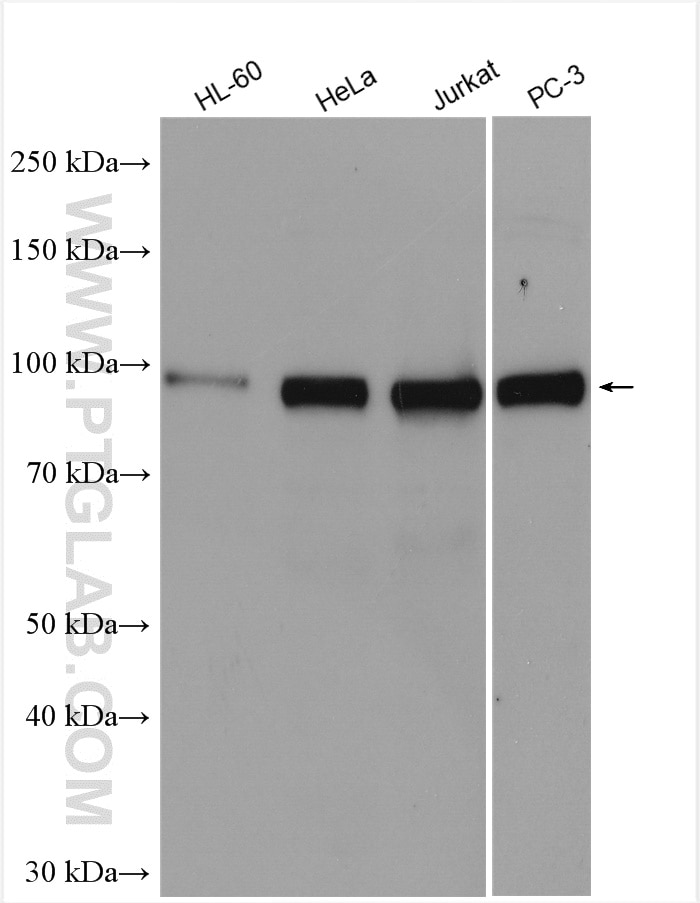
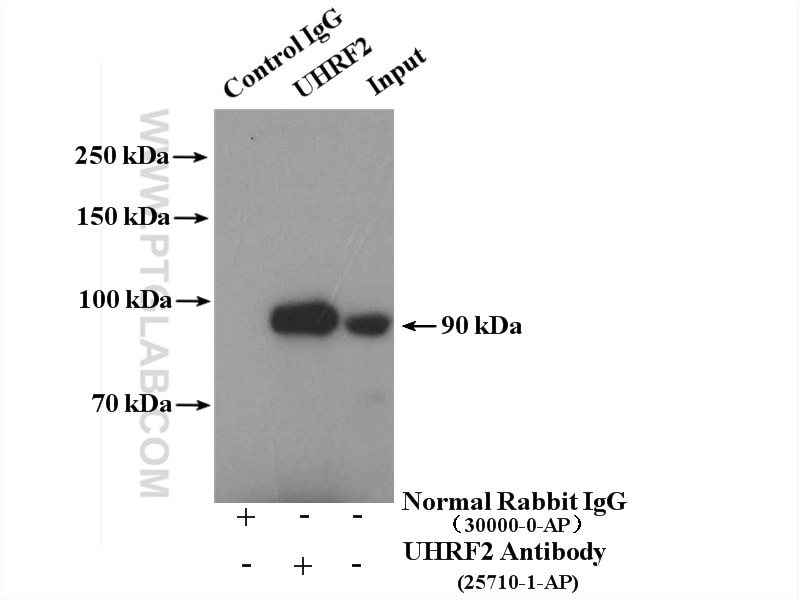
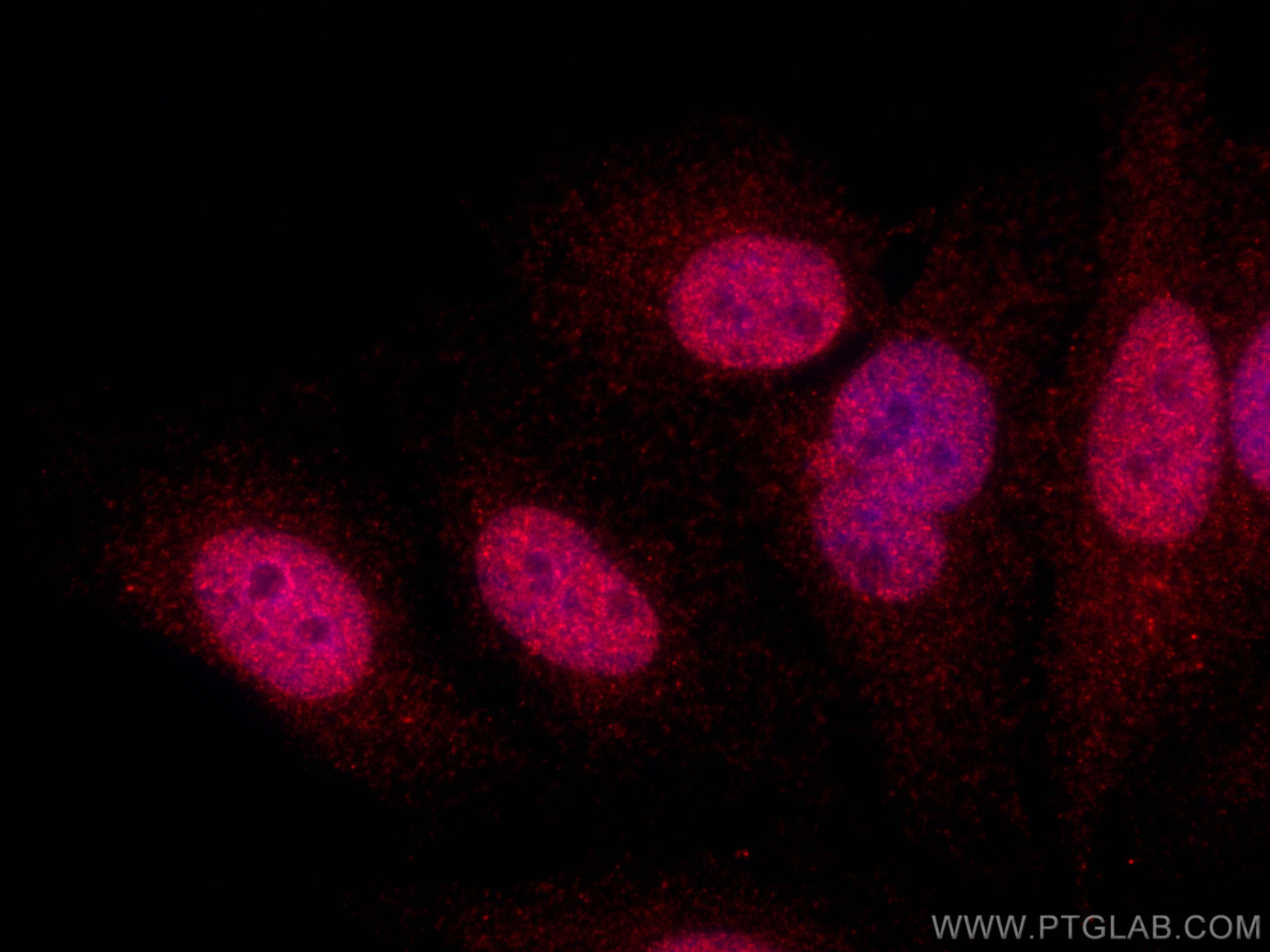
25710-1-PBS cible UHRF2 dans les applications de WB, IF/ICC, IP, Indirect ELISA et montre une réactivité avec des échantillons Humain
| Réactivité | Humain |
| Hôte / Isotype | Lapin / IgG |
| Clonalité | Polyclonal |
| Type | Anticorps |
| Immunogène | UHRF2 Protéine recombinante Ag22519 |
| Nom complet | ubiquitin-like with PHD and ring finger domains 2 |
| Masse moléculaire calculée | 90 kDa |
| Poids moléculaire observé | 90 kDa |
| Numéro d’acquisition GenBank | BC028397 |
| Symbole du gène | UHRF2 |
| Identification du gène (NCBI) | 115426 |
| Conjugaison | Non conjugué |
| Forme | Liquide |
| Méthode de purification | Purification par affinité contre l'antigène |
| Tampon de stockage | PBS only |
| Conditions de stockage | Store at -80°C. 20ul contiennent 0,1% de BSA. |
Informations générales
Ubiquitin-Like with PHD and ring finger domains 2 (UHRF2), a member that belongs to the family of UHRF, contains five recognizable functional domains, namely the ubiquitin-like domain (UBL) domain, tandem-Tudor domain (TTD), plant homeodomain (PHD), SET and RING associated (SRA) domain, and really interesting new gene (RING) finger domain. Due to the complex structure, UHRF2 possesses multiple functions in diverse cellular processes. As a ubiquitin E3 ligase, UHRF2 could ubiquitinate PCNP, a nuclear protein that contains two remarkable PEST sequences which are rich in proline (P), glutamic acid (E), serine (S), and threonine (T). It has been also reported that UHRF2 could serve as a vital cell cycle regulator by interacting with multiple cyclins, CDKs, p53, pRB and PCNA. UHRF2 has been revealed to possess epigenetic regulation function and is capable of maintaining 5mC levels in certain genomic loci in brain and stabilizes TIP60 to regulate H3K9ac and H3K14ac through RING finger domain. Moreover, UHRF2 could promote DNA damage repair by reducing the level of p21 mediated by RING finger domain. Recently, emerging evidence indicated that UHRF2 was involved in the tumorigenesis and progression of several human cancers, such as esophageal squamous cell carcinoma, lung cancer and colorectal cancer. UHRF2 has 2 isoforms with the molecular mass of 56 and 90 kDa. (PMID: 34400880)


