Anticorps Polyclonal de lapin anti-USP50
USP50 Polyclonal Antibody for WB, ELISA
Hôte / Isotype
Lapin / IgG
Réactivité testée
Humain, souris
Applications
WB, ELISA
Conjugaison
Non conjugué
N° de cat : 30239-1-AP
Synonymes
Galerie de données de validation
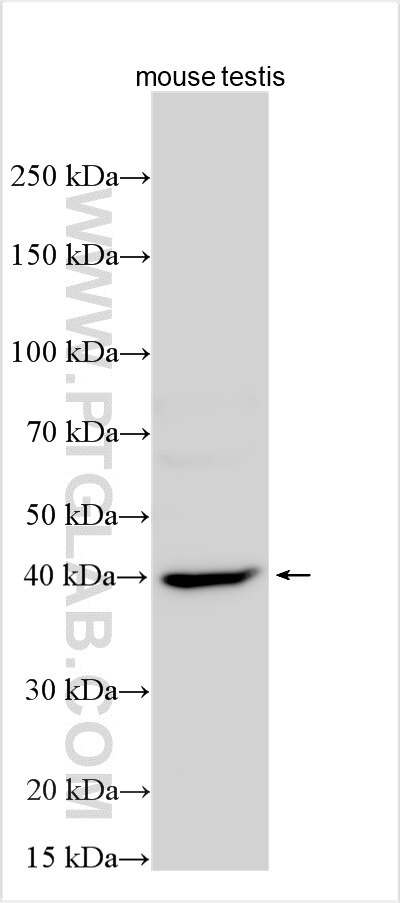
Applications testées
| Résultats positifs en WB | tissu testiculaire de souris, |
Dilution recommandée
| Application | Dilution |
|---|---|
| Western Blot (WB) | WB : 1:500-1:3000 |
| It is recommended that this reagent should be titrated in each testing system to obtain optimal results. | |
| Sample-dependent, check data in validation data gallery | |
Informations sur le produit
30239-1-AP cible USP50 dans les applications de WB, ELISA et montre une réactivité avec des échantillons Humain, souris
| Réactivité | Humain, souris |
| Hôte / Isotype | Lapin / IgG |
| Clonalité | Polyclonal |
| Type | Anticorps |
| Immunogène | USP50 Protéine recombinante Ag31275 |
| Nom complet | ubiquitin specific peptidase 50 |
| Masse moléculaire calculée | 339 aa, 39 kDa |
| Poids moléculaire observé | 40 kDa |
| Numéro d’acquisition GenBank | BC146493 |
| Symbole du gène | USP50 |
| Identification du gène (NCBI) | 373509 |
| Conjugaison | Non conjugué |
| Forme | Liquide |
| Méthode de purification | Purification par affinité contre l'antigène |
| Tampon de stockage | PBS with 0.02% sodium azide and 50% glycerol |
| Conditions de stockage | Stocker à -20°C. Stable pendant un an après l'expédition. L'aliquotage n'est pas nécessaire pour le stockage à -20oC Les 20ul contiennent 0,1% de BSA. |
Informations générales
USP50 (Ubiquitin Specific Peptidase 50) is a deubiquitinating enzyme that belongs to the USP family. It plays a key role in DNA replication, genome stability and cell cycle regulation. Recent studies have found that USP50 maintains the stability of the DNA replication process and telomere integrity by regulating the use of nuclease and deconjugating enzymes. During replication, USP50 was able to inhibit the harmful DNA2 nuclease activity and substitute the use of RecQ deconjugase, thereby preventing replication fork stalling and DNA damage. In addition, USP50 plays a role in the cell cycle G2/M phase transition, assembly of the NLRP3 inflammasome complex, and organization of nuclear speckles. Its loss of function leads to DNA double-strand breaks and telomere instability in cells under replication stress. These findings provide new insights into the understanding of the pathogenesis of genetic diseases and may offer potential targets for the treatment of diseases such as cancer and premature aging.
Protocole
| Product Specific Protocols | |
|---|---|
| WB protocol for USP50 antibody 30239-1-AP | Download protocol |
| Standard Protocols | |
|---|---|
| Click here to view our Standard Protocols |

